Watch This Zeiss Video to See Examples of Lens Focal Length and Angle of View on Full-Frame DSLRs

 Crop factor is one of those terms that really shouldn’t exist, but it does because it makes it very easy to immediately multiply what a particular lens will look like on a sensor that is smaller than full frame 35mm (or Vista Vision in motion picture terms). The correct term, angle of view, isn’t used nearly as much thanks to the popularity of cameras like the Canon 5D Mark II, which uses lenses that have a larger diameter image circle than motion picture lenses do. Angle of view is platform agnostic, but crop factor is the term used everywhere (even by us, admittedly). Zeiss has made a video showing the angle of view of their full frame lenses mounted on a full frame camera. There is no crop factor since these are native lenses, but when we refer to crop factor, you can use the video below to see the equivalent focal length we’re talking about.
the one thing the novice needs to know about the settings that each demo is in movie language, CP.2 refers to compact prime lenses, [non zoom] the 35/T2.1 relates to 35mm angle of view and i believe the T2.1 is the aspect ratio, or f stop. it’s been so long since i’ve worked close to movie cameras, but lenses are lenses and no matter how you’re recording, film or digital the system work almost the same way.

I would like to never use crop factor again, since it changes depending on the lenses in question and the platform, but since it has become the standard online, it will be hard to move completely to angle of view. Either way, the video is a good representation of what you can get out of particular lenses depending on the chosen focal length and the format (full frame in this case). When talking about crop factor, for the most part it is related to these focal lengths and angle of views, so video can help give a clearer picture of exactly what we’re talking about when we use that term.
For example, when we’re discussing a camera like the Blackmagic Cinema Camera, we take about it having a 2.3x crop factor. This means that no matter what lens you mount on the camera, if you multiply the focal length by 2.3, you can use the video above to determine what that lens will look like on that camera. While this can get confusing, it’s helpful for some people who have come over from DSLRs and have been only using full frame still lenses.
B&H also thinks we would be better off just using Angle of View, and here’s a chart from Allan Weitz to show you exactly what’s going on:
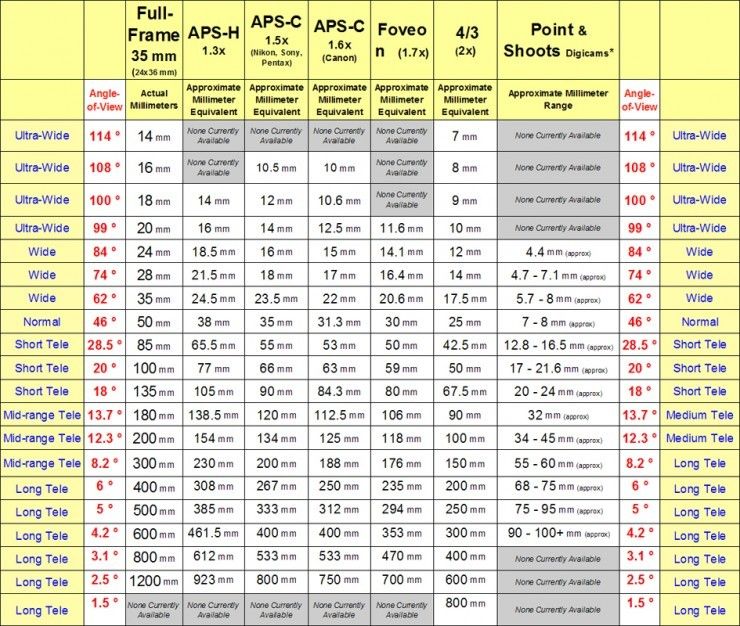 What do you guys think? Would you like to see all mention of crop factor go away? Should NoFilmSchool move to simply referring to lenses by the correct term, angle of view?
Links:


 Fuzzypictures's Weblog