Posts Tagged ‘moma’

Cindy Sherman @ MOMA, my reflections

April 12, 2012

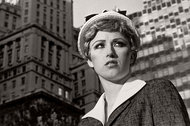
seeing  the spectacular exhibit at moma of Cindy Sherman’s work is impressive on many levels, first on the amount of prints and their physical size. it made me think about how it is when one starts off  working on a project we begin with smaller pieces because of affordability and i guess we don’t have the chops to tackle life size images much less larger than life.

what bothered me most were all the reflections in the glass  protecting the beautiful chromogenic prints. there wasn’t a place one could view the individual pieces were someone or something wasn’t reflected in the pictures glass. that was distracting enough but add to that were people crossing in front of you as you tried to read the descriptions written on the wall. does it take that much of an effort to walk around someone or a group in this instantgram world we are now confronted with? have people lost or not learned manners?
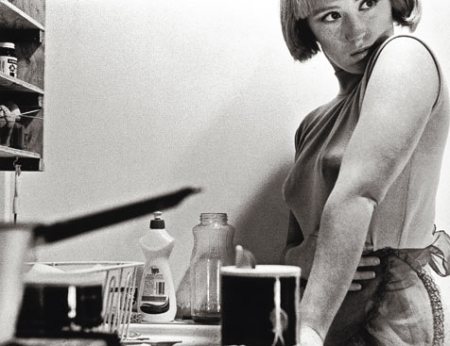
at home in the kitchen

but seeing such a massive show from one artist inspires me to keep on making what i do for myself. i keep telling mary to pursue her ‘self projects’ because i see them as exciting, well i see her as exciting but i won’t go into that now. it’s so hard for me as an artist to be working in the dark, but i think that’s where the most exciting of my work lays, when i don’t know where i am going but act as if i am following an inner voice. just do it.

after all aren’t we just energy converters.

as is sherman herself following in the footsteps of Claude Cahun ( 1894-1954) who was a forerunner of sherman and lady gaga. cahun was a french surrealist photographer,artist, writer, feminist, and radical activist who worked with ‘autoportraits’

claude cahun autoportrait with painted on nipples

‘All By Her Selves” is a comprensive retrospective curated by Francios Leperlier and Juan Vicente Aliaga originating at the Jeu de Paume in Paris now on view at the Art Institute of Chicago through June 3, 2012.

claude cahun

Cahun was born into a wealthy family of Jewish intellectuals from Nantes, France, but left in 1921 drawn to the frenetic, artistically and socially audacoius milieu of paris between wars. she considered herself  a born surrealist but was never accepted as part of the inner circle. nonetheless she did participate in several surrealist exhibits and was part of  the anit-fascist group ‘Contre-Attague.’
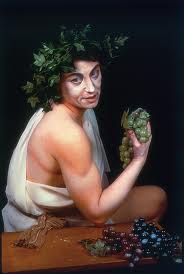
sherman as bacchus

but back to the sherman show. the amount of people who pass through moma’s door is amazing especially at $25.00 a head. the sherman show doesn’t have a special admission price as some shows do making even more money to do what with, buy art? one would think that the highpriest of moma art world would be able to solve the problem of the distracting reflections. is it a money problem? raise the price of the cafe’s latte’s or maybe just tilt the pictures downward, do something.

a personal story: i was lighting a CBS network news show overlooking a new york harbor celebration. the studio was enclosed in 1″ plexiglass with a panaroma view of the harbor. we did two shows that night one at sunset, or normal evening news show with the sun setting behind the anchor, a killer angle and the other one after dark same angle but different subject and fireworks. we used two different lighting systems one for each setup.

when the big muckymucks came down to test both looks we had nothing but reflections for the evening show from the lights reflecting in the plexiglass. horror on horror as everyone looked at each other. i hadn’t set this system up as someone eles had, but i was there and needed to fix it, i asked if i could have a moment to solve the problem. i got the stagehands to wrap some ‘blackwrap’ around the barndoors to eliminate the spill causing the ambient reflections.

when everyone came back and looked on camera a sigh of relief was uttered with jokes and laughter. problem solved everyone could go home and get a good nights sleep.

i can’t believe that not one at moma saw these reflections as a problem before the sherman exhibit opened. well maybe they didn’t care after all you’re inside and have paid your money.

i wonder how cindy feels? oh well. she’s probably in her studio creating another series based on reflections. one can only guess.
jene

Naked before the camera in New York

April 5, 2012

Well one of the true signs that spring has arrived in the city are  bulbs and bosoms busting out all over. i must say this is one of my favorite times of year. the other being fall with it’s colors and smells of dried leaves. so i guess it’s only fitting that so many wonderful naked photography shows are in town in some of the swanky neighborhoods and some not so naked.

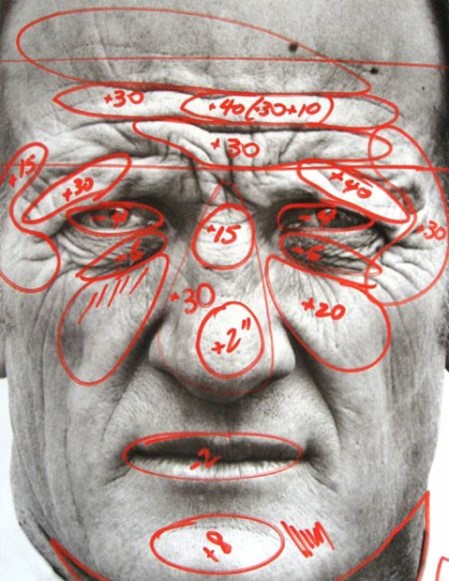
the Gagosian Gallery has Avedon, murals & portraits opening May 4 through July 6 2012 always a show to see of course, here i s a sample of avedons notes to his printers of adjustments on prints. who needs photoshop?

printers notes

as is this one below at Metropolitan Museum of Art which is naked. they even have naked penis at the museum. why does america have such a taboo on penises. is it because the law makers are male and they hate to be compared to one another, but have no problem looking and comparing woman’s breasts?

tomorrow we are going to MOMA to see Cindy Sherman exhibit and dinner out courtesy of a friends invitation.

By Peggy Roalf  Thursday, April 5, 2012

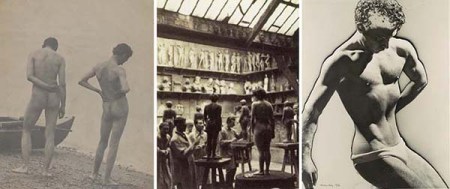
The nude body, one of the subjects photographers have celebrated since the camera was invented, is presented in its many guises at an exhibition that opened last week at the Metropolitan Museum of Art.

While the body has been a central feature in art through the ages, the realism of photography could not help but capitalize on its erotic possibilities—and the show gracefully presents this theme along with some surprising examples from anthropological, medical, and forensic documentations of the mid- and-late 19th century, including an 1860 photograph of a hermaphrodite by the great French photographer, Nadar.

A photograph of a reclining nude female by Julien Vallou de Villeneuve from 1853, which defines the notion of an “hourglass figure,” was made expressly to sell to artists who painted the female form. The use of photography by artists at the time is well known, and many took up the camera for this purpose themselves. One beautiful image of this genre is a photograph by the painter Thomas Eakins of male bathers from around 1883. But male nudity was rather strictly controlled and due to its scarcity, photographs that became available were avidly collected including an 1890s example of what could be considered soft-core porn, by the Italian photographer Guglielmo Plushow.

Man Ray’s 1930 Male Torso introduces Modernism in the middle section of the show, which also includes two classic nude studies by Edward Weston of Charis Wilson, on the sand, both from 1936. Other standouts from this period are Distortion #6, 1932 by Andre Kertesz, which prefigures the distorted nude figures that British photographer Bill Brandt became known for at the end of the 1940s (three of which are included), and a photograph by Irving Penn from 1949 that rivals the prehistoric Venus of Willendorf for its stately corpulence.

The exhibition takes some surprising turns in presenting scenes from the “Age of Aquarius,” including a 1971 photograph by Garry Winogrand of a Central Park be-in; an early 1970s shot by Larry Clark from “Teenage Lust;” and a pair of transgressive performance documents by Hanna Wilke, done at PS 1 in 1978 while the building was still in shambles. But the show is at its best in presenting the earliest uses of photography in capturing images of the naked human body for consumption by artists, scientists, collectors, and voyeurs.

Images above: Row 1, left to right: Thomas Eakins, Thomas Eakins and John Laurie Wallace on a Beach, ca. 1883; Brassai, L’academie Julian, 1932; Man Ray, Male Torso, 1930.
Row 2, left to right: Andre Kertesz, 
Distortion #6, 1932; Irving Penn, Nude No. 1, 1949; Robert Mapplethorpe, Patti Smith, 1976. All courtesy the Metropolitan Museum of Art.

Naked Before the Camera continues through September 6th at the Metropolitan Museum of Art, 1000 Fifth Avenue, at 82nd Street, NY, NY.

i’ll have my clothes on for the shows and dinner, nothing like a hot piece of pasta falling in ones lap.

jene

Cindy Sherman and Robert Frank in the same sentence

February 20, 2012

coming back to new york city and reading the NY Times this past sunday, that is if i don’t read ‘the news that’s fit to print’ which seems to drive me up the wall these days and i am learning to just skip over it and read around the hard news finding the things that interest me i find interesting tidbits here and there. this one in arts and leisure

for starters there is this piece about MOMA’s upcoming Cindy Sherman Photography retrospective which i’ll go see during the week altho these shows are always mobbed with people moving along to the next experience. me i like to savory what’s in front of me, sort of like sex. i won’t be able to attend a pre-opening due to some rotator cuff appointments, ugh. i’ll just have to grin and bear it reading things like this just builds up my excitement.

CINDY SHERMAN UNMASKED

By
Published: February 16, 2012
CINDY SHERMAN was looking for inspiration at the Spence Chapin Thrift Shop on the Upper East Side last month when she eyed a satin wedding dress. An elaborate confection, it had hand-sewn seed pearls forming flowers cascading down the front and dozens of tiny satin-covered buttons in the back from which the train gently hung like a Victorian bustle.
Cindy Sherman

The photographer Cindy Sherman in a rare pose as herself. More Photos »

 Multimedia
self portrait
“It’s Arnold Scaasi,” the saleswoman said, as Ms. Sherman made a beeline for the dress. Unzipping the back the clerk showed off a row of labels, one with the year it was made — 1992 — and another with the name of the bride-to-be. “It has never been worn,” she added. As the story goes, when the gown was finished, the bride decided she didn’t like it.

Ms. Sherman appeared skeptical. Is this really what happened, or is the story just the cover for a jilted bride? One begged to know more.

That tantalizing sense of mystery and uneasiness are similar emotions viewers feel when they see one of Ms. Sherman’s elliptical photographs. Over the course of her remarkable 35-year career she has transformed herself into hundreds of different personas: the movie star, the valley girl, the angry housewife, the frustrated socialite, the Renaissance courtesan, the menacing clown, even the Roman god Bacchus. Some are closely cropped images; in others she is set against a backdrop that, as Ms. Sherman describes it, “are clues that tell a story.”

“None of the characters are me,” she explained, sipping a soda at a cafe near the shop that afternoon. “They’re everything but me. If it seems too close to me, it’s rejected.”

On this unseasonably warm afternoon Ms. Sherman, 58, had bicycled from her apartment in Lower Manhattan to discuss her landmark retrospective at the Museum of Modern Art, which opens Feb. 26 and includes more than 170 photographs. Wearing no makeup, with leggings and sneakers and a tweed hat that carefully concealed her crash helmet, she looked totally inconspicuous, hardly the celebrated artist whose fans include Lady Gaga; Elton John, who collects her work; and Madonna, who sponsored a show of Ms. Sherman’s “Untitled Film Stills,” at the Museum of Modern Art in 1997.

Petite, with strawberry-blonde hair that falls to her shoulders, she is nothing like the larger-than-life characters she portrays in her self-portraits. Soft-spoken and friendly, she is very much a girl’s girl who can as easily giggle about men, movies and makeup as she can discuss literature and art.

see rest of the Times article here

——————————————————————————————————————————————————–

then in the Metropolitan section i find mention of forgotten Robert Franks promotional pictures shot for the NY Times on their Lens Blog  some twelve new york black and white pictures.

In 1958, the promotion department of The New York Times hired a young Swiss expat to take pictures that were collected in a slim hardcover book for prospective advertisers. The book, “New York Is,” extolled the virtues of the city and of the newspaper as the best way to tap its prosperous postwar consumers.

Some of the arrestingly elegant shots that resulted could have been taken by other fresh-eyed art or fashion photographers of the day, like William Klein or Roy DeCarava or Lillian Bassman, who died Monday at 94. But other pictures – snapped seemingly midstride; decidedly grainier and blurrier than commercial work at the time; defined by seas of inky black and oceans of shiny reflective surfaces – are unmistakably the work of only one man: Robert Frank, who with his masterpiece “The Americans,” published the following year, was to change the course of photography.

“New York Is” began as an ad campaign, and the book was distributed in 1959, showcasing two dozen of Mr. Frank’s pictures alongside snappy, boosterish captions. While the book has long been known in scholarly and rare-book circles, where copies now change hands for several thousand dollars, the prints, negatives and contact sheets Mr. Frank made for the project were long thought to have been lost amid shuffles of storage rooms and picture archives at The New York Times.

But Jeff Roth, an archivist at The Times, learned they had been rediscovered three years earlier by Helen Silverstein, the widow of Louis Silverstein, an influential designer who served for many years as the art director of The Times and who died in December. Mr. Silverstein was art director of the promotion department in the late 1950s and for commercial jobs often hired Mr. Frank, who wrote in a note for Mr. Silverstein’s memorial service in January: “He gave me moral support as well as financial – and this made my life in NYC possible.” (Mrs. Silverstein was later to be a producer and co-editor for Mr. Frank’s first feature-length film, “Me and My Brother.”)

read the rest of the Times story here

now i’ve got work to do, hummmm if only i knew what it is i do, that might help me focus on the task at hand. oh well drink another cup of coffee and dream always seems to help.

jene youtt