Well one of the true signs that spring has arrived in the city are bulbs and bosoms busting out all over. i must say this is one of my favorite times of year. the other being fall with it’s colors and smells of dried leaves. so i guess it’s only fitting that so many wonderful naked photography shows are in town in some of the swanky neighborhoods and some not so naked.
the Gagosian Gallery has Avedon, murals & portraits opening May 4 through July 6 2012 always a show to see of course, here i s a sample of avedons notes to his printers of adjustments on prints. who needs photoshop?
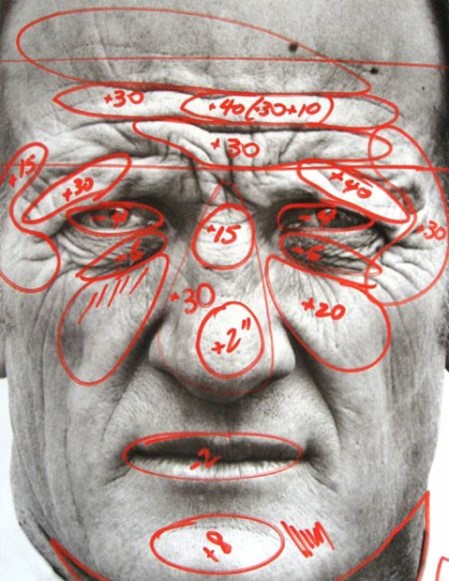
printers notes
as is this one below at Metropolitan Museum of Art which is naked. they even have naked penis at the museum. why does america have such a taboo on penises. is it because the law makers are male and they hate to be compared to one another, but have no problem looking and comparing woman’s breasts?
tomorrow we are going to MOMA to see Cindy Sherman exhibit and dinner out courtesy of a friends invitation.
By Peggy Roalf Thursday, April 5, 2012
The nude body, one of the subjects photographers have celebrated since the camera was invented, is presented in its many guises at an exhibition that opened last week at the Metropolitan Museum of Art.
While the body has been a central feature in art through the ages, the realism of photography could not help but capitalize on its erotic possibilities—and the show gracefully presents this theme along with some surprising examples from anthropological, medical, and forensic documentations of the mid- and-late 19th century, including an 1860 photograph of a hermaphrodite by the great French photographer, Nadar.
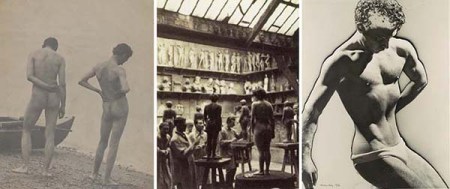
A photograph of a reclining nude female by Julien Vallou de Villeneuve from 1853, which defines the notion of an “hourglass figure,” was made expressly to sell to artists who painted the female form. The use of photography by artists at the time is well known, and many took up the camera for this purpose themselves. One beautiful image of this genre is a photograph by the painter Thomas Eakins of male bathers from around 1883. But male nudity was rather strictly controlled and due to its scarcity, photographs that became available were avidly collected including an 1890s example of what could be considered soft-core porn, by the Italian photographer Guglielmo Plushow.

Man Ray’s 1930 Male Torso introduces Modernism in the middle section of the show, which also includes two classic nude studies by Edward Weston of Charis Wilson, on the sand, both from 1936. Other standouts from this period are Distortion #6, 1932 by Andre Kertesz, which prefigures the distorted nude figures that British photographer Bill Brandt became known for at the end of the 1940s (three of which are included), and a photograph by Irving Penn from 1949 that rivals the prehistoric Venus of Willendorf for its stately corpulence.
The exhibition takes some surprising turns in presenting scenes from the “Age of Aquarius,” including a 1971 photograph by Garry Winogrand of a Central Park be-in; an early 1970s shot by Larry Clark from “Teenage Lust;” and a pair of transgressive performance documents by Hanna Wilke, done at PS 1 in 1978 while the building was still in shambles. But the show is at its best in presenting the earliest uses of photography in capturing images of the naked human body for consumption by artists, scientists, collectors, and voyeurs.
Images above: Row 1, left to right: Thomas Eakins, Thomas Eakins and John Laurie Wallace on a Beach, ca. 1883; Brassai, L’academie Julian, 1932; Man Ray, Male Torso, 1930.
Row 2, left to right: Andre Kertesz, Distortion #6, 1932; Irving Penn, Nude No. 1, 1949; Robert Mapplethorpe, Patti Smith, 1976. All courtesy the Metropolitan Museum of Art.
Naked Before the Camera continues through September 6th at the Metropolitan Museum of Art, 1000 Fifth Avenue, at 82nd Street, NY, NY.
i’ll have my clothes on for the shows and dinner, nothing like a hot piece of pasta falling in ones lap.
 Stereoscope Co. and the American firm Underwood & Underwood, marketed an entire series of ethereal ghosts, angels and fairies for the amusement of the public.” — from: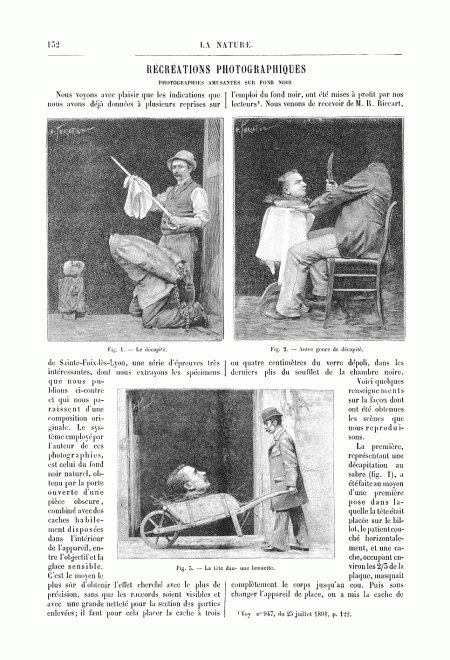

 Fuzzypictures's Weblog