Posts Tagged ‘internet privacy’

i know this isn’t art but important anyways, removing google history

February 23, 2012

from the Electronic Frontier Foundation

February 21, 2012 | By Eva Galperin

How to Remove Your Google Search History Before Google’s New Privacy Policy Takes Effect

[UPDATE 2/22/2012] It is important to note that disabling Web History in your Google account will not prevent Google from gathering and storing this information and using it for internal purposes. More information at the end of this post.

On March 1st, Google will implement its new, unified privacy policy, which will affect data Google has collected on you prior to March 1st as well as data it collects on you in the future. Until now, your Google Web History (your Google searches and sites visited) was cordoned off from Google’s other products. This protection was especially important because search data can reveal particularly sensitive information about you, including facts about your location, interests, age, sexual orientation, religion, health concerns, and more. If you want to keep Google from combining your Web History with the data they have gathered about you in their other products, such as YouTube or Google Plus, you may want to remove all items from your Web History and stop your Web History from being recorded in the future.

Here’s how you can do that:

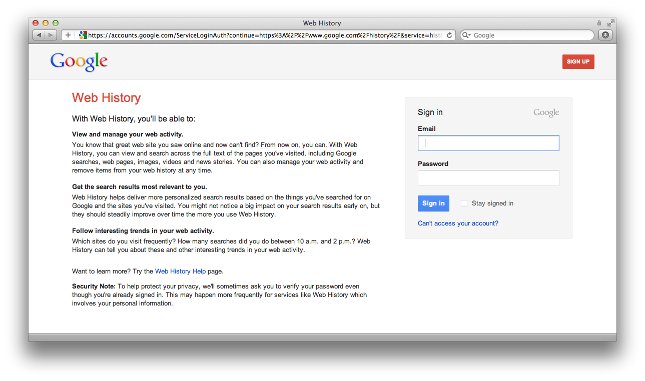
1. Sign into your Google account.

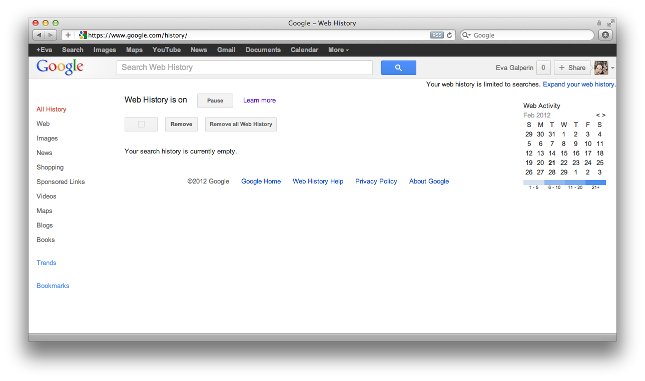
2. Go to https://www.google.com/history

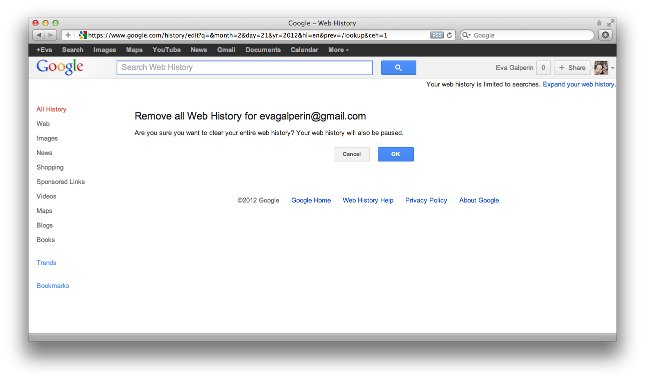
3. Click “remove all Web History.”

4. Click “ok.”

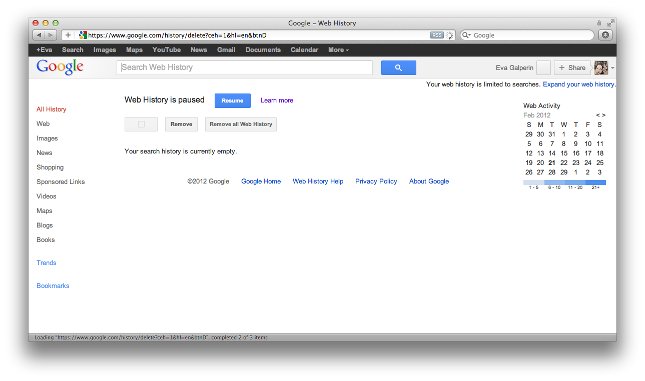
Note that removing your Web History also pauses it. Web History will remain off until you enable it again.

[UPDATE 2/22/2012]: Note that disabling Web History in your Google account will not prevent Google from gathering and storing this information and using it for internal purposes. It also does not change the fact that any information gathered and stored by Google could be sought by law enforcement.

With Web History enabled, Google will keep these records indefinitely; with it disabled, they will be partially anonymized after 18 months, and certain kinds of uses, including sending you customized search results, will be prevented. If you want to do more to reduce the records Google keeps, the advice in EFF’s Six Tips to Protect Your Search Privacy white paper remains relevant.

If you have several Google accounts, you will need to do this for each of them.

remember the new logo

NYTimes David Pogue’s excellent article on Sopa/Pipa

January 20, 2012

Put Down the Pitchforks on SOPA

By now, you’ve probably heard of the Stop Online Piracy Act (SOPA) and the Protect I.P. Act (PIPA). These are anti-piracy bills that had been making their way through the House and Senate, respectively.

You might have been made aware of these proposed bills Wednesday, when Wikipedia and other Web sites “went dark” in protest. (Google covered up its logo with a big black rectangle, as though censored.)

Protestors in San Francisco.Robert Galbraith/ReutersProtestors in San Francisco.
FDDP
The Times’s technology columnist, David Pogue, keeps you on top of the industry in his free, weekly e-mail newsletter.
Sign up | See Sample

I’ve been watching these doings with fascination. One reason: it’s the first time so many big Web sites have banded together for a political action. (Jenna Wortham in The New York Times offers a great analysis of this sea change here.)

But I’ve also been a little alarmed. Of the millions joining in outraged protests, I’ll bet that only a few have actually read the proposed bills. Everyone else is, no doubt, swept away by the Web sites’ shock language. These bills, say the opponents, will allow Hollywood to censor free speech, kill innovation, and “fatally damage the free and open Internet,” as Wikipedia put it. Light the torches! Grab the pitchforks!

In a perverse stroke of curiosity, I thought maybe I’d actually study these bills.

Nobody’s disputing that these bills have been put together by the entertainment industries — movies, TV, music. The bills are intended to address their chronic frustration: that most of the piracy sites, which make movies, TV, music and book files available free, are overseas. Even though they get more visits than Google or Wikipedia, American laws can’t touch them.

The SOPA and PIPA bills would try to shut down these overseas piracy sites by exerting leverage on companies here in the United States, where they do have jurisdiction.

For example, they’d force American service providers to block the domain names (for example, “piracy.com”) of overseas piracy sites. They’d allow the government to sue American sites like Google and Facebook, and even blogs, to remove links to the piracy sites. And they’d give the government the right to cut off the piracy sites’ funding; they could force forcing American payment companies (like PayPal) and advertisers to cut off the foreign accounts.

The outrage reminds me of the controversy over global warming. Yes, there are climate-change deniers. But nobody seems to notice that they’re in two totally different camps, making totally different arguments. Some people deny that there’s been any climate change at all. Others acknowledge the climate change, but deny that people have anything to do with it. These two categories of people actually aren’t on the same side at all.

In SOPA’s case, too, there are two groups. Some people are O.K. with the goals of the bills, acknowledging that software piracy is out of control; they object only to the bills’ approaches. If the entertainment industry’s legal arm gets out of control, they say, they could deem almost anything to be a piracy site. YouTube could be one, because lots of videos include bits of TV shows and copyrighted music. Facebook could be one, because people often link to copyrighted videos and songs. Google and Bing would be responsible for removing every link to a questionable Web site. Just a gigantic headache.

But there’s another group of people with a different agenda: They don’t even agree with the bills’ purpose. They don’t want their free movies taken away. A good number of them believe that free music and movies are their natural-born rights. They don’t want the big evil government taking away their free fun.

For the record, I think the movie companies have approached the digital age with almost slack-jawed idiocy. The rules for watching online movies from authorized sites are absurd (24 hours to finish the movie? Have they never heard of bedtime?). And there are plenty of movies, even big ones, that you can’t rent or stream online at all. (The original “Star Wars” trilogy, the first three “Indiana Jones” movies, and hundreds of others.)

It should occur to these movie studios that if you don’t give people a legal way to buy what they want, they’ll find another way to get it.

At the same time, what the piracy sites are doing doesn’t seem quite fair, either. Yes, it’s a quirk of the Internet that you can duplicate something infinitely and distribute it at no cost. But that doesn’t make it O.K. to shoplift, especially when the stolen goods are for sale at a reasonable price from legitimate sources. Yes, even if the company you’re robbing is huge, profitable and led by idiots.

In this case, the solution is to work on the language of the bills to rule out the sorts of abuses that the big Web sites fear. (And to fix the other minor point, which is that the bills won’t work. For example, they’d make American Internet companies block your access to domain names like “piracy.com,” but you’d still be able to get to them by typing their underlying numerical Internet addresses, like 197.12.34.56. In other words, anybody with any modicum of technical skills would easily sidestep the barriers.)

As it turns out, that’s exactly what’s happening. Dozens of members of Congress, and the White House itself, have dropped support of the bills; their sponsors are considering big changes to the proposals. (They might look, for starters, at the suggestions in Wednesday’s Times editorial: “The legislation could be further amended to narrow the definition of criminality and clarify that it is only aimed at foreign sites. And it could tighten guarantees of due process. Private parties must first get a court order to block business with a Web site they deem infringing on their copyrights.”)

In other words, the protests were effective. There’s no chance that the bills will become law in their current forms.

But it was a sloppy success; the scare language used by some of the Web sites was just as flawed as the Congressional language that they opposed. (I actually have sympathy — just a tiny bit — for the music business’s frustration. It was put nicely by Cary Sherman, chief executive of the Recording Industry Association of America: “It’s very difficult to counter the misinformation when the disseminators also own the platform.”)

Finally, not enough people have acknowledged that the opposition was arguing two totally different different points — the “you’re going about it the wrong way” group and the “we want our illegal movies!” group.

In the new world of Internet versus government, the system worked; the people spoke, government listened, and that’s good. But let’s do it responsibly, people. Both sides have an obligation to do the right thing.

Hey folks we need some help here stop SOPA, PIPA contact your congress person

January 17, 2012
SOPA, PIPA opponents prepare for Capitol Hill piracy showdown

by Kenneth Corbin, CIO   Jan 17, 2012 10:00 am

Opponents of controversial anti-piracy legislation are gearing up for a major fight in both the House and the Senate as they press for support for an alternative bill they say would avoid draconian measures that, if enacted, could create major security vulnerabilities in the architecture of the Internet.

The two lawmakers leading the charge, Sen. Ron Wyden (D-Ore.) and Rep. Darrell Issa (R-Calif.), took to the Consumer Electronics Show in Las Vegas last week to press their case – a fitting setting, as the mammoth trade show gives an annual coming out party for tech firms’ latest innovations. The trade group that puts on the show, the Consumer Electronics Association, has been a vocal member of the lobbying efforts to oppose the Stop Online Piracy Act (SOPA) in the House and the Senate version, the Protect IP Act (PIPA), both of which the organization argues would impose dramatic limits on online innovation by exposing Web firms to excessive legal liability in the name of curbing piracy.

“We have been teaming up on this and have been working on this for some time,” Wyden said of his partnership with Issa, who in turn added that the two “in many ways are not predictable partners.”

Wyden and Issa are backing an alternative anti-piracy bill, the Online Protection and Enforcement of Digital Trade (OPEN) Act, a measure they say would create a more effective path for copyright holders to protect their intellectual property from foreign websites that profit from piracy, while avoiding the disastrous consequences they anticipate resulting from the enactment of SOPA or PIPA.

Although they vary slightly in their language, both SOPA and PIPA would empower the Department of Justice to seek an injunction from a federal judge against a foreign website that it considers to be primarily dedicated to piracy. If the judge agreed, Justice could then prevail on all manner of Internet players, including service providers, search engines, payment processors and ad networks, to cut off services to the offending site.

Critics of the bill, which include major Web companies such as Google and Facebook, have warned that in its efforts to crack down on overseas piracy, the legislation would inevitably ensnare legitimate websites in a form of censorship that would threaten to banish innovative and lawful companies from the Internet.

Additionally, a host of Internet luminaries and security experts have warned of the impact the legislation could have on the core naming and routing system of the Internet, creating the sort of network errors and insecurity that are common to the Internet landscape in authoritarian countries where state censorship is the norm.

“The biggest problem is the damage done to the domain name system [DNS] in these two bills,” Wyden said. Wyden, who serves on the Senate Intelligence Committee, said that the provisions that could jeopardize the DNS are at odds with the work that members of the national security community are doing to shore up the critical infrastructure of the Internet from cyberattacks. “Everything they’re trying to do in terms of cybersecurity is premised on the domain name system,” he said.

Wyden and Issa both stressed that they agree with the backers of SOPA and PIPA up to the point that online piracy and the trafficking of knock-off pharmaceuticals and other goods are real problems that deal a major economic blow to U.S. firms. But the consensus breaks down there.

The OPEN Act takes a far more limited approach, and places jurisdiction for complaints against foreign websites with the International Trade Commission, rather than the Justice Department and the federal courts. And instead of going after a wide range of Internet players in a bid to isolate the infringing site, the OPEN Act would limit the response to payment providers such as Visa and PayPal, choking off the sites’ influx of revenue.

While Wyden stressed the security concerns the members have with SOPA and PIPA, Issa called the bills’ language on jurisdiction their “fatal flaw.” He argued that the ITC is a far better venue for handling overseas infringement claims for a variety of reasons, including language in the OPEN Act that would ensure a continuity among the judges who handle such cases, compared to the merry-go-round of judges on the federal bench that could be involved.

Additionally, he suggested that the ITC is a more favorable venue for small content owners to assert their IP rights both because its process is faster than U.S. courts and litigation is less expensive, claims that SOPA supporters dispute.

“You can, in fact, get justice at a very reduced cost. Theoretically you could get justice without an attorney,” Issa said. “We’re not claiming that the ITC is perfectly prepared. What we’re saying is there’s a better solution and it ought to be considered.”

In broad strokes, the battle lines over online piracy legislation have pitted content-oriented industries such as film and music against Web firms and open Internet advocates, though each side has marshaled a long and diverse list of stakeholders to support its position.

Some of the most outspoken critics have thrown their lot in with the OPEN Act. Google, Facebook, Twitter and other members of the Net Coalition advocacy group have delivered a letter ( PDF) to Wyden and Issa endorsing their legislation.

“This approach targets foreign rogue websites without inflicting collateral damage on legitimate, law-abiding U.S. Internet companies by bringing well-established international trade remedies to bear on this problem,” the companies wrote.

The debate over the competing anti-piracy measures is on track to flare up in short order after Congress comes back in session later this month. Issa has scheduled a committee hearing Jan. 18 to focus on the national security ramifications of the IP legislation under consideration. He said that he plans formally to introduce the OPEN Act, the drafting of which has been the subject of a crowdsourced debate on the Web, the day before the hearing.

Issa said that House Judiciary Committee Chairman Lamar Smith (R-Texas), the lead sponsor of SOPA, has signaled that he intends to introduce a manager’s amendment that will amount to a “major” overhaul of the bill in its current form, but that he had not shared a draft with other committee members.

A spokeswoman for Smith did not respond to a request for comment on the status of the bill or the criticisms of its provisions, but had previously confirmed that the committee will renew its work marking up the legislation shortly after the holiday recess.

In the Senate, PIPA is scheduled to receive consideration on the floor Jan. 23 and 24, a debate that Wyden hopes to derail with a filibuster.

Both Wyden and Issa cast their campaign as something of a David vs. Goliath struggle, as opposition to SOPA and PIPA has been largely at the grass-roots level, stoked by Web firms that are outgunned in Washington by the deep-pocketed lobbies supporting the measure. Nevertheless, they noted modest success in peeling off some lawmakers who had initially signed on as cosponsors of the legislation, and hope that more will follow suit as they continue to sound the alarm about the bills’ provisions.

“I think it would be fair to say that our side has been fighting above our weight, and we are now moving into the last rounds and we’re still on our feet and there is tremendous support growing for our side,” Wyden said. “We’re up against the savviest, toughest, smartest lobbying folks around.”

macworld news

jene