50 years since first breast implants

March 29, 2012

my first hand experience of breast implants was weird, she was a friend of a friend is how we met and we both shared working in the theater. she had large silicone implants, being a stage performer everything is exaggerated, her breasts were the same laying down as standing. they didn’t move they looked nice but i am sure she didn’t feel much sensation in them. she made lots of noise but somehow it rang false. i’ve never been attracted to large breast per se and i see women, models who conform to some weird playboy mag idea of booming basooms. don’t get me wrong i do love to play with breasts and that fine tuning knob on the end is neat. i am just opposed to implants. i’ve had partners who had small breasts and our sex life was fine, so size doesn’t impede that good sex. as people are so should breast be, all different. but this isn’t about me it’s about boobies and history.

It is 50 years since the first breast enlargement using silicone implants. Today it rates as the second-most popular form of cosmetic surgery worldwide, undergone by 1.5 million women in 2010.

It was spring 1962 when Timmie Jean Lindsey, a mother-of-six lay down on the operating table at Jefferson Davis hospital in Houston, Texas.

Over the next two hours, she went from a B to a C cup, in an operation that made history.

“I thought they came out just perfect… They felt soft and just like real breasts,” says Lindsey now aged 80.

“I don’t think I got the full results of them until I went out in public and men on the street would whistle at me.”

Though the operation boosted her self-confidence – and she enjoyed the extra attention – she had never planned to have a breast augmentation.

Timmie Jean Lindsey in 1962 before her operation (left), just after (centre) and today Timmie Jean before and just after her op, and today

Lindsey had been to hospital to get a tattoo removed from her breasts, and it was then that doctors asked if she would consider volunteering for this first-of-its-kind operation.

“I was more concerned about getting my ears pinned back… My ears stood out like Dumbo! And they said ‘Oh we’ll do that too.'” So a deal was struck.

read the rest of story here

just one mans opinion. i know breast are pretty important in this world, i personal like them natural. TASTY


Hands on article of the Lytro camera

March 29, 2012

There’s been a lot of buzz about the Lytro digital camera that promises you can shoot an image and focus it afterward. But how does it work? What are the images like? And can you really focus after the fact? Here’s a hands-on look at the Lytro.

A new camera has been in the news recently: the Lytro, a $399 camera that allows you to take a photo now, and focus — or refocus — later. Sounds provocative. But does it work? Is this something you should add to your camera bag? I’ve had the opportunity to use one for several weeks now, and I’m pretty gung-ho. Here’s why.

The Lytro uses a technique that is called plenoptic — or light field — photography. The camera captures all the light coming through the lens from all angles, striking an array of microlenses on its sensor. The camera’s inventor, Ren Ng, says that the Lytro captures 11 million “light rays” in every photo.

Here’s one thing to get out of the way: the “focus later” aspect of the Lytro happens in special software after the shoot. The 11 million pieces of data the camera captures are written to a proprietary file that you download to your computer. Once the photo is on your computer screen, you click on any part of the image to bring that point into focus. Click on another part of the same image, and that point comes into focus. Lytro calls these images “Living Pictures.” The first time you see one, and experiment with focus, you will be impressed by how unusual these photos are. Living Picture photos are perfect for viewing live on a Web site, blog post, Facebook page, or other online entity.

here’s the link at creative pro com.

jene

Cabin fever how i am recovering from surgery or WTF is going on

March 26, 2012

is going on in my life? it’s gotten turned around a bit here so what do i do just go with the flow. i am not sure if i’ll gain some readers or loose them with this post. just know i am playing around here and haven’t lost my mind, wait i’d better check.

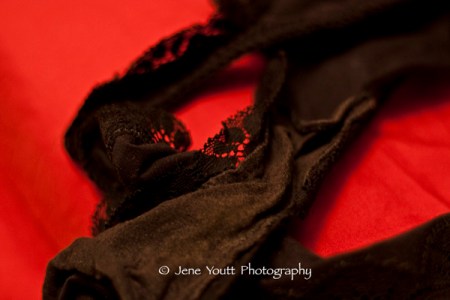
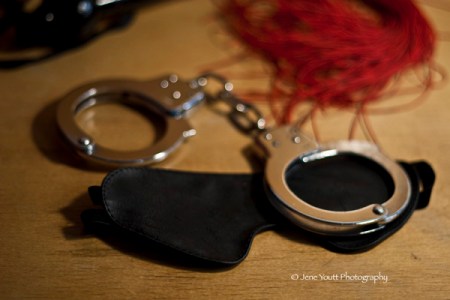
this might be the place to warn people that i am posting pictures of erotic material some found around the house some not. i don’t want to offend anybody and since most people follow links to the naked photos here this might be a safe subject. i just wont put it on farcebook. what a useless use of bandwidth that is, i never saw a need for it myself.

my web host, Photoshelter has decided to upgrade their software and servers. here we go again. they do this on the weekends i guess so nobody can bother them when things don’t work right, right now i am waiting to get through to friendly customer support myself. last fri i downloaded some Cambodian images been sitting here for years with the purpose to finally finish setting up the site to sell prints of my stuff. lots of redownloading for me. but hey i’ve got time on my hands right?

but i’ve been feeling disconnected from my honey as she is also. so i started looking around for something to shoot opening drawers and closets when i got the idea of doing some erotica and using found objects.

let things fall where they may

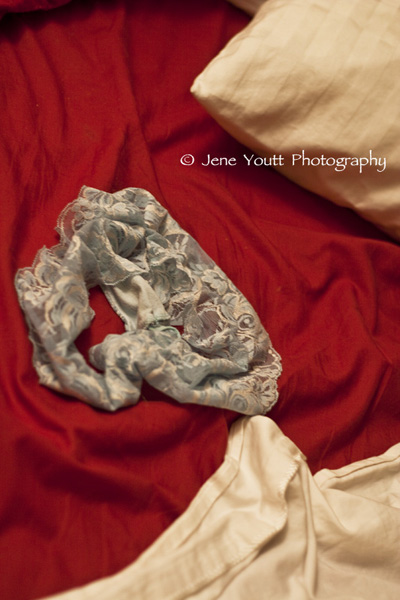
no these aren’t mine, a bit small for me but i might look cute in them if they were. so one thing leads to another and eroticism is all in the eyes of the beholder. objects are just as suggestive as the wearer although i do like to see these on my honey just seeing them alone brings up fond memories.

danger will robinson

now i am having fun and being creative in the privacy of our own apartment. i am not quite following the rule of thirds here but i do like the drape out of frame along with the detail of lace but i may try and rework this.

hummmmmmm

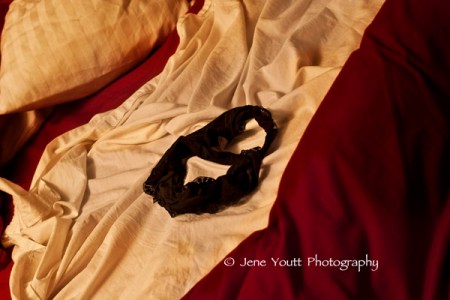
looking at this picture now i never saw the composition of the white bottom sheet. but hey my subconscious mind at work is more intuned to what i am doing than i am. cool but after awhile i start to run out of ideas

ML

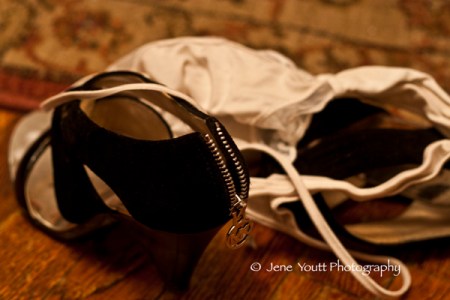
and this being new york where just about anything is available greenwich village is a quick subway ride away and time for some fresh air as i began to hyperventilate handling these delicate things i go for a ride. i’ve money burning a hole in my pocket along with all these thoughts running around. wee

sleep aids

hey that’s what the store clerk called them, what do i know? guess some could say i’ve way too much time and money on my hands and a very active imagination but even the angels have a dark side to them and i am way too old to die before i taste the fruits of life.

so it is another week of recovery from surgery while still being my crazy self. maybe these pictures are some that not needed to be taken. i am just getting to be too old to worry about that, at my age being sexual and erotic is a pleasure. and sharing my pleasure with my honey and her with me is something to look forward to every day. i’ve always thought of sex as play and something playfully done. procreate yea i did that but probably while we were playing. i love to play with my honey as we really enjoy giving to each other. what a better way to eat cake than with a friend.

sometimes i get a bit carried away but i chalk that up to my creativity which is alway pushing the boundaries and say ‘lets see’. boy has that gotten me in trouble sometimes.

i don’t want to live my life in a dark cave not being able to explore the wonderful world around us, i want to share that world with everyone. i don’t need you to agree with me just let me and everyone else live their lives without hurting anyone.

that’s what i have to say today……………………where the heck is tech support?

jene

Something Weegee didn’t have to think about, photos not taken

March 26, 2012

Photographs Not Taken: what makes a photographer freeze?
A new book of essays by photographers explores the missed opportunities of images never captured
Sean O’Hagan
guardian.co.uk, Thursday 15 March 2012 11.12 EDT

Christian Patterson

In the heat of the moment … a house on fire was American photographer Christian Patterson’s lost moment. Photograph: Sean Gallup/Getty Images

The American photographer Christian Patterson was driving along a deserted road in rural Nebraska when he saw a house on fire. He jumped out of his car and ran towards the house, but the intense heat drove him back. As he was about to take a picture of the scene, a truck pulled up and a man jumped out. He fell to his knees, crying. A fire truck arrived but, by then, the house and all its contents were reduced to ash.

South African photographer Roger Ballen once drove an acquaintance across Johannesburg to the house of a witch doctor. There, in a back room “full of cat’s skins on clotheslines”, the man produced a live cat from a sack. The witch doctor took the cat, weighed it, and paid the man accordingly. Ballen watched the transaction in silence, then drove the man back across town.

These are just two of the 62 stories collected by Will Steacy in a new book, Photographs Not Taken, published by Daylight. In his introduction, Steacy, a photographer himself, describes it as “a collection of essays by photographers about moments that never became a picture”. He writes: “Here, the process of making a photograph has been reversed. Instead of looking out into the world through a camera lens, these essays look directly into the mind’s eye to reveal where photographs come from in their barest and most primitive form – the original idea.”

Sylvia PlachyTwin tower encounter … Sylvia Plachy. Photo: Bru Garcia/AFP/Getty ImagesThe stories also show that there are many reasons not to take a photograph. For several of the photographers here, including Patterson, the decision not to press the shutter is usually an ethical one. Consider the story related by Sylvia Plachy who, on a street in midtown Manhattan just after the twin towers of the World Trade Centre had collapsed on 9/11, encountered a dust-covered man “who had walked though hell”. He was, says Plachy, “the icon” of the human tragedy. Many people took his photograph. She did not. “I would have had to step in front of him, interrupt his frantic pace,” she writes. “I felt ashamed. I hesitated. I questioned. It didn’t seem right. In an instant he was gone. I didn’t do it.”

Plachy spent the following fortnight roaming the streets of downtown New York looking for another picture as powerful as the one she had not taken. “His image haunts me to this day,” she writes, adding ruefully, “Diane Arbus would have done it.”

This story, it seems to me, gets to the heart of the matter. Many photographers share Arbus’s view that you take the picture whatever the cost – to yourself as well as the subject. I have always been uncomfortable with that notion. It says that nothing is too intimate, too private. It insists, too, on the primacy of the photograph over the experience.

Simon Roberts‘s story argues the opposite. On assignment in Zimbabwe, he visited the Mashambanzou Aids clinic where he encountered Priscilla Dzengwe, who had been raped as a child by her uncle and was HIV-positive. She was close to death, but curious and engaging. As they were talking, a group of local girls came in and began singing. “It was a haunting, spiritual and utterly captivating sound that filled the small room,” writes Roberts. “The girls, including Priscilla, began to cry as they sang. For the first time in my career, I felt physically unable to take a photograph.”

Would that experience have been the same, carried the same intensity for him, had he taken his camera out to photograph the scene? In doing so, he would inevitably have placed himself outside the experience. And, as he notes, “no image, however accomplished, could have captured the agonising poignancy of the moment. It was a moment to be lived, not framed, analysed or reduced in any way.”

The book is full of lost moments and missed opportunities, some poignant, some hilarious, some mysterious. (We never find out why Ballen did not photograph inside the witch doctor’s house. Was it superstition, or had he simply gone out without his camera?) One of the funniest is told by Matt Salacuse. As a struggling photographer in New York, he was waiting to meet his father in the lobby of the Ritz Carlton Hotel, when he spotted Tom Cruise and Nicole Kidman with their newborn adopted baby. Salacuse went outside and positioned himself by a waiting limo, waiting for the celebrity couple to emerge. Just as he was about to photograph them, Cruise looked straight at him and said calmly: “You’re not going to do that.” Salacuse writes: “It must have been some crazy Scientologist voodoo mind trick, because I looked at him and said, ‘You are right. I am not.’ And, I didn’t.”

Like the others, all that Salacuse was left with from his chance encounter was a story about a great photograph that never happened. Sometimes, as this book shows, that’s enough.

Now see this

Carole Callow, who has printed all of Lee Miller’s work since the photographer’s death, curates Through the Eyes of Lee Miller at Lucy Bell Gallery in St Leonards on Sea. The show will focus on two sets of work: Miller’s portraits of Picasso and images taken at Farley Farm House in East Sussex. From 20 March until 21 April.

In London, Foto8 is showing Rob Hornstra’s images of Abkhazia, the coastal strip of the Black Sea once known as the Riviera of the Soviet Union. The Sochi Project: Empty Land, Promised Land, Forbidden Land runs until 5 April.

thank you guardian uk

jene
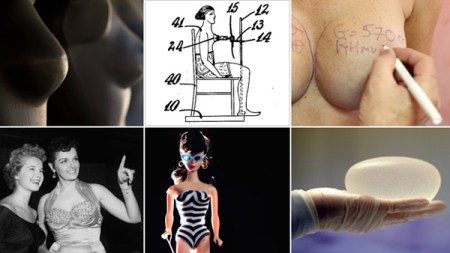
Murder is my business, Weegee at ICP, impressions on a young mind

March 19, 2012

the other day, being slow for me, which is really a good thing in that it gives me leisure  time to catch up with this metropolis ever flow and ebb of events, i took a stroll over to ICP see their weegee exhibit.

new york’s history is interesting to me, i even wrote a theatrical history article stored in lincoln center library.  i’ve lived here 48 years on and off but still consider this my home city and yet i don’t know half of what’s transpired here.

oh why couldn’t my city be Paris,  ghost have traveled both, oh well it is what it is

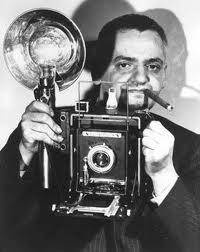
walking down the stairs underneath the replica of a colt revolver and  seeing the opening blown up picture on the wall of weegee perched on a window ledge with his speed graflex poised to snap the shutter i said ‘ i know where that is.’ and so i was hooked right away.

the galleries of this exhibit in ICP basement are full of gritty 8×10 pictures which show an invasive side of new york i’ve not known. the streets i’ve know, the names of clubs remembered but long forgotten by most.

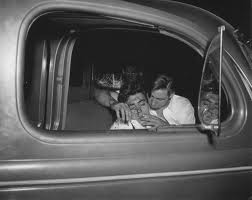
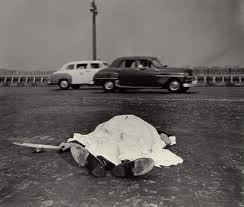
it was a time in the city when policemen wore wool overcoats saying ‘move along now’ and people obeyed. paddy wagons littered the streets as did the corpses weegee’s subjects. there he was ‘johnny on the spot’ snapping pictures of accident victims waiting for ambulances,

covered corpses laying where they fell and the ever present crowd of gawkers.

but what surprised me were the many pictures of weegee, camera ready to grab the shot. there was no mention of who his accomplice was taking the picture of him. he was always ready to promote himself.

it’s been said weegee set up some of the scenes he photographed with the ever helping policemen around. i guess for a few bucks a cup of java or quick produced cigar things got done and no one was hurt. who cared if a body was in the hallway of in the vestibule for a better shot. dead men tell no tales.

the ledge where weegee perched was across the street from police headquarters where the shift turned out for duty calls in the street long before it became famous for property room where the french connection heroin disappeared. new york was different then as it is now in the co-op apartments of old domed headquarters.

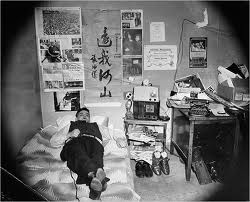
this exhibit showed what weegees life was like beginning with a replica of his room, small cot, tear sheets pinned on the wall, radio beside on a table of the ever police scanner by his side.

there is a picture of weegee working out of the trunk of his 38 chevy typewriter, camera, flashbulbs and the ever present box of cigars.  i thought how could a person live like this?

but there are plenty of other pictures of celebrities, celebrations and people everywhere, dead or alive. one of weegees favorite escape places was coney island where new yorkers thronged from summers heat. he loved recording people and  new york of the time.  weegee was a part of new york and new york a part of him, inseperable.

i can almost smell the cigar smoke. surely  murder was his business.

is your web site slow? what does it cost you? see graphic below

March 16, 2012
Americans Don’t Have Time For Slow Websites [INFOGRAPHIC]
Remember how your mother used to always tell you “patience is a virtue?” It turns out none of us took her advice.

Today, with lightning-speed data connections and optimized web browsers, online inquiries are answered in mere milliseconds — that is, until the website you’re pinging grinds to a halt.

The people at OnlineGraduatePrograms.com took a look at the impact of site speed on American browsing habits. For example, more than 3 billion Google searches are performed each day, but slowing the response time for results by even four-tenths of a second reduces that number by 8 million. When you multiply those lost users across major websites like Google and Amazon, you’re looking at serious amounts of missing revenue.

This infographic also explores how the “Google Generation” relates to a world that doesn’t always provide instant gratification. For example, many Americans now refuse to wait in line longer than 15 minutes. As always, time is money — but the Internet may have sent that equation into overdrive.

infographic

as the wold speeds up i am getting slower Hummmmmmm./ oh well  i am still having fun.

jene youtt

Macro photography with iphone, just add water

March 12, 2012

Transform Your iPhone Into a Microscope: Just Add Water

I’ve engineered a fair number of inexpensive DIY camera hacks. This one is by far the cheapest: it’s free! Simply place a drop of water on the phone’s lens, carefully turn the device over, and the suspended droplet serves as a liquid lens. Behold:

Droplet images are dreamy, blurred at the periphery, and just a little bit…wet. But the tiny subjects underneath are magnified with sufficient resolution for an impromptu microscope. Indeed, I started playing around with the technique after reading that the U.C. Davis iPhone microscope team experimented with water before moving to a solid lens.

After spending a few hours this weekend with a slightly moist iPhone, I am pleased to report the following:

  • It works!
  • Larger, rounder droplets lead to higher magnification, and as the droplet evaporates and shrinks magnification decreases.
  • The liquid lens is jiggly and sensitive to vibrations. The phone should be placed on a stable platform for maximum clarity. For these photos, I coopted a pair of short drinking glasses as a stand.
  • Image quality is not as sharp as that provided by solid, commercially available clip-on lenses like Olloclip. But hey. You get what you pay for!
  • Water is not generally good for cell phone electronics, so be careful when applying the droplet.

Below are my attempts at iPhone water-graphs.

If you try the technique, I’d love to see your results! Drop a link in the comments, or send me an email.

Alex WildAbout the Author: Alex Wild is an Illinois-based entomologist who studies the evolutionary history of ants. In 2003 he founded a photography business as an aesthetic compliment to his scientific work, and his natural history photographs appear in numerous museums, books, and media outlets. Follow on Twitter @myrmecos.

originally published in Scientific American blog compound eye

my question is: Does it work with beer?

jene youtt

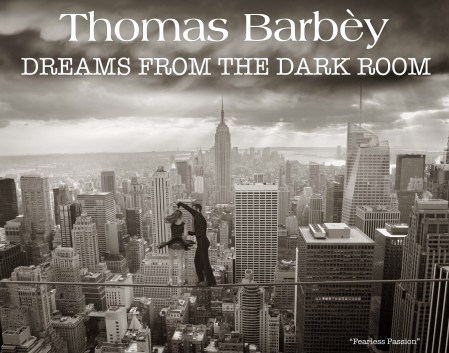
Dreams from the dark room” Thomas Barbey solo exhibition at Emmanuel Fremin gallery

March 12, 2012

Emmanuel Fremin Gallery is pleased to announce its second exhibition for renowned photographer Thomas Barbèy. “Dreams from the dark room” will run from March 15 to April 21 2012, the opening reception will be held on Thursday, March 15 from 6 to 8 PM. 547 West 27 Street, suite 508, New York City, NY 10001.

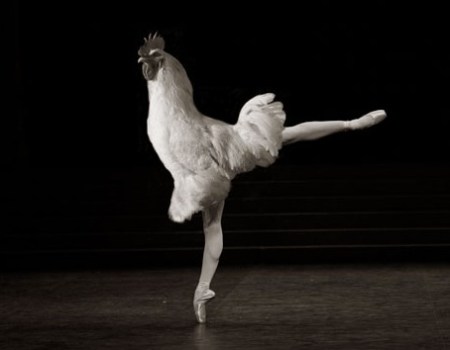
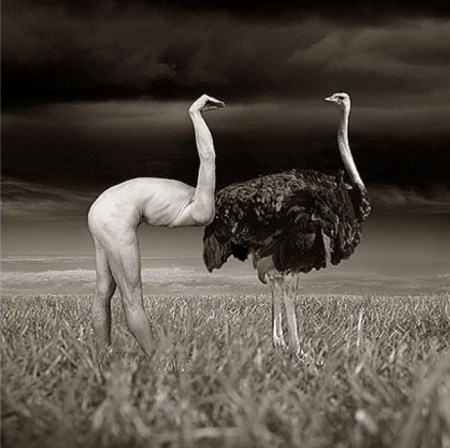
This  will be an exhibition of Barbey’s black and white photo compositions that give evidence to his ability to capture the impossible and fantasized through the manual process of developing film negatives and the assemblage of various imagery.


The French poet and founder of the surrealist movement André Breton may turn a blind eye in disbelief, René Magritte  roll over in his grave green with envy at the absurd and imaginative compositions of Barbèy. While the artistry and imagination of Man Ray might smile down knowingly.

Barbèy who For the past 20 years has been collecting and combining photographs that depict a variety of subject matter: cityscapes, trees, beaches, gondolas, and cathedrals. In other words, relatively mundane images that, when viewed independently, may fail to illicit a response.

When taken to the dark room, Barbèy coalesces these negatives through a series of unique and impressively orchestrated steps. For many artists, photoshop and graphic editing has become a shortcut in contemporary photography. Thomas Barbèy has chosen the road less traveled. His process is a personal and intricate labyrinth resulting in compositions best described as impressively surreal. Each negative is selected after years, and sometimes decades of storage, and then matched with other negatives to meet an unimaginable transmogrification.

“The process of my montage starts with concept. It is then followed by the exposure and selection of negatives. The design is then created by carefully choosing printing procedures as combination printing: sandwiching negatives together, thereby printing them simultaneously; pre-planned double exposure in the camera; the re-photographing of collaged photographs; and/or a combination of the above.”

Thomas’s works along the same ascetic as Jerry Uelsmann’s creations in photomontage which is not new as  this working method may date back to the 1860’s which may have been a high point in Europe  “In the 1860s and subsequent decades publishers of binocular photographs, such as the London Stereoscope Co. and the American firm Underwood & Underwood, marketed an entire series of ethereal ghosts, angels and fairies for the amusement of the public.” — from: The Perfect Medium,s p.52.
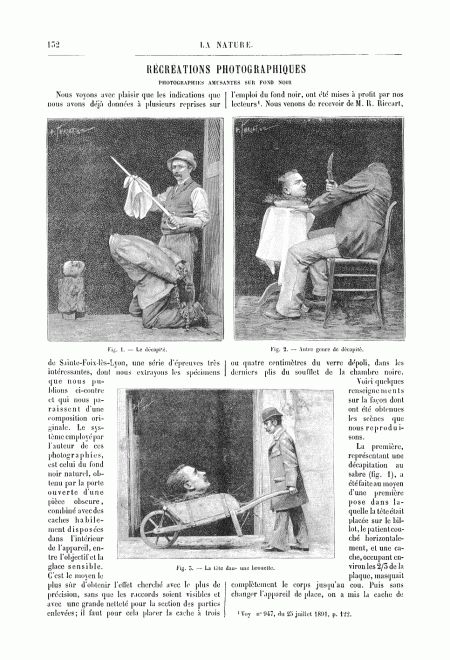
Thomas’s photo montages join the ranks of many other artist exploring the illusionistic quality and juxtaposing imagery that prevails in this type of process.  A ski slope that drapes like a bed sheet or a highway in San Francisco that intersects through a Banyan tree; each title is a play on words, as with “Wet Dreams”, showing a seascape beaching out onto a bedded mattress where the sun kissed figures stroll, play, and lounge on the sand.

The use of film and the manual exposure of each photograph in a darkroom is an essential element to the process and final product of Barbèy’s work where the images must pass the “So what?” test. That is, if the final montage of two or more images does not affect the artist in a particular way he throws it out and starts over. It is not until after that Barbèy experiments with different images, sometimes by accident and other times willfully, does the combination fit by transcending one into another world.

Thomas Barbèy was born in Greenwich, Connecticut and spent his childhood in Geneva, Switzerland. He began drawing seriously at an early age, using black “encre de Chine” and gouaches for color. Some early influences for his surrealistic images have been Philippe Druillet, Roger Dean, René Magritte, M.C. Escher and H.R. Giger. He has been interviewed and featured on the cover of “Inked” Magazine and featured in the New Britain Herald.

So if you’re in the neighborhood or don’t need to see your accountant who’s preparing your taxes or if you’ve a large return why not stop down and see some unusual art. Buy a piece of history, you never know.

Art Strong Bags, a sponsor of the 2012 Armory show

March 10, 2012

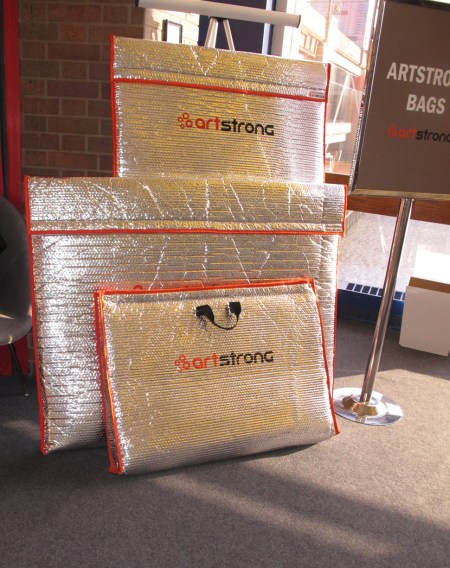
a friend of ours company ART STRONG BAGS is one of the sponsors of the Armory art show on pier 92 & 94 this weekend. Mary Nguyen pictured here

is the company’s president, founder and problem solver who came up with a solution of how to transport and protect art in a very convenient way. despite the aluminum  look it’s a very lightweight way to carry art and it’s green although it looks silver, green in that it’s very tough reusable and doesn’t fill trash heaps.

here is what Mary has to say about this product. artstrong bags are the most durable bags in the marketplace. Created with 5X the protection of normal bags, artstrong bags start with two layers of polyethylene bubbles sandwiched between one layer of fire retardant metallized polyester film and one layer of white polyethylene. Then we use shock-absorbing polyethylene foam that is filled with thousands of air cells that are resilient, anti-lint/dust/static free. The inside is lined with a superbly soft technologically innovative fabric that resists scratches and snags. Finally, our bags are sewn at the edges and reinforced with tough nylon to provide the most secure edges.

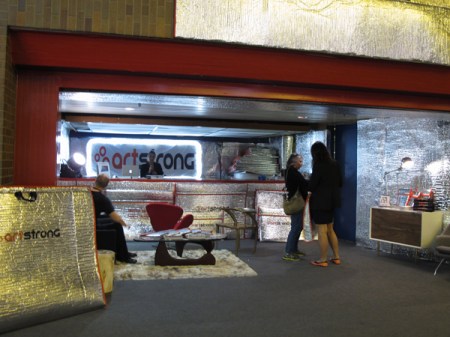
Art strong display is located just inside the entrance of pier 92, one doesn’t have to pay and enter the Armory show to see and feel them as they are before ticket entry, so if you want to play with them first hand you can do so

Art Strong display booth

right off the lounge area, heck you can even lounge around looking cool without spending money while people might think you’re an artist if you don’t wear a suit.

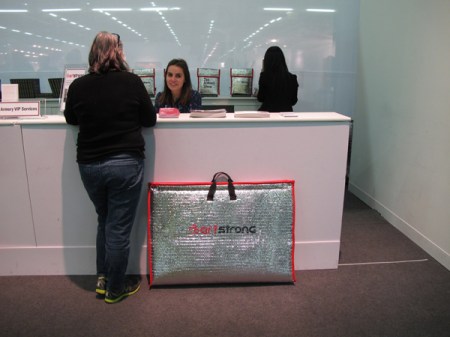
or you may find people wandering around the show as we did here at the contemporary ticket booth.

these bags are a great product filling a much needed demand in the art world. so if you’re considering purchasing a piece of art and want to carry it home safe and sound i would suggest you stop by and see what’s offered. after all we can’t be too careful of our loved ones can we?

i wonder who picked out the Art Strong model on their web site, must have been an interesting casting call at least.

oh well it’s nice to have fun and no animals were harmed writing this blog

jene youtt

Emmanuel Fremin Gallery at Scope 2012

March 10, 2012

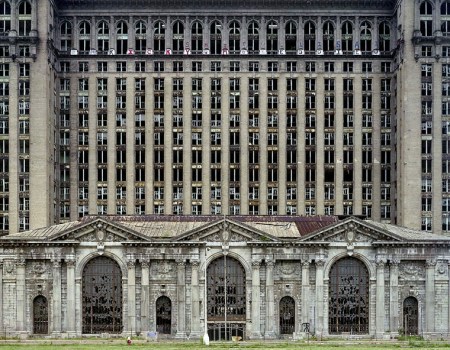
last night we visited Scope as part of Armory week and visited with Emmanuel Fremin who has a wonderful exhibit in his space. what attracted me the most, well i think of myself as a photographer, was his new association with Yves Marchand and Romain Meffre ” The Ruins of Detroit ” book and C prints. a gotta see, the prints are beautiful.

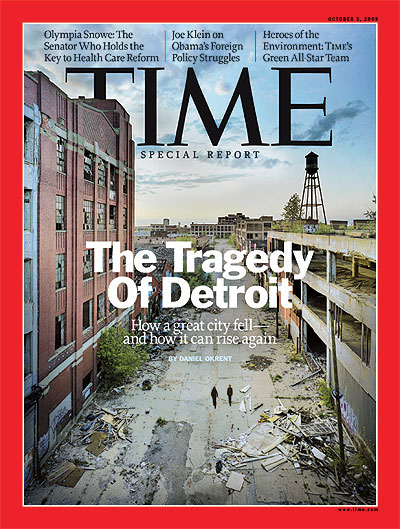
not to take anything away from the lovely oversized book which i’d love to have on my coffee table or bookshelves. this photographic essay of Detroit and it’s architectural fall from grace due to economic shenanigans is a serious comment on our lives and time. i remember the tragic  loss of New York’s  Pennsylvania Station to developers but this study of an American city Detroit which i first became aware of  in Time magazines coverage.

Time Cover

but the real tragedy is conveyed by the pictures which begin with the Michigan Central train Station.

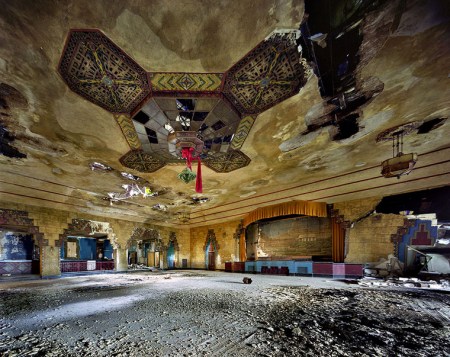
and you could say ends in a ballroom full with ghost of many memories

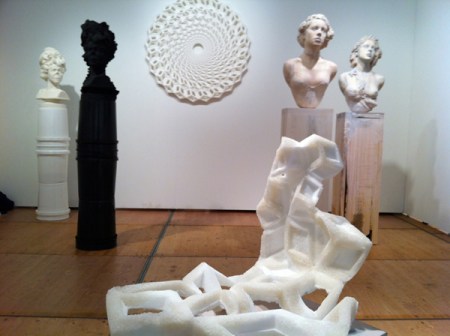
do stop by and see the prints and book, but wait there’s more also sculptures by Ted Lawson who works in salt, hard marble and other mediums

Entropy

That’s right there is still more from another artist working in unique and different mediums Fernando Mastrangelo

This too shall pass ( virgin mary )

made from Gunpowder, 13 rosaries, MDF, hemp, and automotive paint. while another piece in the show is made from

La Salva Mara ( santa muete )

Cremated human ash

the artist creates his work through a variety of materials, including sugar, coffee, corn, gunpowder, human cremated ash, and other controversial materials, Mastrangelo’s large scale sculptures often address social, cultural, and political issues relevant to the contemporary experience.most of the projects function as sculptural tableaus, and combine content, form and materials as a conceptual strategy.

this show along with his chelsea gallery and the selection of artist is one of the reasons i find emmanuel’s choices so interesting. i never know who or what i’ll find at his openings. so stop by Scope this weekend and say hello to this charming fellow.

Emmanuel Fremin

say Fuzzy sent you.

jene youtt