
happy new year
December 31, 2012
A Holiday treat….enjoy………………journey of the magi
December 23, 2012Journey of the Magi
‘A cold coming we had of it,
Just the worst time of year
For a journey, and such a long journey
The ways deep and the weather sharp,
The very dead of winter’.
And the camels galled,sore-footed,refractory,
Lying down in the melting snow.
There were times we regretted
The summer palaces on slopes, the terraces,
And the silken girls bringing sherbet.
Then camel men cursing and grumbling
And running away, and wanting their liquor and women,
And the night-fires going out, and the lack of shelters,
And the cities hostile and the towns unfriendly
And the villages dirty and charging high prices:
A hard time we had of it.
At the end we preferred to travel all night,
Sleeping in snatches,
With the voices singing in our ears, saying
That this was all folly.
Then at dawn we came down to a temperate valley,
Wet, below the snow line, smelling of vegetation,
With a running stream and a water –mill beating the
Darkness,
And three trees on the low sky.
And an old white horse galloped away in the meadow,
Then we came to a tavern with vine-leaves over the
Lintel,
Six hands at an open door dicing for pieces of silver,
And feet kicking the empty wine-skins.
But there was no information, and so we continued
And arrived at evening, not a moment too soon
Finding the place; it was (you may say) satisfactory.
All this was a long time ago, I remember,
And I would do it again, but set down
This set down
This: were we led all that way for
Birth or Death? There was a Birth, certainly,
We had evidence and no doubt. I had seen birth and
death,
But had thought they were different: this Birth was
Hard and bitter agnoy for us, like Death, our Death.
We returned to our laces, these Kingdoms,
But no longer at ease here, in the old dispensation,
With an alien people clutching their gods.
I should be glad of another death.
T.S Eliot
CNET reports facebook/instagram claims the right to sell user’s images without payment
December 18, 2012Instagram says it now has the right to sell your photos
In its first big policy shift since Facebook bought the photo-sharing site, Instagram claims the right to sell users’ photos without payment or notification. Oh, and there’s no way to opt out.

December 17, 2012 9:54 PM PST
Instagram said today that it has the perpetual right to sell users’ photographs without payment or notification, a dramatic policy shift that quickly sparked a public outcry.
The new intellectual property policy, which takes effect on January 16, comes three months after Facebook completed its acquisition of the popular photo-sharing site. Unless Instagram users delete their accounts before the January deadline, they cannot opt out.

Under the new policy, Facebook claims the perpetual right to license all public Instagram photos to companies or any other organization, including for advertising purposes, which would effectively transform the Web site into the world’s largest stock photo agency. One irked Twitter user quipped that “Instagram is now the new iStockPhoto, except they won’t have to pay you anything to use your images.”
“It’s asking people to agree to unspecified future commercial use of their photos,” says Kurt Opsahl, a senior staff attorney at the Electronic Frontier Foundation. “That makes it challenging for someone to give informed consent to that deal.”
That means that a hotel in Hawaii, for instance, could write a check to Facebook to license photos taken at its resort and use them on its Web site, in TV ads, in glossy brochures, and so on — without paying any money to the Instagram user who took the photo. The language would include not only photos of picturesque sunsets on Waikiki, but also images of young children frolicking on the beach, a result that parents might not expect, and which could trigger state privacy laws.
Facebook did not respond to repeated queries from CNET this afternoon. We’ll update the article if we receive a response.
Another policy pitfall: If Instagram users continue to upload photos after January 16, 2013, and subsequently delete their account after the deadline, they may have granted Facebook an irrevocable right to sell those images in perpetuity. There’s no obvious language that says deleting an account terminates Facebook’s rights, EFF’s Opsahl said.
Facebook’s new rights to sell Instagram users’ photos come from two additions to its terms of use policy. One section deletes the current phrase “limited license” and, by inserting the words “transferable” and “sub-licensable,” allows Facebook to license users’ photos to any other organization.
A second section allows Facebook to charge money. It says that “a business or other entity may pay us to display your… photos… in connection with paid or sponsored content or promotions, without any compensation to you.” That language does not exist in the current terms of use.
Google’s policy, by contrast, is far narrower and does not permit the company to sell photographs uploaded through Picasa or Google+. Its policy generally tracks the soon-to-be-replaced Instagram policy by saying: “The rights you grant in this license are for the limited purpose of operating, promoting, and improving our services.” Yahoo’s policies service for Flickr are similar, saying the company can use the images “solely for the purpose for which such content was submitted or made available.”
Reginald Braithwaite, an author and software developer, posted a tongue-in-cheek “translation” of the new Instagram policy today: “You are not our customers, you are the cattle we drive to market and auction off to the highest bidder. Enjoy your feed and keep producing the milk.”
One Instagram user dubbed the policy change “Instagram’s suicide note.” The PopPhoto.com photography site summarized the situation by saying: “The service itself is still a fun one, but that’s a lot of red marks that have shown up over the past couple weeks. Many shooters — even the casual ones — probably aren’t that excited to have a giant corporation out there selling their photos without being paid or even notified about it.”
 Instagram CEO Kevin Systrom speaks at the LeWeb conference in Paris. Click for larger image.
(Credit: Stephen Shankland/CNET)
Another unusual addition to Instagram’s new policy appears to immunize it from liability, such as class action lawsuits, if it makes supposedly private photos public. The language stresses, twice in the same paragraph, that “we will not be liable for any use or disclosure of content” and “Instagram will not be liable for any use or disclosure of any content you provide.”
Yet another addition says “you acknowledge that we may not always identify paid services, sponsored content, or commercial communications as such.” That appears to conflict with the Federal Trade Commission’s guidelines that say advertisements should be listed as advertisements.
Such sweeping intellectual property language has been invoked before: In 1999, Yahoo claimed all rights to Geocities using language strikingly similar to Facebook’s wording today, including the “non-exclusive and fully sublicensable right” to do what it wanted with its users’ text and photos. But in the face of widespread protest — and competitors advertising that their own products were free from such Draconian terms — Yahoo backed down about a week later.
It’s true, of course, that Facebook may not intend to monetize the photos taken by Instagram users, and that lawyers often draft overly broad language to permit future business opportunities that may never arise. But on the other hand, there’s no obvious language that would prohibit Facebook from taking those steps, and the company’s silence in the face of questions today hasn’t helped.
EFF’s Opsahl says the new policy runs afoul of his group’s voluntary best practices for social networks. He added: “Hopefully at some point we’ll get greater clarity from Facebook and Instagram.”
sometimes silence is all that crosses my lips
December 17, 2012to the children may you be children and remember to love every moment. hugs and kisses to all a good nite.
rip
Dancing around the Bride: Cage, Cunningham, Johns, Rauschenberg, and Duchamp….. in Philadelphia
December 13, 2012
At the Philadelphia Museum of Art
Dancing around the Bride: Cage, Cunningham, Johns, Rauschenberg, and Duchamp
October 30, 2012 – January 21, 2013
now this is where i want to be next month as this show sounds like just the place for me and my lovely wife mary. sounds like a wonderful experience. getting together that many artists in one place, even if it’s mostly the spirit of them conjures up a very special event. shivers be still. so i bought tickets for the january 12 showing leaving room to see more performances if we wanted to. i am really looking forward to this as i love the Philadelphia Museum, it’s a beautiful building.
 Bride, 1912
Marcel Duchamp, American (born France)
Oil on canvas
35 1/4 x 21 7/8 inches (89.5 x 55.6cm)
The Louise and Walter Arensberg Collection, 1950
1950-134-65
[ More Details ]
Oil on canvas
35 1/4 x 21 7/8 inches (89.5 x 55.6cm)
The Louise and Walter Arensberg Collection, 1950
1950-134-65
[ More Details ]
Dancing around the Bride: Cage, Cunningham, Johns, Rauschenberg, and Duchamp
October 30, 2012 – January 21, 2012
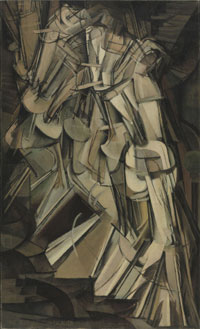
Live Dance Performances >> Dancing around the Bride is the first exhibition to explore the interwoven lives, works, and experimental spirit of Marcel Duchamp (American, born France, 1887–1968) and four of the most important American postwar artists: composer John Cage (1912–1992), choreographer Merce Cunningham (1919–2009), and visual artists Jasper Johns (born 1930) and Robert Rauschenberg (1925–2008). Creating both individually and together, they profoundly affected the direction of postwar avant-garde art and American culture as a whole. The exhibition tells of their multiple levels of engagement, focusing on the ways in which Cage, Cunningham, Johns, and Rauschenberg produced work inextricably linked to key aspects of Duchamp’s practice, such as the use of chance, the incorporation of everyday materials into their art, and the probing of the boundaries between art and life. With over eighty objects, stage sets, musical compositions, videos of dance, and live dance and music performances, the exhibition is organized as an environment in which visitors can explore the creative world of these artists and experience diverse aspects of their work firsthand. Duchamp’s celebrated painting Bride (1912) introduces to the exhibition a central character that would later become the protagonist of his masterwork The Bride Stripped Bare by Her Bachelors, Even (The Large Glass) (1915–23). The Bride served as a critical point of reference for Cage, Cunningham, Johns, and Rauschenberg, and their works that invoke the physical and conceptual figure of the Bride are brought together here for the first time. A potent example is Johns and Cunningham’s homage to Duchamp, Walkaround Time (1968), in which Johns’s décor replicates elements of the Large Glass and Cunningham’s choreography references different aspects of Duchamp’s oeuvre, including the mechanical movements of his Nude Descending a Staircase (No. 2) (1912)

Nude Descending a Staircase (No. 2), 1912
Marcel Duchamp, American (born France)
Oil on canvas
57 7/8 x 35 1/8 inches (147 x 89.2 cm) Framed: 59 3/4 x 36 3/4 x 2 inches (151.8 x 93.3 x 5.1 cm)
The Louise and Walter Arensberg Collection, 1950
1950-134-59
[ More Details ]
Oil on canvas
57 7/8 x 35 1/8 inches (147 x 89.2 cm) Framed: 59 3/4 x 36 3/4 x 2 inches (151.8 x 93.3 x 5.1 cm)
The Louise and Walter Arensberg Collection, 1950
1950-134-59
[ More Details ]
Dancing around the Bride unfolds in a series of four sections devoted to the Bride, to chance, to collaborations and performance, and to chess as a symbol of these rich exchanges. Envisioned collaboratively with contemporary artist Philippe Parreno (French, born 1964), the exhibition’s design allows for a variety of visitor experiences, from close examination of stationary works of art to timed sequences of videos, music, and live events occurring in the exhibition space, such as performances of Cunningham’s radical choreographies planned in concert with the Merce Cunningham Trust. A festival of Cage’s innovative music— presented by Philadelphia-based organization Bowerbird in conjunction with the Museum and in close consultation with the John Cage Trust—includes performances at the Museum and in other venues throughout the city. The artists of Dancing around the Bride created works that blurred the boundaries between art and life through a radical exploration of chance, collaboration, and interdisciplinarity—practices that have proven to be highly influential today. As the works of Cage, Cunningham, Johns, and Rauschenberg have never before been examined together in the context of their exchanges with Marcel Duchamp, the exhibition presents these artists in a new light, revealing their profound effects on one another and on the reinvention of art itself in the twentieth and twenty-first centuries.
Sponsors

The exhibition is made possible by The Pew Center for Arts & Heritage through the Philadelphia Exhibitions Initiative. Additional support is generously provided by the John S. and James L. Knight Foundation, The Women’s Committee of the Philadelphia Museum of Art, Glenstone, The Presser Foundation, the Dedalus Foundation, The Robert Saligman Charitable Foundation, Dr. Sankey V. Williams and Constance H. Williams, Dina and Jerry Wind, John Wind, Barbara B. and Theodore R. Aronson, Christie’s, Mary S. and Anthony B. Creamer, Jaimie and David Field, Lawrence Luhring and Roland Augustine, Seda International Packaging Group, Mari and Peter Shaw, Mr. and Mrs. Aaron Levine, Alice Saligman and Klaus Brinkmann, and other generous individuals. The exhibition is supported by an indemnity from the Federal Council on the Arts and the Humanities. Support for the accompanying publication is generously provided by Larry Gagosian. Special thanks to The Pew Center for Arts & Heritage through the Philadelphia Music Project, The Aaron Copland Fund for Music, Dina and Jerry Wind, and John J. Medveckis for their support of the festival Cage: Beyond Silence. Yamaha Disklavier Pianos courtesy of Jacobs Music Company and Yamaha Corporation of America. In-kind support for the sound system is provided by Meyer Sound. In-kind support for the exhibition is provided courtesy of Pilar Corrias, London, and the Leo Katz Collection, Bogotá, Colombia.
Curators
Carlos Basualdo, The Keith L. and Katherine Sachs Curator of Contemporary Art, in collaboration with Erica F. Battle, Project Curatorial Assistant, Modern and Contemporary Art
Location
Philadelphia Museum of Art, 2600 Benjamin Franklin Parkway
Philadelphia, PA 19130
Dorrance Special Exhibition Galleries, first floor
Hours
Mondays: Closed *
Tuesday through Sunday: 10:00 a.m.–5:00 p.m.
Friday evenings: 10:00 a.m.–8:45 p.m.**
here is a link to the new york times article discovering this exhibit http://www.nytimes.com/2012/12/07/arts/design/dancing-around-the-bride-at-philadelphia-museum-of-art.html
we are very excited because we just bought tickets to this event in january, looking forward to something very special.
police are routinely tracking cell phones……….. are you on the list?
December 9, 2012Police Are Using Phone Tracking as a Routine Tool
By ERIC LICHTBLAu
◦
WASHINGTON — Law enforcement tracking of cellphones, once the province mainly of federal agents, has become a powerful and widely used surveillance tool for local police officials, with hundreds of departments, large and small, often using it aggressively with little or no court oversight, documents show.
A GPS tracker. The Supreme Court recently ruled that such a device placed on a suspect’s car was an unreasonable search.
The practice has become big business for cellphone companies, too, with a handful of carriers marketing a catalog of “surveillance fees” to police departments to determine a suspect’s location, trace phone calls and texts or provide other services. Some departments log dozens of traces a month for both emergencies and routine investigations.
With cellphones ubiquitous, the police call phone tracing a valuable weapon in emergencies like child abductions and suicide calls and investigations in drug cases and murders. One police training manual describes cellphones as “the virtual biographer of our daily activities,” providing a hunting ground for learning contacts and travels.
But civil liberties advocates say the wider use of cell tracking raises legal and constitutional questions, particularly when the police act without judicial orders. While many departments require warrants to use phone tracking in nonemergencies, others claim broad discretion to get the records on their own, according to 5,500 pages of internal records obtained by the American Civil Liberties Union from 205 police departments nationwide.
The internal documents, which were provided to The New York Times, open a window into a cloak-and-dagger practice that police officials are wary about discussing publicly. While cell tracking by local police departments has received some limited public attention in the last few years, the A.C.L.U. documents show that the practice is in much wider use — with far looser safeguards — than officials have previously acknowledged.
The issue has taken on new legal urgency in light of a Supreme Court ruling in January finding that a Global Positioning System tracking device placed on a drug suspect’s car violated his Fourth Amendment rights against unreasonable searches. While the ruling did not directly involve cellphones — many of which also include GPS locators — it raised questions about the standards for cellphone tracking, lawyers say.
The police records show many departments struggling to understand and abide by the legal complexities of cellphone tracking, even as they work to exploit the technology.
In cities in Nevada, North Carolina and other states, police departments have gotten wireless carriers to track cellphone signals back to cell towers as part of nonemergency investigations to identify all the callers using a particular tower, records show.
In California, state prosecutors advised local police departments on ways to get carriers to “clone” a phone and download text messages while it is turned off.
In Ogden, Utah, when the Sheriff’s Department wants information on a cellphone, it leaves it up to the carrier to determine what the sheriff must provide. “Some companies ask that when we have time to do so, we obtain court approval for the tracking request,” the Sheriff’s Department said in a written response to the A.C.L.U.
And in Arizona, even small police departments found cell surveillance so valuable that they acquired their own tracking equipment to avoid the time and expense of having the phone companies carry out the operations for them. The police in the town of Gilbert, for one, spent $244,000 on such equipment.
Cell carriers, staffed with special law enforcement liaison teams, charge police departments from a few hundred dollars for locating a phone to more than $2,200 for a full-scale wiretap of a suspect, records show.
Most of the police departments cited in the records did not return calls seeking comment. But other law enforcement officials said the legal questions were outweighed by real-life benefits.
The police in Grand Rapids, Mich., for instance, used a cell locator in February to find a stabbing victim who was in a basement hiding from his attacker.
“It’s pretty valuable, simply because there are so many people who have cellphones,” said Roxann Ryan, a criminal analyst with Iowa’s state intelligence branch. “We find people,” she said, “and it saves lives.”
Many departments try to keep cell tracking secret, the documents show, because of possible backlash from the public and legal problems. Although there is no evidence that the police have listened to phone calls without warrants, some defense lawyers have challenged other kinds of evidence gained through warrantless cell tracking.
“Do not mention to the public or the media the use of cellphone technology or equipment used to locate the targeted subject,” the Iowa City Police Department warned officers in one training manual. It should also be kept out of police reports, it advised.
In Nevada, a training manual warned officers that using cell tracing to locate someone without a warrant “IS ONLY AUTHORIZED FOR LIFE-THREATENING EMERGENCIES!!” The practice, it said, had been “misused” in some standard investigations to collect information the police did not have the authority to collect.
“Some cell carriers have been complying with such requests, but they cannot be expected to continue to do so as it is outside the scope of the law,” the advisory said. “Continued misuse by law enforcement agencies will undoubtedly backfire.”
Another training manual prepared by California prosecutors in 2010 advises police officials on “how to get the good stuff” using cell technology.
The presentation said that since the Supreme Court first ruled on wiretapping law in 1928 in a Prohibition-era case involving a bootlegger, “subtler and more far-reaching means of invading privacy have become available to the government.”
Technological breakthroughs, it continued, have made it possible for the government “to obtain disclosure in court of what is whispered in the closet.”
In interviews, lawyers and law enforcement officials agreed that there was uncertainty over what information the police are entitled to get legally from cell companies, what standards of evidence they must meet and when courts must get involved. A number of judges have come to conflicting decisions in balancing cellphone users’ constitutional privacy rights with law enforcement’s need for information.
In a 2010 ruling, the United States Court of Appeals for the Third Circuit, in Philadelphia, said a judge could require the authorities to obtain a warrant based on probable cause before demanding cellphone records or location information from a provider. (A similar case from Texas is pending in the Fifth Circuit.)
“It’s terribly confusing, and it’s understandable, when even the federal courts can’t agree,” said Michael Sussman, a Washington lawyer who represents cell carriers. The carriers “push back a lot” when the police urgently seek out cell locations or other information in what are purported to be life-or-death situations, he said. “Not every emergency is really an emergency.”
Congress and about a dozen states are considering legislative proposals to tighten restrictions on the use of cell tracking.
While cell tracing allows the police to get records and locations of users, the A.C.L.U. documents give no indication that departments have conducted actual wiretapping operations — listening to phone calls — without court warrants required under federal law.
Much of the debate over phone surveillance in recent years has focused on the federal government and counterterrorism operations, particularly a once-secret program authorized by President George W. Bush after the Sept. 11 attacks. It allowed the National Security Agency to eavesdrop on phone calls of terrorism suspects and monitor huge amounts of phone and e-mail traffic without court-approved intelligence warrants.
Clashes over the program’s legality led Congress to broaden the government’s eavesdropping powers in 2008. As part of the law, the Bush administration insisted that phone companies helping in the program be given immunity against lawsuits.
Since then, the wide use of cell surveillance has seeped down to even small, rural police departments in investigations unrelated to national security.
“It’s become run of the mill,” said Catherine Crump, an A.C.L.U. lawyer who coordinated the group’s gathering of police records. “And the advances in technology are rapidly outpacing the state of the law.”
December 5, 2012
it’s always nice to hear what others are thinking. i first saw steve’s work at at our first Friends Without A Border auction a few years ago. he had donated a book of his fine art prints to raise money for the charity, lovely work, fwab just ended their 15 annual one last night, hopefully with a fist full of dollars.

 Steve McCurry, a professional photographer and author of several photography books, shares his reasons for why he blogs on WordPress.com. His iconic photo, Afghan Girl, graced the cover of National Geographic and was named one of the 100 Best Pictures of the magazine. McCurry has been recognized with some of the most prestigious awards in the industry, including the Robert Capa Gold Medal, National Press Photographers Award, and an unprecedented four first prize awards from the World Press Photo contest, to name a few.

You are a world-famous photographer. Why do you blog?
Steve: Who would even dream 20 years ago that we would even have the internet? Clearly the internet is changing the landscape of publishing, news, and entertainment. There are countless channels on television, infinite content on the internet, and stimuli literally everywhere we turn. . . . There is so much competition. My blog is just my way of…
View original post 536 more words
News from the Jose Limon company, Moor’s Pavane
December 4, 2012yes news from one of my favorite dance companies and dancer. Clay Taliaferro who is an old time friend of mine from the company. I watched him perform the ‘The Moor’s Pavane’ many many times while we were with the company along with Carla Maxwell the current artistic director. So their ‘Pavane’ is burned into my brain, the turn of the wrist or an arabesque making it very hard for me to watch others dancers perform this dance. yes i’ve watched others perform this Pavane and have tried to love their version of the Pavane because it’s really Jose’s dance, which i’ve never seen him perform it other than on film. but for me it’s always clay, carla, jennifer and lewis who i compare others to.
Isn’t memory a funny thing, just when you think you’ve got it nailed down off it goes?
i did see Erik Bruhn dance the Pavane at St Johns cathedral in NYC, what a lovely setting, years later i gave my program away to a friend of mine whom it ment so much to.
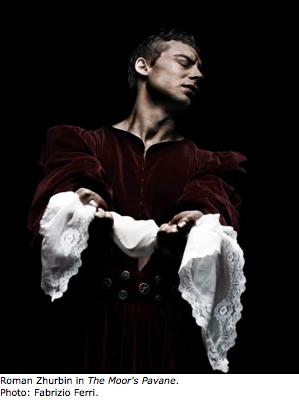
In the last newsletter we told you that four companies licensed The Moor’s Pavane, one of José Limón’s most famous pieces, to be performed at the same time: American Ballet Theater in New York City; SjDANCEco in San Jose, CA; The Staatsballett in Munich, Germany; and Ballet Nice Méditerranée in Nice, France.
Clay Taliaferro worked to restage the ballet on American Ballet Theater, which was performed on October 17 at Lincoln Center. “In preparation for the remount of ‘The Moor’s Pavane’ I research the work using personal notes I’ve taken over the years of having been directed as a dancer, talk with former dancers of the roles being taught, watch videos of former rehearsals and performances, and physically revisit the movement in question”, says Taliaferro when asked how he goes about translating Limón’s choreography. Clay also advises that dancers should never “mark” the movement while learning it, and that the “new” dancer should know something about José Limón and the work that is being learned.
Taliaferro also spoke about some of the challenges he faced as a dancer. He said, “the single most important challenge for me in taking on the role of Moor (beyond all its technical, stylistic needs) was to maintain the work’s integrity in the mining and refining process of finding myself in the role, and to take care not to imitate José Limón in the role”.
News, performances and projects
| What’s going on? | |
|
Dec 2012
|

| Othello Project | |
|
Limón Dance Company and Teatro Stage Fest launched the Othello Project in October, a program focusing on two classic masterpieces; Shakespeare’s play Othello and José Limón’s classic modern dance The Moor’s Pavane. The intention of the program, supported by the National Endowment for the Arts, is to introduce high school students to the creative tools choreographers and playwrights use to tell a story and to show how a great work of art can remain relevant through the ages when the source material still speaks of the human experience. As the project continues look out for photos and videos! |
Friends Without A Border Photography Auction…. to benefit the Angkor hospital for Children
November 28, 2012 12/04/2012
During a series of photography trips to Cambodia’s Angkor Wat monuments, internationally acclaimed photographer Kenro Izu was deeply affected by his encounters with often ill, malnourished, and disfigured children. As a symbol of his gratitude for the profound artistic inspiration he received from Cambodia’s historical treasures, Izu committed himself to building a pediatric hospital to provide desperately needed healthcare for its children…its future.
Friends Without A Border (Friends), a non-profit organization, was founded by Izu in 1996 to manage the project. With the help of an international board of healthcare professionals, the art community, and over 5,000 supporters worldwide, Friends opened Angkor Hospital for Children (AHC) in 1999.
Since its inception the art community has been a vital source of support for Friends and AHC. An integral part of this relationship has been the Friends of Friends Photography Auction, first held in 1997. In the years since, hundreds of artists and their representatives have generously donated their work to the auction, the proceeds from which directly support AHC and its many programs.
During the past fourteen years the auction has raised nearly $2 million, including $175,000 in 2010. In Cambodia, where almost half of the population lives on a little more than $1 a day, every dollar goes a very long way. We hope that this year’s event will be even more successful.
When and Where
Tuesday, December 4, 2012
6:00 – 7:00 pm: Cocktail Reception, Silent Auction, and Preview of Live Auction Lots
7:00 – 8:30 pm: Live Auction (The Silent Auction runs through the entire evening and
ends 10 minutes after the conclusion of the Live Auction.)
Metropolitan Pavilion
123 West 18th Street (between 6th Avenue and 7th Avenue)
5th Floor, The Level
New York, NY 10011
Map/directions
Auctioneer: Nicholas Dawes, VP, Special Collections, Heritage Auctions, New York
Décor: Megumi/sono.ei, Brooklyn, NY
Hors d’oeuvres provided by: Saffron 59
All proceeds benefit Angkor Hospital for Children in Siem Reap, Cambodia, Friends Without
A Border’s new health initiative in Luang Prabang, Laos, and other Friends programs that support high-quality healthcare for children in Southeast Asia.
Here is a link to the Live auction Prints [lot 1 to lot 31] and the silent auction ones here [ lots S33 to S 160] where Mary Durante Youtt  print
print

and my Phantom print shown here.
Special Print: Created for Friends Without A Border
It is our pleasure to present this limited-edition print, generously donated by Wendy Sacks on the occasion of the 15th Annual Friends of Friends Photography Auction.
The print is now available prior to the auction.

Seeing Things
Seeing Things
From the series Monsters in the Closet
by Wendy Sacks
Price $500 (tax-deductible portion $480)
Edition of 15
Pigment print
Year of work: 2012
Image size 12 x 7 7/8″ on 14 x 11″ paper,
presented in 17 x 14″ 4-ply mats
Signed and editioned by the artist in pencil on the recto
Embossed with Friends Without A Border stamp
Prints courtesy of www.LumierePhoto.com.
Artist’s Statement on the Series
A child’s ordinary bedtime routine is often times incomplete without the parent’s feigned search for the scary monsters that lurk under the bed and in the closet, accompanied by the comforting reassurance that every dark crevice is vacant of evil. All too often however, such a reassurance is not entirely true. Real monsters don’t hide in the closet. They hide at the bedside under the guise of a guardian and blur their violence or anger under the pretense of love, discipline, or trust. Monsters in the Closet depicts how child abuse is veiled from society by the fog of lies abusive parents tell to their children, themselves, and to the world.
Purchase of a special limited-edition print also includes admission to the auction, a paddle number, and a copy of the auction catalog.
For further information about the work of the photographer please visit: www.wendysacksphotography.com
Special Portfolio [Lot 32] by James Whitlow Delano
Imagining Asia: Two Decades On
A collection of ten pigment prints. Foreword by Syunichi Nishiyama, Founder and President
of Mado-sha Publishing, Tokyo, Japan. All of the prints are matted and presented in a hand-crafted double wall drop spine box, covered in elegant bookbinding cloth and foil-stamping on the cover. See link here.
 |
 |
 |
 |
 |
 |
 |
 |
 |
 |
Various image sizes printed on 11 5/8 x 16 1/2″ paper, matted with 16 x 20″ boards
Printed in 2012
Signed, titled, dated and editioned by the artist in pencil on the verso
Embossed with Friends Without A Border stamp on each print
Edition no. of portfolio 1/2 with artist proof prints from edition of 10, prints are edition of 25
Estimate $8,000
Donated by the artist
Portfolio courtesy of Cloverleaf Studio
Foreword to the Portfolio
Every time I see photographs, I always ponder about the neutral relationship between the artwork and its artist. I realize that, in a search for the true value, I should separate the artist from the artwork and evaluate the art purely on its own merit.
James Whitlow Delano is a photojournalist. Yet, as far as viewing the images from his portfolio and his book titled “I viaggi di Tiziano Terzani,” I cannot help thinking that he is a poet of gentle spirit who loves travel and respects people and nature deeply, more than simply a photojournalist. The photographs are certainly documents; however, his images appear to me more than simple documents. The reason why I am attracted to his photographs is because of this mysterious experience of the senses.
Scenes from remote villages and towns in Asia, monasteries and fields in confined mountains, or portraits of ordinary citizens living in harsh environments, people with hopes and innocent children, and grandiose sceneries of steep mountains; every image appears to me as if a microcosm beyond the reality or a piece of poem. From his photographs, I can even hear the sound of time, smell the scent of landscape, and see the color of people’s hearts. The agony, sadness, anger, happiness or joy of people, who spend their whole life where they were born, echoes as a quiet song. Before I know it, I am invited to a place he must have once been and drawn into another world beyond that spot.
His images make me aware that there must have been different realities than the moment the photographer captured and fixed them within a frame using his five senses. I can imagine a different setting just a few feet away to the left or right, or an entirely different atmosphere five seconds before or ten minutes after. Such imagination and association are rarely induced by documentary photographs. His images must possess a magical power to be remembered, and that is why his images are difficult to forget once you have seen them.
Upon every gaze, I get the sensation of traveling to unknown places and of experiencing something new. Jorge Luis Borges once said, “Thus, it might be said that poetry is a new experience every time. Every time I read a poem, the experience happens to occur. And that is poetry.” I experience what Borges experiences from poems through looking at James’ photographs. That is the very reason that I can’t help but think that his photographs are poems and that he is a poet.
Syunichi Nishiyama
Founder and President, Mado-sha Publishing
Tokyo, October 2012
About the Artist
Based in Tokyo, Japan, since 1993, James Whitlow Delano has photographed throughout Asia, Latin America and Africa. He balances his time between magazine assignments, projects on social issues, and creating fine-art images.
Delano is drawn to Asia because it does not turn away a stranger, who moves on instinct with a Leica camera. “I have lived several lifetimes in two decades without beginning to quench my curiosity.”
His finely-crafted black and white images have been extensively exhibited throughout Europe, North America, Asia and Australia, and is in the collections of Museum of Fine Arts Houston, Museum of Photographic Arts, La Triennale di Milano Fine Arts Museum, and Museo Fotografia Contemporanea. His work regularly appears in publications such as the New York Times Magazine, Newsweek, GEO, and Time, among many others. Delano has been cited with the Alfred Eisenstadt Award from the Columbia University Graduate School of Journalism/Life Magazine, NPPA’s Best of Photojournalism, Leica’s Oskar Barnack, and Picture of the Year International, among others.
Protein Folding, Nova Science now………. a redeeming television presentation
November 24, 2012the other week i was watching Nova Science now when this segment came on which i found fascinating so i’d though i’d share it with you guys. i realize this isn’t about art or photography but i though it’s so cool, and there is a game attached. so heres the main Science Daily article below then the link to Fold It web page here. think you can beat a ninth grader doing this?
ScienceDaily (Nov. 22, 2012) — Fifty years after scientists first posed a question about protein folding, the search for answers has led to the creation of a full-fledged field of research that led to major advances in supercomputers, new materials and drug discovery, and shaped our understanding of the basic processes of life, including so-called “protein-folding diseases” such as Alzheimer’s, Parkinson’s and type II diabetes.
In an article in Science, Stony Brook University researchers reviewed the progress on a 50-year-old puzzle called the Protein Folding Problem. Ken Dill and Justin MacCallum of Stony Brook’s Louis and Beatrice Laufer Center for Physical and Quantitative Biology show how a community of scientific researchers rose to tackle a grand-challenge problem of very basic science that had no obvious payoff at the time.
“Protein folding is a quintessential basic science. There has been no specific commercial target, yet the collateral payoffs have been broad and deep,” the researchers said in their paper, The Protein Folding Problem, 50 Years On.

whole protein
“We have learned that proteins fold rapidly because random thermal motions cause conformational changes leading energetically downhill toward the native structure, a principle that is captured in funnel-shaped energy landscapes. And thanks in part to the large Protein Data Bank of known structures, predicting protein structures is now far more successful than was thought possible in the early days. What began as three questions of basic science one half-century ago has now grown into the full-fledged research field of protein physical science.”

folded up puzzle
This year marks the 50th anniversary of the 1962 Nobel Prize in Chemistry awarded to Max Perutz and John Kendrew for their pioneering work in determining the structure of globular proteins. That work laid the foundation for structural biology, which interprets molecular level biological mechanisms in terms of the structures of proteins and other biomolecules. Their work also raised the question of how protein structures are explained by physical principles.
Since Perutz and Kendrew discovered the structures of two proteins, nearly 80,000 protein structures have been discovered. The protein folding “problem” arose when Perutz and Kendrew were unable to make sense of how the folded structure of the protein molecule was related to its sequence of bead types. Ever since then, there has been great interest in understanding the protein-folding “code”: how does a given string of amino acids lead to a particular balled-up (“native”) structure of a protein?
Proteins are molecules that perform the basic functions in biological cells — converting food to growth, to repairing DNA molecules and damaged cell parts, to motion in muscles, to transduction of signals in the brain and light in the eye, for example. Humans have about 20,000 different types of protein molecules. Each performs a different function. The abilities of proteins to perform such a broad array of powerful chemical functions arise from a peculiar principle of chemical structure and function, namely the folding of each protein. A protein is miniature string of beads, like a pearl necklace, where the bead-like component pieces are called amino acids. Amino acids come in 20 different types. The folding principle is that different sequences of amino acids strung together cause different protein molecules to ball-up in very specific, but different, ways, giving rise to their very different functionalities.
The protein folding problem became a set of three inter-related puzzles: What is the folding code? How does the protein find its one native structure in fractions of a second inside the cell (the needle-in-a-haystack problem)? And: Can we make a computer method that can discover new structures of proteins from the large number of amino acid sequences that are now known?
Dill, Director of the Laufer Center and Distinguished Professor of Physics and Chemistry, and MacCallum, a junior fellow at the Laufer Center, describe how huge advances have been made on all three fronts. They detail some very important collateral payoffs of this work that was completely unanticipated at the time, including the development of the IBM Blue Gene computer and distributed-grid computing, computer-based methods for discovering new pharmaceuticals, a deeper understanding of molecular mechanisms in biology, a deeper understanding of the inter-atomic interactions inside proteins (that has also involved Stony Brook Laufer Center researchers Carlos Simmerling, David Green, and Rob Rizzo), and a new class of very promising polymer materials called “foldamers.”
Dill and MacCallum argue that what started out as one compelling question of basic science has now become an entire field of theoretical and experimental approaches in which many questions are now leading to a few answers and many more questions.
other links:
New Insights To the Function of Molecular Chaperones

 Fuzzypictures's Weblog