Archive for the ‘Photography’ Category

hoboken art walk and studio tour 2012,

November 12, 2012

you can flood the city, fill the path tunnels with water, ruin almost everyones weekend without power but art walks go on.  mary and i will be showing our work at the hoboken nj art walk and studio tour at the Monroe Center, 720 Monroe Street, Hoboken NJ on Sunday November 18, 2012 from noon to 6pm.

if you’re in the neighborhood do stop by and say hello.

be there or be square

jene

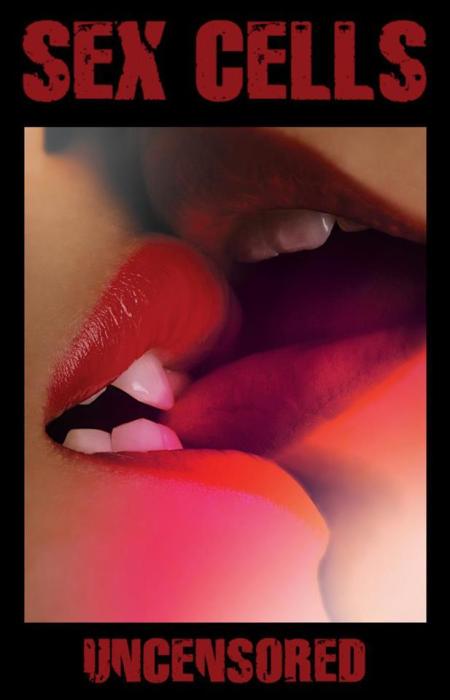
Sex cells and here at Emmanuel Fremin gallery it’s on or off the walls

June 14, 2012

“Sex Cells” at Emmanuel Fremin Gallery
Curated by Asli Unal

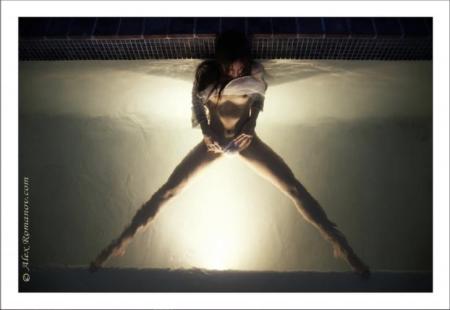
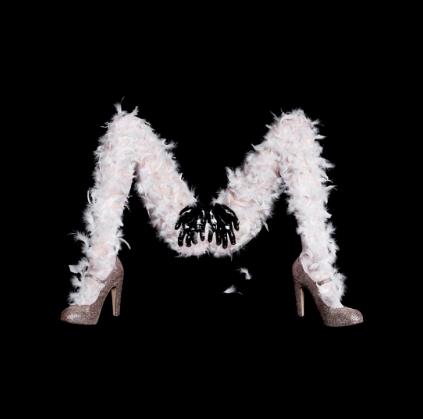
The most universal subject of art through the ages, the human nude has been a vehicle for commercialization, a symbol of freedom, and a topic of heated debate. In “Sex Cells,” eig…ht contemporary photographers explore how we direct sex appeal, both consciously and unconsciously, as a means of empowerment and manipulation. From the provocative to the grotesque, the featured artists combine familiar props and subjects in an original manner as they tackle themes of seduction, bondage, religion and bestiality. A reception on Thursday night, June 28th, kicks off the month long exhibition at the Emmanuel Fremin Gallery.


Reka Nyari’s jarring compositions juxtapose lust and disgust by pairing a beautiful model with animal carcasses. Her stark compositions present the objectified body as a target for consumption and challenge the viewer’s ability to hold two opposing emotions simultaneously. Using herself as the model, Brooklyn artist Erica Simone poses nude in public while unabashedly going about her daily routines. Simone wittily challenges the nature of the nude in art, examining the line between the mundane and the sexualized. The context tells us to interpret her as the subject of the photographs rather than the object of a sexual fantasy.

“Sex Cells” is on display from June 28th-July 28th, 2012 at the Emmanuel Fremin Gallery, 547 West 27th Street, Suite 508, New York, NY 10001.
Vernissage: June 28th, 6-8 p.m.

Cindy Sherman knows all the world loves a clown

January 9, 2012

The Museum of Modern Art Announces a Retrospective of Cindy Sherman for 2012

artwork: Cindy Sherman - Untitled #425, 2004 - Chromogenic color print, 70 3/4 x 89 3/4" (179.7 x 228 cm). - Courtesy the artist and Metro Pictures, New York - © 2011 Cindy Sherman

NEW YORK, N.Y.- The Museum of Modern Art will present the exhibition Cindy Sherman, a retrospective survey tracing the groundbreaking artist’s career from the mid 1970s to the present, from February 26 through June 11, 2012. The exhibition will bring together more than 170 key photographs from a variety of the artist’s acclaimed bodies of work, for which she created myriad constructed characters and tableaus. The first comprehensive museum survey of Sherman’s career in the United States since 1997, it will draw widely from public and private collections, including the collection of The Museum of Modern Art. The exhibition is organized by Eva Respini, Associate Curator, Department of Photography, The Museum of Modern Art.

art knowledge news

jene

Exciting new developments in computational photography may render aperture irrelevant

January 4, 2012
Tuesday, August 16, 2011

Misinformation: Camera Tech

Exciting new developments in computational photography may render aperture irrelevant

By David Willis
In early July, researchers at Cornell University were able to develop a lens-free camera that’s literally pinhead-sized.At 100th of a millimeter thick and one-half a millimeter on each side, the microscopic camera uses no lenses or moving parts, and is said to cost pennies to manufacture. Affectionately dubbed the Planar Fourier Capture Array, the “camera” is a flat piece of silicon that looks like a tiny compact disc, and each pixel is able to capture a vital piece of imaging information that can be combined computationally into a single image.

Myth: Losing Focus Is A Bad Thing

The term “camera” is vague in that all it implies is a device that’s able to capture images and, in general, store them. As digital technology advances and computers become more and more intrinsic to the photographic process, even this broad definition is going to be put to the test. A new technology from Lytro, for instance, allows you to adjust the vital focus of an image after it already has been taken. The camera’s core concept is based around the “light field,” which is comprised of all of the rays of light in a scene. Rather than funneling two-dimensional light rays through a lens and sandwiching them to a camera’s sensor, the Lytro camera takes these light rays and then projects them to a sensor that includes an incredibly efficient microlens array. Lytro is introducing a new file format (.lfp), and the camera includes an interior “light field engine” that works in concert with desktop software to produce “Living Pictures” that maintain multiple focusing points throughout the image.

Once browsers have adopted the format, these images also will carry the necessary information for adjusting focus as they’re shared online. With their first field camera, Lytro is promising an instant shutter without lag, both 2D and 3D capabilities in a single image and taken with a single lens (sort of), a continuously focusable image (discounting motion blur), and better low-light sensitivity because the camera takes all of the light in a scene from all angles. Not surprisingly, their first release is planned to be a point-and-shoot device for consumers, without video, and available by the end of the year. From Lytro’s site: “Relying on software rather than components can improve performance, from increased speed of picture taking to the potential for capturing better pictures in low light. It also creates new opportunities to innovate on camera lenses, controls and design.”

Particularly for action, event and reportage photographers, the implications for photography are enormous, even perhaps allowing for multiple focal points in an image without the need for extensive postprocessing stacking of multiple exposures. The technology, however, isn’t new. In fact, researchers have been aware of light-field theory for three-quarters of a century, and light-field rendering of 2D images from 4D information even was suggested by Marc Levoy and Pat Hanrahan in 1996. A German company called Raytrix actually has had plenoptic light-field cameras available for purchase for nearly a year, offering similar possibilities at a somewhat larger price. Adobe also has been experimenting with a plenoptic camera that takes a three-dimensional image utilizing a grouping of specially configured lenses that combine multiple captures into one behemoth, 100-megapixel image.

There are a lot of thoughts online about how this technology could, or could not, change the field of photography as we know it. Plenoptics removes many of the physical limitations of a lens, including lens aberrations, missed focus and the binding relationship between depth of field and aperture. Removing focus (and, to an extent, aperture) from the image equation has broad implications, however, culminating in the concept that you could theoretically place a camera anywhere, fire it remotely, make changes on a computer and remove the photographer from the image-taking process entirely. Of course, you can do that already. Whether through focus stacking of multiple exposures or software options that give you extensive control over bokeh, these options are already available to photographers and clients. Regardless, removing focus doesn’t necessarily remove the photographer. A camera, no matter how advanced, is just a tool. A photographer is someone who knows how to wield that tool effectively.

reprint from Digitalphotopro

 Jene

Emmanuel Fremin Gallery is pleased to announce its grand re-opening 1/5/12

January 4, 2012

EXHIBITION: INDEPENSENSE by GIUSEPPE MASTROMATTEO

Emmanuel Fremin Gallery  is pleased to announce its grand re-opening in
its new, larger Chelsea space located at  547 West 27 Street, suite 508.
The gallery first vernissage will be held on January 5, 2012 from 6-8 PM,
introducing a 5 week solo show for Italian born artist Giuseppe
Mastromatteo
for his “Indepensense” series. Following a wide acclaim
reception in 2011 at Art Hamptons, the AAF, Greenwich Art Fair and Red Dot
Miami, this will be be the first solo show for Giuseppe in the United
States.

Giuseppe Mastromatteo was born in Italy in1970 . After a period spent as a
recordist’s assistant inside a record company, he graduated from Accademia
di Comunicazione di Milano in art direction. He writes about the Arts,
teaches Advertising at various significant academic institutions, and
collaborates with the Triennale Museum of Milan in the role of art
director. Since 2005 his works have been exhibited at the Fabbrica Eos Art
Gallery, Milan as well as at national and international art fairs. He
currently lives and works in Milan.

Mastromatteo’s portraits bring poetic Surrealism back to life. They could
be collages, but take advantage of the subtlety of digital technology to
reproduce humanity in impossible and illusory dimensions. Ripped faces,
eyes and ears which run through hands, are the centre of an imaginary truth
that draws inspiration from the visions of Magritte and Man Ray to land
inside a new visual synthesis with stylistic patterns representing the most
contemporary photography of our time, in a continuous overlapping of visual
languages that live in the world of advertising and genuine research.
Backgrounds are white, the light homogeneous: nothing averts the detailed
expressions in the characters of this silent and fascinating theatre of the
absurd. Transfigured bodies, pierced and lacerated do not show any form of
violence, but instead pose solemnly in front of the photographer=92s lens,
beyond any suffering. No expression exists in these faces, there is no
tension, but rather a sense of timelessness that leaves us open to reflect
about the uncertainty of this third millennium. The observer’s eye is
immediately attracted by the extravagance of these creatures, which at the
same time produces a true sense of discomfort and uneasiness. Mastromatteo
intervenes in the interior sense of beauty. The models he chooses for his
images bring to the stage classic canons of harmony and equilibrium
creating a complex dialectict between fascination and repulsion. From here
the evident sensation emerges of discovering oneself in front of a Pantheon
where every possibility of self identification is precluded. A universe
unto itself is the object of aesthetic contemplation and intriguing
reverence, magnified by the means with which this is all narrated because
photography continues to maintain a link with an indissoluble reality of
facts. The process of recognition inherent in portrait photography appears
as something distant. Physiognomy comes to light only to recover the
aesthetic detail of our time. Reality and fiction appear as outdated ideas
with full attention focusing on memory. As a conclusion, in order to bring
together feelings and fragments of this project, photography in itself
seems not enough and becomes something more, transforming into a metaphor
of itself, reaching the final objective of communicating through other
forms and channels.

Denis Curti.

Emmanuel Fremin Gallery
547 West 27 Street suite 508, New York, NY 10001
646.245.3240

Challenging the Forces of Xenophobia with Art, one picture at a time

December 26, 2011


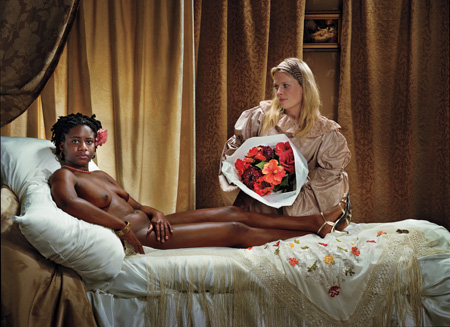
Jan Banning's 'National Identities' project includes his version of Manet's 'Olympia' Painting

With a new series of images called “National Identities,” Dutch photographer Jan Banning re-creates works by Old Masters with a multicultural twist as a means of challenging the rising forces of xenophobia in Europe. His version of Vermeer’s “Girl Reading a Letter at an Open Window” (c. 1657) for instance, features a young Muslim woman wearing a headscarf, reading by a closed window. A proud Turkish laborer posed for his recreation of Rembrandt’s 1654 portrait of the artist’s friend and patron, Jan Six. And his homage to Manet’s “Olympia” (c. 1863) switches the black and white subjects of the original, so the nude woman is black and the lady-in-waiting is white.

“By doing this, I question the concept of homogeneous ‘national identities’ of European countries,” Banning writes in Newsweek International, which recently published the images. Banning, who is himself the son of immigrants to the Netherlands, explains to PDN that “[Anti-immigration parties] are stressing the importance of national culture all over Europe. The idea is that immigrants should adapt to [European] cultures, or they should get out.

”

On his Web site, Banning reminds readers that during the Dutch golden age of the 17th century, “the percentage of immigrants was about the same as it is now.” Not only were many proletarians from foreign countries, but so were various men of arts and letters, including Descartes and Spinoza.

Banning says he got the idea for his project five or six years ago when he was studying the work of various Enlightenment painters. Looking at the work of Vermeer in particular, he says, “It struck me that so many of the women in his paintings are wearing scarves.” He recalled how his mother, a Christian, wore a headscarf to church services when Banning was a boy. But now, he says, scarves are the lightning rod of debate and a symbol of “other” because Muslim women wear them. “People are making such a fuss,” he says.
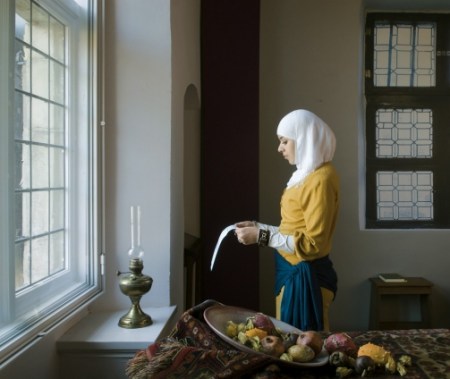
Jan Banning's version of Vermeer’s “Girl Reading a Letter at an Open Window” (c. 1657)

That led to his first piece in the series, showing a Muslim girl reading an application for a citizenship course by a window. The challenge was finding a location that matched the scene of the original Vermeer. After looking at 25 possibilities, Banning came upon a suitable room inside a museum for religious art near his home in Utrecht. The subject of the photograph is the daughter of his long-time housekeeper, who is Moroccan. “She is very modern, and a practicing Muslim,” Banning says. The image seems to dare Western viewers to deny her culture—and humanity—without casting a shadow over their own.

“His creative solution to addressing the hypocrisy in the right wing’s position on immigration in Europe is brilliant,” says Newsweek senior photo editor Jamie Wellford.
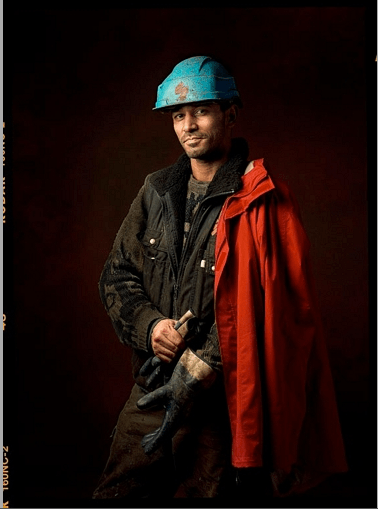
Jan Banning's Turkish Turkish laborer posed for his recreation of Rembrandt’s (c 1654)

Banning says he struggled for months over the symbols and meanings of the original paintings before recreating them. “I didn’t want to do this in a superficial way,” he says. “I really wanted to grasp the ideas of the original paintings.

”

The “Olympia” work presented several challenges, both technical and symbolic. Switching the black and white subjects was the easy part. But what, he wondered, was the importance of the expression of the original “Olympia”? What was the significance of the cat? And of the dog, in an earlier Titian painting that Manet’s painting referenced? Banning eventually figured out that the dog signified the naked subject’s loyalty, while the cat signified just the opposite. But, what animal to put in his own image as an international symbol? A hawk, he thought, “could be kind of absurd.” So he ended up choosing a mouse (look closely) to symbolize his subject’s vulnerability, in a political sense.

At first, he tried to imitate the lighting of the Manet painting. “I got pretty close, but once you transpose that [painting] to photography, it becomes very boring,” he says. (He ended up using lighting that was far less flat.) Banning also discovered that a barely noticeable opening in the curtain behind the servant in the Manet painting was not trivial. “I thought, let’s leave it out. But then I found it was hard to balance the composition without it.” (He included the opening, adding a reproduction of a small Rembrandt painting in the gap.)

Banning says the image still needs work. “I’m not happy with the mouse. I’m OK with the idea of the mouse, but I didn’t get the particular mouse that I wanted. I also have my doubts about the clothing of the white woman in the background, and maybe the expression could be better,” he says.

It’s a painstaking project, and because of the effort he has to put into each image, he expects to create only two or three more. Currently he’s planning an image of the Annunciation, for which he is now studying many different renditions. He also decided to release the first images before the series is complete, because xenophobia is a pressing issue right now. “My idea is to use it in a political context. I didn’t want to wait,” he says.

Asked about the danger that political messages pose to the integrity of artistic works, Banning says, “Of course I’ve been wondering: Is this simply propaganda? I don’t think it is. At least that is my hope. I have no problem putting messages in my work that are commenting about society, and raising questions. What I try to stay away from is suggesting a one-dimensional solution to things.”

By David Walker for Photo District News
Musée de l’Elysée suspends Prize in wake of censorship of Palestinian artist

December 22, 2011


.

Photo from an exhibition of works by Larissa Sansour: Ex-Terrestrial, Kulturhuset, Stockholm. 23 October 2010 – 13 February 2011. (http://www.larissasansour.com)

Introduced in 2010 to support young photographers, the prestigious €25,000 Lacoste Elysée Prize is awarded by the Swiss Musée de l’Elysée in Lausanne Switzerland, with sponsorship from Lacoste, the clothing brand.

The Musée de l’Elysée has decided to suspend the organisation of the Lacoste Elysée Prize 2011 in response to the decision of the organizers to exclude the work of Palestinian artist Larissa Sansour’s work.

Sansour was among eight finalists shortlisted for the 2011 prize

Eight nominees for the 2011 prize were selected to take part in the contest, and asked to produce three photographs on the theme la joie de vivre.

With the help of a grant of €4,000, each nominee had “carte blanche” to interpret the theme how they saw fit, whether directly or indirectly. The nominees were free to make a submission based upon their existing work or as an entirely new project.

An expert jury was scheduled to meet at the end of January 2012 to select the winner of the Lacoste Elysée Prize 2011.

Larissa Sansour was among the eight artists shortlisted for the 2011 prize. In December 2011, sponsor Lacoste demanded that Sansour’s nomination be revoked. Lacoste stated their refusal to support Sansour’s work, describing it as “too pro-Palestinian.”

In November 2011, three photos from Sansour’s ‘Nation Estate’ project were accepted, and she was congratulated by the prize administrators for her work and professionalism. Sansour’s name was subsequently included in all literature relating to the prize and on the website as an official nominee. Her name has since been removed, however, and her project was withdrawn from an upcoming issue of contemporary art magazine ArtReview introducing the nominated artists.

Sansour was asked to approve a statement saying that she voluntarily withdrew her nomination “in order to pursue other opportunities.” Sansour refused to agree to such a statement.

Sansour says, “I am very sad and shocked by this development. This year Palestine was officially admitted to UNESCO, yet we are still being silenced. As a politically involved artist I am no stranger to opposition, but never before have I been censored by the very same people who nominated me in the first place. Lacoste’s prejudice and censorship puts a major dent in the idea of corporate involvement in the arts. It is deeply worrying.”

Sansour’s multimedia project ‘Nation Estate’ was “conceived in the wake of the Palestinian bid for UN membership. Nation Estate depicts a science fiction-style Palestinian state in the form of a single skyscraper housing the entire Palestinian population. Inside this new Nation Estate, the residents have recreated their lost cities on separate floors: Jerusalem on 3, Ramallah on 4, Sansour’s own hometown of Bethlehem on 5, etc.

Sansour’s shortlisted work, ‘Nation Estate,’ conceived in the wake of the Palestinian bid for UN membership, is a multimedia science fiction project that imagines a future Palestinian state in the form of a skyscraper. The single skyscraper houses the entire Palestinian population, with residents recreating their lost cities on separate floors.

Sansour from Bethlehem is a prominent Palestinian artist and filmmaker. Her most recent film, ‘A Space Exodus,’ was nominated for the short-film category at the Dubai International Film Festival

The Musée de l’Elysée has announced its suspension of the 2011 Prize and has offered to exhibit ‘Nation Estate’ outside the framework of the prize and Lacoste’s sponsorship.

originally reported in ahramonline

more on Larissa Sansour rejection at Artinfo or see her web site larissasonsour for more info on her.

American artist Cindy Sherman Awarded the 2012 Roswitha Haftmann Prize

December 17, 2011


ZURICH.- The Board of the Roswitha Haftmann Foundation has awarded the 2012 Roswitha Haftmann Prize – worth CHF 150,000 – to the American artist Cindy Sherman (born 1954). Sherman is one of the leading exponents of staged photography. She uses mostly herself – her own body – as her model; yet the concept underlying her work is anything but self-referential. She has reinvented role photography. Her roleplay, which begins in the studio as a performance, ultimately reaches its audience in the form of a photograph. Her works transcend the boundaries of the exhibitionistic, and are all the more provocative because they are not intended to be viewed as self-portraits. Rather, through her alternating roles, Sherman parodies stereotypical representations of womanhood and explores the meaning of female identity in a male-dominated society. She investigates the processes of physical, psychological and sexual repression and the taboos that surround them, depicting them in the form of sometimes garish, overdrawn ‘reproductions’.

artwork: Cindy Sherman - The Monstrous Feminine Untitled # 205 Private CollectionSherman references the techniques and forms of advertising, cinema and classical painting, but moves freely within these creative parameters. Her initial breakthrough came with a series of black and white photographs created between 1977 and 1980: the ‘Untitled Film Stills’ seemingly emulating images from Italian Neo-Realism and American film noir. They were followed by her first photo series in colour that dealt with the issue of sexual objectification, in which prosthetic limbs and mannequins were her preferred props. Later came the ‘History Portraits’ that replicated the composition of celebrated paintings easily recognizable to the viewer, as well as series on topics such as Hollywood and clowns.

Sherman draws her audience into conflict-laden situations. The individual identity that she presents is confronted with a collective sub-conscious, artificial beauty with natural brutality. Sherman’s particular talent lies in her ability at once to attract and repel the viewer with works that are both profoundly unsettling and enduringly fascinating. In the opinion of the Roswitha Haftmann Foundation jury, she is the leading artist of filmic and photographic self-exploration after Andy Warhol. It is in recognition of these artistic achievements that she has been awarded the Roswitha Haftmann Prize.

PRIZEWINNER AND AWARD CEREMONY
Cindy Sherman was born in Glen Ridge, New Jersey in 1954. She studied painting at the State University College in Buffalo, New York and, during that time, also began working with photography. Her first important work, ‘Bus Riders’ (1976), was created while she was still a student.

She currently lives and works in New York. Her works appear in the collections of some of the world’s most prestigious art museums, not only in the US but also in Europe and, indeed, Mexico and Israel. Cindy Sherman is the twelfth artist to receive Europe’s most valuable art prize and the fourth woman to do so, after Maria Lassnig, Mona Hatoum and Vija Celmins . The award, worth CHF 150,000, will be presented on 10 May 2012 at the Kunsthaus Zürich.

artwork: Courtesy of Cindy Sherman and Metro Pictures - Untitled #462 (2007-8) From the Cindy Sherman “Untitled (Balenciaga) Series


SPECIAL ACCOLADE FOR HARUN FAROCKI

The Prize was originally the initiative of Roswitha Haftmann (1924-1998), whose Foundation has awarded it since 2001 to a living artist who has created an oeuvre of outstanding quality. The winner is chosen by the Foundation Board, which includes the directors of the Kunstmuseum Bern , the Kunstmuseum Basel, the Museum Ludwig in Cologne and the Kunsthaus Zürich as well as other members co-opted by the Board. The deed of foundation provides for the jury to award special prizes at its discretion. It has now chosen to do so for the third time, and is bestowing on film director Harun Farocki a prize of CHF 75,000.

Author, lecturer and filmmaker Harun Farocki was born in 1944 in what is now the Czech Republic and from 1966 to 1968 studied at the German Film and Television Academy in Berlin, where he now lives. He has established a reputation as a film critic and screenwriter and has completed more than 100 productions since 1966, predominantly documentaries, essay films and story films. Many of the works he has created since 2000 have been shown in exhibitions and museums ranging from the São Paulo Art Biennial to documenta 12. He curates exhibitions for art societies and museums. The Bourdelle Muse

jene

originally published in Art Knowledge News

3rd edition of The Julia Margaret Cameron Award

December 8, 2011

for Women Photographers

Professional and non professional women photographers from all countries. On this occasion there will be only one section: pro and non-pro will be juried together.

Deadline:
   December 30th, 2011, at 11:59pm PST

Jurors:   Amber Terranova and Dina Bova.

Amber Terranova is the photo editor for Photo District News. She worked previously for New York magazine and Outside. She holds a BFA in photography from the School of Visual Arts, Manhattan. Amber has assisted with programming at Center, a Santa Fe-based non-profit organization that supports photographers. Her taste in photography tends toward emerging and established artists with strong personal projects, surprising content and evidence of political or social engagement. She’s most drawn to introspective, provocative work.

Dina Bova was born in Moscow and currently lives in Israel. Her images have been awarded in Px3, Hasselbald Masters, Sony Awards, 1st edition of the JMCA, Nikon, PDN’s World in Focus, and have won 21 Gold medals in international photo-contests under FIAP/PSA patronage in USA, Austria, France, England, Croatia, Ukraine, Taiwan and Israel. Her art is a world of allegories, metaphors and multifaceted associations. She thinks that it’s not important how an artist creates his work. It can be created with any tool and any medium, but it should speak for itself and convey a very special mood. It should need no explanation, no elaboration and no apologies. It can be very aesthetic or the opposite of it. For Dina, the most important thing  is freeing the imagination.

Award:
The Julia Margaret Cameron Award will be given to 12 women photographers which will be invited to exhibit (and sell) their work in a very selective collective exhibition in Paris during 2013, honoring one hundredth year of the birth of Robert Capa, co-founder of Magnum Photos and famous war photojournalist. WPGA will take care of the framing and matting, as well as all gallery expenses. Exhibitors will receive 40% of the sales, 20% will be reserved for the gallery/organizers, and 40% will be donated to a charitable organization selected by the awardees.A catalog will be printed, and all 12 awardees will receive one free copy.

Categories:
Portraits
Landscapes and Seascapes
Street Photography and Cityscapes
Fine Art
Nude and Figure
Documentary and Editorial

Only Single images will be accepted; no portfolios in this edition.

Announcement :

March 8th, 2012 (honoring the International Women’s Day, observed for the first time on 28 February 1909 in United States; proclamed in 1977 by the United Nations General Assembly as the UN Day for Women’s Rights and International Peace; and marked in 2011 by President Barack Obama as the International Women’s Day to reflect “the extraordinary accomplishments of women” in shaping the country’s history”  — and we expect this award will reflect the extraordinary accomplishments of women in picturing the human emotions, the nature, the current affairs, and the beauty that surround as well as calling for action to end with the conflicts and poverty in this troubled world.)

Entry Fees:      $40 for the first 3 images; $10 each additional image

ENTER Here

Angkor Hospital for Children, Friends Without A Border photography auction

December 2, 2011

Don’t forget this worthy photography auction viewing Monday December 5, 2011 at The Tenri Cultural Institute of NY, 43A W 13th Street, NYC, showcase hours 7-9pm. Stop by and meet the artist mary and i and see our lovely prints,. heck just stop by some very good stuff to see, maybe make new friends.


Friends Without A Border has collected 44 beautiful prints taken by artists from all over the world and made them available to you online this holiday season. The proceeds from the auction will support Angkor Hospital for Children and associated programs.

The online auction will run from November 25- December 18th.

How can I bid?

Prints are available to view online before the auction goes live by clicking on this link http://www.biddingforgood.com/FWAB. The online auction will go live from November 25- December 18th.


How can I see the prints in person?

If you live in the New York area, We will showcase the prints at Tenri Cultural Institute of NY, 43A West 13th Street, NY, New York (between 5th and 6th Avenues), on December 5th from 7-9pm.

This event is free and open to the public. If you or your friends are in the New York area, we hope to see you there!

Please e-mail rsvp@fwab.org to RSVP or with any inquiries.

Our annual Friends of Friends Photography Auction will be back in 2012.