| Written by Ann Levin, Associated Press |
Thursday, 26 August 2010 02:13
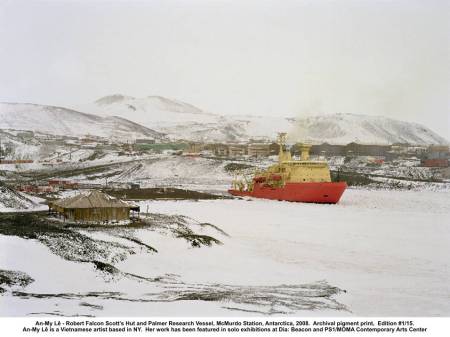 Robert-Falcon-Scotts-Hut |
|
NEW YORK, N.Y. – The Museum of Modern Art’s photography collection is so rich that it can present virtually the entire history of the medium using only images taken by women and in many cases, of women. It’s instructive to realize that whatever genre or style in which men worked, even industrial photography, women were doing the same. The show is organized chronologically, beginning with a gallery of 19th and early 20th century photographs that illustrate the two traditions of documentary and pictorial photography. For much of photography’s 170-year history, women have expanded its roles by experimenting with every aspect of the medium.Pictures by Women: A History of Modern Photography presents a selection of outstanding photographs by women artists, charting the medium’s history from the dawn of The show continues with a stunning array of photographs by European artists in the 1920s and 1930s, including Ilse Bing’s 1931 “Self-Portrait in Mirrors,” which shows her looking straight at the viewer and in profile at the same time, an illusion made possible by using her camera as a third eye. the modern period to the present. Including over two hundred works, this exhibition features celebrated masterworks and new acquisitions from the collection by such figures as Diane Arbus, Berenice Abbott, Claude Cahun, Imogen Cunningham, Rineke Dijkstra, Florence Henri, Roni Horn, Nan Goldin, Helen Levitt, Lisette Model, Lucia Moholy, Tina Modotti, Cindy Sherman, Kiki Smith, and Carrie Mae Weems, among many others. The exhibition also highlights works drawn from a variety of curatorial departments, includingBottoms, a large-scale Fluxus wallpaper by Yoko Ono. The most compelling in the first category is a series of photos taken by Frances Benjamin Johnston at the all-black Hampton Institute (now Hampton University), founded to educate former slaves. At the other end of the spectrum are the self-conscious, artistic photographs by Gertrude Kasebier, known for her symbolic, soft-focus images of Victorian motherhood such as the 1899 “The Manger” and 1904’s “The Heritage of Motherhood.” And since the art world seems to be having a Picasso moment, with major shows in museums and galleries and the record-breaking sale of one of his paintings at auction, be sure to look at an untitled work from 1930 by Picasso’s lover and muse Dora Maar, a highly regarded artist in her own right. It shows a woman from the rear with her long black coat lifted up in the wind. The show continues with a stunning array of photographs by European artists in the 1920s and 1930s, including Ilse Bing’s 1931 “Self-Portrait in Mirrors,” which shows her looking straight at the viewer and in profile at the same time, an illusion made possible by using her camera as a third eye. 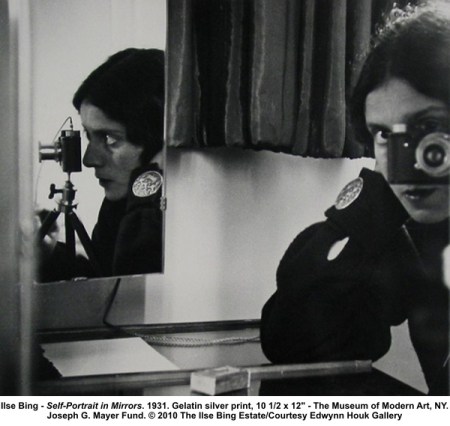 Ilse-Bing-Self-Portrait-New You’ll also want to spend time in front of two prints by French photographer Germaine Krull, whose beautifully composed images of urban landscapes show that women could do muscular photographs of architectural structures as well as any man. Although Dorothea Lange is among the best-known U.S. photographers, male or female, the curators have rightly devoted an entire wall to almost 20 of her photographs, all the subjects girls and women. They range from her iconic Depression-era picture “Migrant Mother, Nipomo, California” to the poignant image of Japanese-American children saying the pledge of allegiance soon after President Roosevelt ordered the relocation of 120,000 Japanese-Americans into grim camps in the West. The mid-to-late 20th century is represented by MoMA’s newly acquired colour photographs of New York street life by Helen Levitt, best known for her work in black and white, and uncomfortable but affecting images by Austrian-born Lisette Model and Diane Arbus. Witty wallpaper just outside the entrance shows close-ups of human buttocks, reproduced from a 1960s-era film made by Yoko Ono. The images look vaguely human up close but resolve into a pillowy abstraction when seen from a distance. And as you leave the show, “29 Palms: Mortar Impact,” a large, black-and-white photograph by Vietnamese-American photographer An-My Le, depicts a few clouds of smoke rising from the barren desert floor, framed by the distant peaks of a rugged mountain range. It suggests the bleakness of war, hints at U.S. engagement in Iraq, and in its simplicity and clarity, is a work of stunning beauty. The sixth gallery of the exhibition will close on Aug. 30, and the other five will remain on view through 21 March, 2011. Visit on the Net: http://www.moma.org/ |
Archive for the ‘photography exhibits’ Category
MoMA presents “Pictures by Women – A History of Modern Photography
August 26, 2010more Keira Grant nudes
August 17, 2010sometimes i make myself sick doing things and not really paying attention to what i am doing. well so far that’s exactly what i’ve been doing today.
first mistake is having missed the PDN digital contest which closed monday. I had a very nice image i wanted to submit but needed to clean it up a bit. oh well, lets move on to today where i wanted to go through the Keira Grant shoot

keira grant
and send some images she has requested but these images she’s never seen so this is also for her as much as it is for you

keira thinking
i retouched 7 images. had to move a open eye to one of them which i liked better than the closed eye she had in that take. so time to resize them and save for the web. i have an photoshop action for that, to save me time. well i ran the action thinking it would save the jpegs to my desktop and i’d drag and drop where i wanted them later.
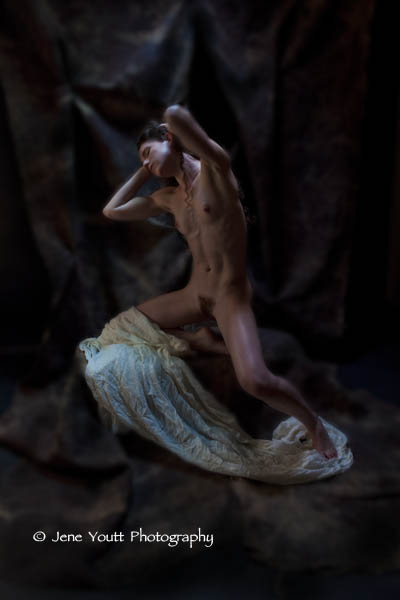
keira streching
what i really did was resize the tiffs and save them as tiffs and not jpegs. so now i have some small tiffs which are useless and small jpegs which i can use for the web. ugh
making myself more work instead of less. what do they say ‘ if i didn’t have bad luck i’d have no luck at all’

keira praying
maybe this is what i should be doing to the Adobe gods, i wonder if it would really help? this old agnostic probably would get hit by lightning.

waiting for the gift
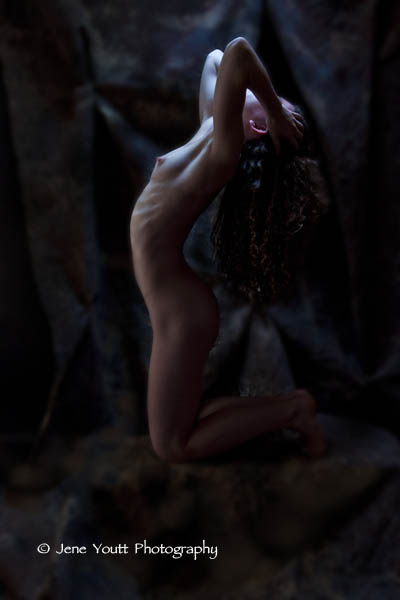
angel wings flapping

i can’t hear myself thinking because the sun is streaming in here through the window telling me to go outside.
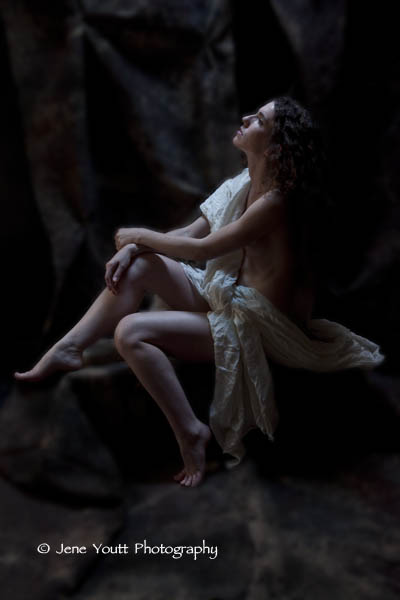
keira sitting
so what i need to do is just finish this posting up and move on to finding car parts as the xr7 money pit has gone to the paint shop and begin shooting the wedding rings so invitations can get designed and go out in the mail.
Richard Avedon’s Lively Fashion Images at the Museum of Fine Arts, Boston
August 12, 2010Richard Avedon’s Lively Fashion Images at the Museum of Fine Arts, Boston
Written by Vincent Baldino
Wednesday, 11 August 2010 01:53
BOSTON, MA.- Richard Avedon (1923–2004) was the man who brought fashion photography to life. Instead of perpetuating static images of human mannequins posing stiffly in magazines, Avedon depicted his models as real women whose energy and exuberance complemented their modern lifestyles. Considered one of the great image-makers of the 20th century, he redefined fashion photography and his lasting contributions are explored in the traveling exhibition Avedon Fashion 1944–2000, a major retrospective devoted exclusively to his work in this medium. On view in the Foster Gallery at the Museum of Fine Arts, Boston (MFA), from August 10, 2010, through January 17, 2011, the exhibition highlights approximately 140 objects, including photographs, magazines, engravers’ prints, and contact sheets that span almost six decades of his successful career.

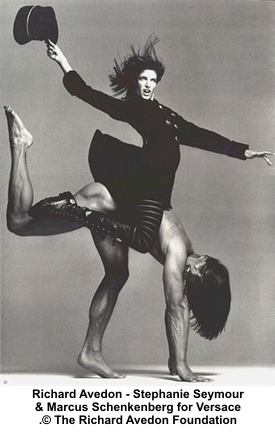
Richard-Avedon-Seymour-Versace
Avedon Fashion 1944–2000 examines Avedon’s years as a photographer who helped shape the image of the fashionable woman, drawing from thousands of pictures he took as staff photographer for Harper’s Bazaar and Vogue. It unfolds by decade, with the greatest emphasis on the classic work from the 1950s and 1960s, when Avedon’s distinct vision of the ideal American woman revolutionized magazine photography.
“Richard Avedon was one of the greatest photographers of all time, who forever transformed the way we look at fashion. The MFA is delighted to be able to showcase his supremely stylish and important work,” said Malcolm Rogers, Ann and Graham Gund Director of the Museum of Fine Arts, Boston.
Richard Avedon – Veruschka, dress by Kimberly, New York, January 1967. – © Richard Avedon FoundationThe exhibition begins with elegant, romantic, and lively images taken in Paris, where he visited extensively from 1947 to 1965 on assignment for Harper’s Bazaar.

Richard-Avedon-Veruschka
Despite the bleakness of the post-war years, Paris still represented the height of sophistication, and Avedon infused his photographs with a sense of optimism, helping the City of Light reclaim its position as the capital of the fashion world. The photographer created imaginative narratives—sometimes continued through several issues of the magazine—highlighting couture collections and featuring his favorite models: Dorian Leigh, her sister Suzy Parker, Sunny Harnett, Dovima, Carmen, Elise Daniels, and even his wife, Doe Avedon. He took these smartly outfitted women out of the studio and photographed them in French locales: Daniels, dressed in a Balenciaga suit, watching street performers in the Marais district in 1948; Harnett, in an evening dress by Grès, playing roulette at the Casino in Le Touquet, France, in 1954; and Parker, draped in a Grès gown, sitting near cancan dancers at the Moulin Rouge in 1957. Avedon’s famous night scenes in Paris, which began in 1954, broadened his creative range. Like movie sets, the complex fashion shoots he directed used generators to light up entire city blocks, allowing him to capture stylish bon vivants enjoying Parisian nightlife.
During his early years at Harper’s Bazaar, fashion photographs by Avedon were more than just a vehicle to market luxurious clothing to post-World War II American women—they were the embodiment of a dynamic lifestyle. His expressive images celebrated spirited women laughing, jumping, and dancing—even roller skating in Paris—all while wearing the most beautiful clothes.
“Those candid snapshots were in direct contrast to what was being done. I came in at a time when there weren’t any young photographers working in a free way. Everyone was tired, the war was over, Dior let the skirts down, and suddenly everything was fun. It was historically a marvelous moment for a fashion photographer to begin. I think if I were starting today, it would be much harder,” said Avedon in 1965.
The son of a women’s clothing store owner (Avedon’s Fifth Avenue), Avedon became fascinated with fashion photography as a boy. As a young man, he joined the Merchant Marine (1942–44), where he was assigned to the photography division. After leaving the service, Avedon enrolled in design classes at the New School for Social Research taught by Alexey Brodovitch, the art director of Harper’s Bazaar. In 1944, at age 21, Avedon joined the magazine, primarily as a photographer for Junior Bazaar. Shortly thereafter, he became an official staff photographer, working with the now legendary figures Carmel Snow, Brodovitch, and Diana Vreeland.
During the height of his career, Avedon became fashion photography’s most influential and prolific practitioner. His style was energetic and playful, with a flair for the dramatic, and while Avedon’s location shoots were groundbreaking, his major studio shots were also ingeniously inventive. The photographer illustrated the excitement of the “new look” of Dior—featuring cinched waists and voluminous circle skirts—by showing his model twirling on a Parisian street (Renée, “The New Look of Dior,” Place de la Concorde, Paris, August 1947). He developed the “Avedon blur” using variable focus, a technique creating a subtle background scene while highlighting the model in the foreground, as seen in an image of a well-turned ankle showing off a fur-trimmed bootie in front of the softly visible Eiffel Tower (Shoe by Perugia, Place du Trocadero, Paris, August 1948). Avedon also liked to show models “behind-the-scenes”—sitting at a café, seemingly in tears (Elise Daniels, turban by Paulette, Rue François-Premier, Paris, August 1948); assessing an outfit in the mirror (Dorian Leigh, evening dress by Piguet, Helena Rubenstein’s apartment, Île Saint-Louis, Paris, August 1949); or shown within the backdrop of a studio set (Suzy Parker, evening dress by Dior, Paris, August 1956). In many of his photographs, dogs and other animals share center stage with the models—Dovima in a Balenciaga suit and Sacha, an afghan, sitting next to one another outdoors at the Café des Deux Magots, Paris (1955), or Dovima in a Dior evening dress, shown alongside elephants at the Cirque d’Hiver (1955)—one of the photographer’s many iconic images.
Avedon was one of the most engaging image-makers of the 20th century. He revolutionized fashion photography with his dynamic images that set an ideal of the modern American woman. His enormous success led to great fame, and the status he attracted helped define the role of the high-profile fashion photographer that we are familiar with today,” said Anne Havinga, the MFA’s Estrellita and Yousuf Karsh Senior Curator of Photographs, who is responsible for the show in Boston with Emily Voelker, the MFA’s Estrellita and Yousuf Karsh Assistant Curator of Photographs. The exhibition was curated by Carol Squiers, curator, and Vince Aletti, guest curator, for the International Center of Photography (ICP), in conjunction with The Richard Avedon Foundation, New York.
Richard-Avedon-Stephanie-Seymour
Avedon’s innovative approach enlivened the vocabulary of fashion photography, and even made him famous. The 1957 movie musical Funny Face is loosely based on Avedon, who served as the visual consultant for the production. Starring Fred Astaire as “Dick Avery,” a photographer working in New York and Paris, it co-starred Audrey Hepburn as his muse, a model chosen for her spirit and intelligence. Avedon’s own models were not only beautiful, but also embodied the idealized American woman, who had wit, personality, confidence, and a sense of adventure. They also reflected Avedon’s awareness of social and cultural changes. He was the first major photographer to use models of color, such as China Machado, a Portuguese-Chinese beauty he featured in the 1950s, or Donyale Luna, a sinewy model of African, Mexican, Egyptian, and Irish descent he worked with in the 1960s. His images elevated many of his models to celebrity status, especially in the 1960s and ’70s, when he worked with Jean Shrimpton, Lauren Hutton, Anjelica Huston, Twiggy, Penelope Tree, and Veruschka. In the 1980s and ’90s, his photographs helped bring supermodel fame to Kate Moss, Naomi Campbell, and Stephanie Seymour.
Avedon Fashion 1944–2000 includes a wide range of photographs that document the 1960s era, when advances in technology and demands for social reform became part of the evolving modern American experience. Among them are Avedon’s pictures of models wearing the “mod” fashions of the period at Cape Canaveral near an Atlas missile, or in the spacesuit-inspired fashions of André Courrèges, as seen in the famous April 1965 Harper’s Bazaar, the magazine’s 20th anniversary edition, which Avedon guest edited. The cover featured a Pop Art-inspired photograph by Avedon of Shrimpton in a day-glo pink helmet—the same photograph that appears on the cover of the exhibition’s catalogue, Avedon Fashion 1944–2000 (Abrams, New York, 2009). The photographer also embraced changing social mores with his forays into imagery that included nudity, or were discreetly erotic, as seen in his depiction of a suggested “ménage a trois” (Natty Abascal and Ana-Maria Abascal with model Helio Guerreiro, bathing suit by Brigance, Ibiza, Spain, September 1964).
In 1966, Avedon joined Vogue, where Vreelend had become its editor-in-chief. He captured the youthful brashness of the 1960s and turned Brooke Shields, Isabella Rossellini, and Barbra Streisand into fashion icons. With Vreeland’s approval, he also sought out quirky, unconventionally beautiful models, such as the wide-eyed waifs Penelope Tree and Twiggy, for his compelling photographs featuring Pop Art and “mod”-inspired fashions. Avedon’s work was included in most issues of Vogue until the mid 1970s. Vreeland was dismissed from the magazine in 1971, but Avedon stayed on, taking every cover photograph after 1980 until he quit in 1988. Avedon also photographed many imaginative advertising campaigns during his long career for clients including Versace, Calvin Klein, and Dior. In 1992, he was named the first staff photographer for The New Yorker, where his post-apocalyptic, wild fashion fable “In Memory of the Late Mr. and Mrs. Comfort,” featuring model Nadja Auermann and a skeleton, was published in 1995. In these later years, Avedon continued to contribute to Egoïste, a journal of fashion and the arts, where his photographs appeared from 1984 through 2000. He also pursued his own work as a portraitist, photojournalist, and the author of photography books until his death in 2004. His innovations are still evident in portraiture and fashion photography today.
Visit the Museum of Fine Arts, Boston at : http://www.mfa.org/
posted from Art KnowledgeNews
Library of Congress Places William P. Gottlieb’s Iconic Jazz Images on Flickr
August 4, 2010Washington, DC – In the late 1930s, a Golden Age of Jazz started to emerge, as hard economic times began to fade
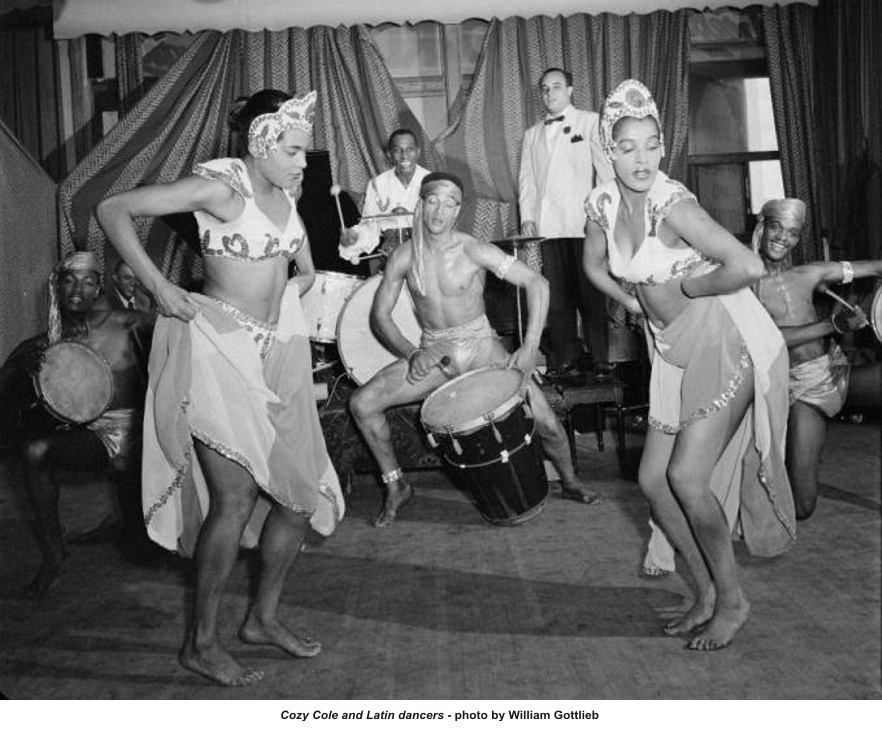
Cozy-Cole-Latin-Dancers
Airwaves were pulsating with jazz and record sales were rising. Legends like Billie Holliday, Louis Armstrong, Duke Ellington, Charlie Parker, Dizzy Gillespie, Ella Fitzgerald, Frank Sinatra, and many more were on the scene – and so was William P.Gottlieb.Equipped with a bulky Speed Graphic camera, Gottlieb, a young columnist for the Washington Post and later a writer for Down Beat magazine, photographed jazz musicians and performers, capturing classic images that are well-known today. Gottlieb photographed the jazz greats from 1938 to 1948.
Yousuf Karsh 100 ” A Biography In Images “
July 20, 2010Yousuf Karsh 100 ” A Biography In Images ” to open at the Museum of Fine Arts, Boston
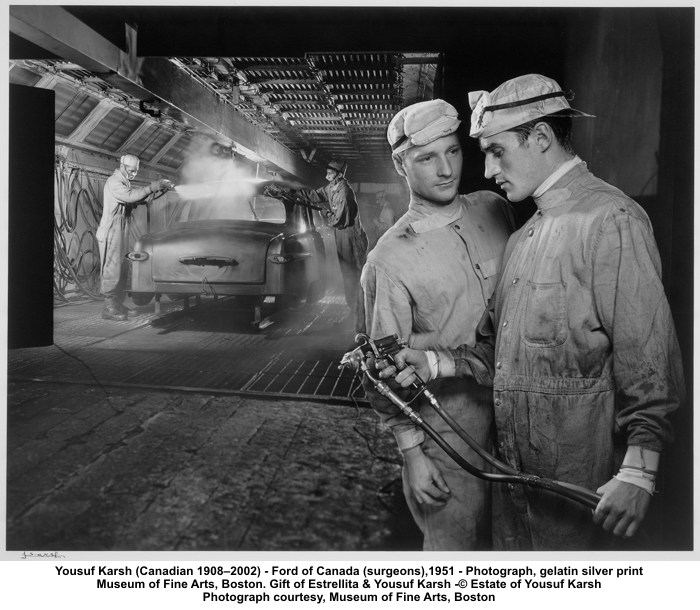 Yousuf Karsh (Canadian 1908–2002) – Ford of Canada (surgeons),1951 – Photograph, gelatin silver print Museum of Fine Arts, Boston. Gift of Estrellita & Yousuf Karsh -© Estate of Yousuf Karsh Photograph courtesy, Museum of Fine Arts, Boston
BOSTON, MA – The legacy of Yousuf Karsh. . the man behind the lens of some of the 20th century’s most famous photographic portraits is illuminated as the Museum of Fine Arts, Boston (MFA), presents Karsh 100: A Biography in Images.
The exhibition of more than 100 works celebrating the 100th anniversary of Karsh’s birth (1908) presents his iconic portraits of the era’s most illustrious faces alongside rarely seen earlier photographs and little-known work. Karsh 100 will be on view September 23, 2008, through January 19, 2009, in the Rabb Gallery at the MFA. This exhibition is generously supported by the Government of Canada through the Consulate General of Canada in Boston.
art hampton’s update
July 12, 2010well busy weekend for sure. first it was driving out to the Hampton’s, route 27 is no picnic as traffic has been jammed on it for years and this past thursday was no exception. but we made it in time, mary always is punctual while i am a bit lax on time, as we were staying with a friend whom had invited us for dinner after the special preview.

mary checking in
seems like most of the surrounding towns people showed up, some colorful characters as the invitation said casual business attire.
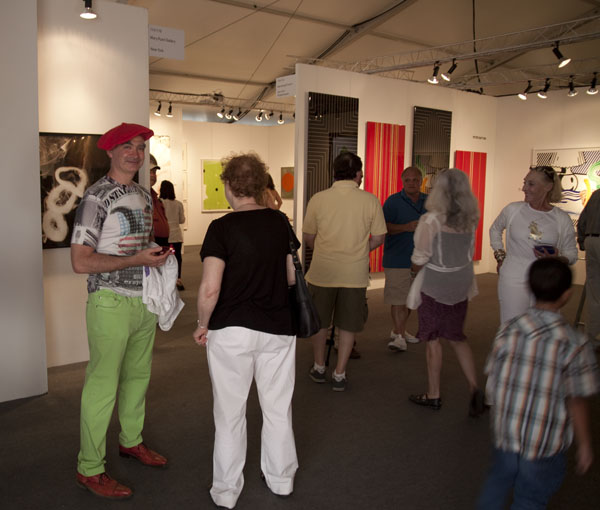
characters
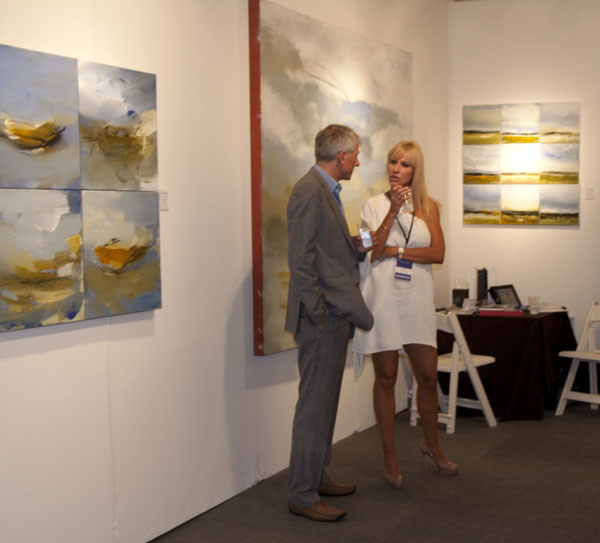
more art patrons

sailor dance
but the hardest part for me was to find the HP prints that i had written about. it took a lot of sleuthing to find the prints. i had to go back to the computer and research my post as well as HP web site to look up the photographer Elliott Erwitt then find a gallery that was representing him. Magnum photo. now why couldn’t that have been more readily available? it wasn’t, oh well.
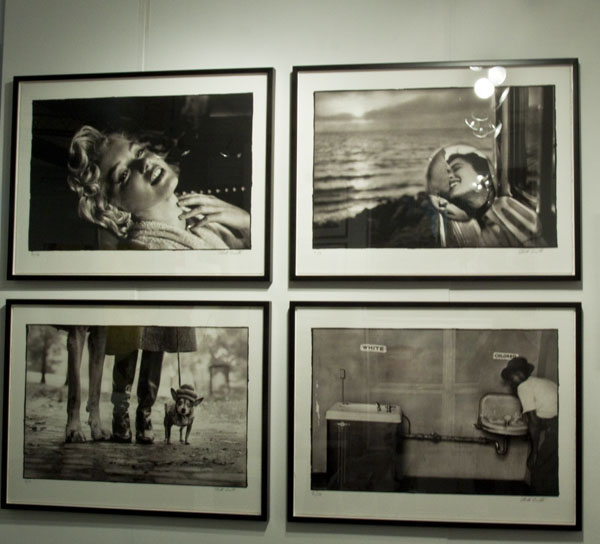
elliott erwitt pictures
the prints were beautiful, but my photography wasn’t the best catching the booth lighting reflection. we did speak with the curators of the gallery and show about the quality of the prints and how exciting these developments are to the art of photography. they really need to be seen in person but since magnum only has galleries in london or paris (although there is also an agency office in NY) it might be worth a trip, i guess most of us will have to wait until HP rolls out the publicity machine for the software.
when we first started walking around the room mary said ‘maybe we’ve been to too many of these shows as we were seeing artist work we’d seen many times before’. but we did see some new and exciting work and some expanded work from other artist.

here is a small sample of Peter Bynum‘s work being shown at Van Brunt Gallery of his paintings on glass which are very organic. they are done on different sheets of glass stacked together. very cool.
another artist we found interesting was the sculptor Rainer Lagemann represented by Oxenberg gallery. lagemann sculptures captures the human body in motion, a freeze frame of classic, timeless gestures and emotions. he uses hollow metal squares which represent the trails and tribulations of life and the four cornered squares are intellectual, emotional, physical and spiritual.
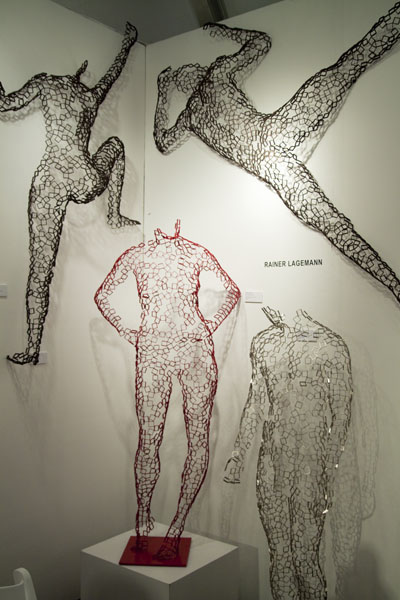
rainer lagemann people
i did like Jeff Muhs work of fuzzypictures shown here with some male bonding seemingly going on in this picture. the painting in the background may have been sold as it was replaced on the second day by an adaptation of vermeer’s ‘girl with pearl earring’ with the artist being represented by the McNeil Art Group by the woman in the red dress.

jeff muhs
we did run into an artist’s work, who we first saw at a small nyc gallery called Merge gallery whom i am told is no longer in existence, who works in cows blood and resin called Jordan Eagles. he’s being represented by benjamin krause gallery now. they are really amazing to see in person so vibrant.
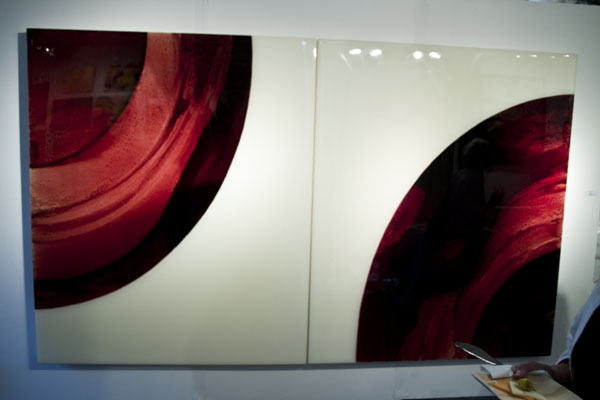
jordan eagles
along with a woman caught sampling his work

but all this rubbing elbows with art connoisseur’s can start to get to one especially before dinner in a hot tent in the middle of a dusty field
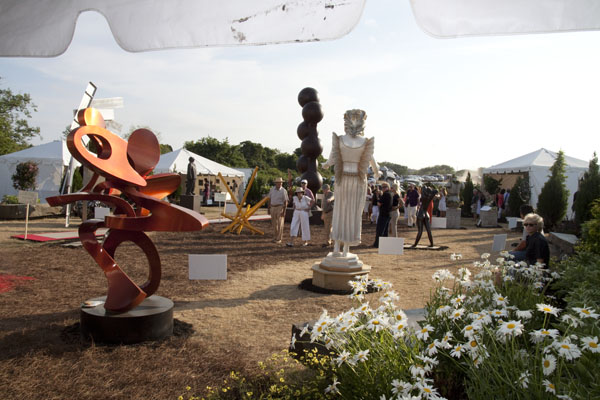
entrance way
keeping one eye on the clock so as to not be late for our dinner appointment and the other on art and people one misses a few things.
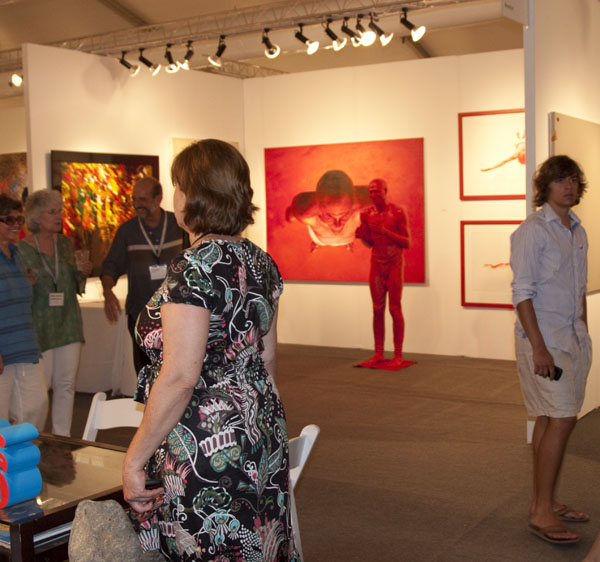
sorry i didn’t catch the name of this gallery, but one can only do so much.interesting work though.
but there is only so much time in a day and i am afraid i’ve spent a lot of it on this post today. enjoy
pathetic ny photo awards announcement
July 7, 2010i am really disappointed with the nyphotoawards whom just posted the entire winners of the award on 7/6/2010 of a festival held on 5/12-16/2010 with awards given out on 5/14/2010 via their unsigned newsletter.
were these guys drunk and in jail or in rehab? i know they weren’t off fighting a war unless it was with themselves. can you image the incompetence of a photo festival in not showing the pictures of the winning image? or announcing the winners two months after the awards were given out
these guys are the most inept festival organizers well i am being nice even to think they were organized which this just proves.
i’ve given my time and energy, to say nothing of entry fees money, volunteering for this festival and i’ll never do it again.
i questioned the choice of exhibits and artist but i gave them the artistic latitude which didn’t fit my aesthetic judgment but then again who am i?
it seems i am more on the ball than this group of bimbos. a fool is one who is fooled twice and i will not be one anymore. too many of these festivals and photograph contest are all about making money for the organizations. it seems this is one of them.
boo who for the loss of a fine opportunity. the fools are amongst us, least they not be us.
maybe they will go away before suckering more young photographers only if we ignore them.
Art Hamptons this weekend July 9-11, 2010
July 7, 2010The International Fine Art Fair
ArtHamptons returns as one of the highlights of the Hamptons summer season. Now in its 3rd successful year, ArtHamptons has established itself as one of the top new art fairs in America. Expect to see a mesmerizing display of post-war and contemporary art, presented by a renowned lineup of international galleries. It’s all assembled in a museum-like setting. There’s important art pieces for every budget and level of art collector. It’s all here for you, from paintings, works on paper and printed editions to photography, art glass, ceramics and sculpture.
This year ArtHamptons moves 2 blocks west to Sayre Park’s 5 bucolic acres. The site is located between Bridgehampton Commons and the Hamptons Classic field, just 1 block north of Montauk Highway on Snake Hollow Rd.
the real exciting news for me is that HP will be showing their new printer software allowing the Z3200 series to create large format negatives, thanks to tyler boley for this information for this rob galbraith link. see more information at http://www.hp.com/go/designjet. woo hoo
a very interesting Gallery out there this year is the Emmanuel Fremin Gallery who has invited us the the opening preview party benefiting Longhouse Reserve.
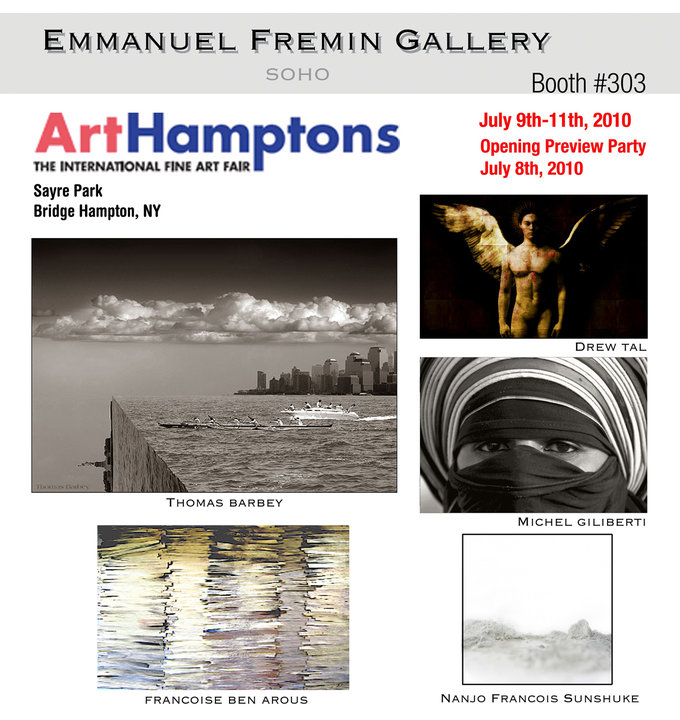 emmanuel has always been very supportive in our creative efforts and represents us in some markets. thank you.
Elisa Cooper of Elisa Contemporary Art also sent us an invitation to see some of her artist at Art Hamptons and a free pass to see the show. we first met her at Red Dot Art fair this year, she has some very interesting artist.
Summer in the Hamptons at ArtHamptons – July 8-11th.
We’ll be in Booth #439

The art world will be converging in Bridgehampton and we’ll be there with new works from Suzan Woodruff, Wayne Zebzda, and Rosalind Schneider.
Waterscapes, Landscapes and imagined worlds by LA Artist Kimber Berry, Maui surfing legend, Pete Cabrinha and Hawaii artists Carol Bennett and Connie Firestone. And we’ll be debuting new artists including Allison Gregory.
This year, in a new location at Sayre Park (154 Snake Hollow Road) in Bridgehampton, ArtHamptons will feature over 80 galleries and be host to a number of special events.
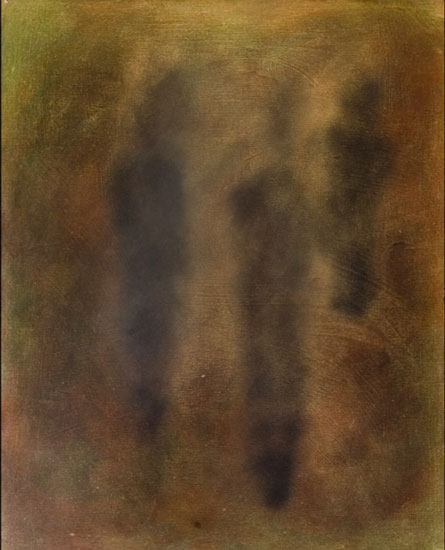 Be sure to join them at Booth #439.
Fair hours are:
Thursday, July 8th 6-9pm – Opening Preview Party
Friday, July 9th 11 am – 7pm
Saturday, July 10th 11 am – 7pm
Sunday, July 11th 11 am – 6pm


For a complimentary Day pass courtesy of Elisa Contemporary Art, click here.
Suzan Woodruff, a fourth generation native of the American West was born in Phoenix, Arizona where, from an early age, she was imbued with her love and awe of nature.
 She is considered one of the co-leaders of the “Flow Movement” in Los Angeles. Suzan’s abstract expressionist paintings are deeply informed by the forces of nature and physics and appear to draw inspiration from patterns found in natural phenomena observed from life.
Using thinned acrylic pigments, and a specially designed table, Suzan’s paintings form rills, deltas, waves and eddies. They appear as voluptuous, sensual landscapes, cloudscapes, seascapes, dunescapes and all sorts of natural spaces – even bodyscapes. Her elegant fields of flowing color blend Zen serenity and human passion.
Suzan’s work has been exhibited in galleries and museums in the US, Canada, Europe and Asia. She was recently featured in a two-person exhibit of Flow Painting at the Art Factory in Budapest, Hungary.

Wayne was born in Hartford Connecticut and started his journey out west attending the San Francisco Art Institute on a full scholarship as a painting major. With day jobs in construction, he also developed a facility with tools of a different trade, and eventually shifted to producing sculptural and installation works, as well as his carbon smoke drawings.
Wayne’s work communicates a deep sense of delight in the face of the absurdities of life and he loves to create art from the everyday objects we encounter (including the Cross Walk Man sign).
According to Wayne, the process for his Carbon Smoke drawings is as follows:
“I have to move continuously while the smoke pours out of the torch. If you have ever seen the film footage of Jackson Pollack painting it is a similar continuous movement, his with drips, mine with smoke and the added possibility of catching the drawing on fire. I enjoy the immediacy and physicality of drawing. The welding torch has the pressure turned down low which makes it sooty/smoky. Working back into the drawings with erasures and brushes reveals what’s underneath and a clear fixative sets the soot in place (hopefully) and yes, I have burned the paper and will again.”
Wayne currently lives and works on the Hawaiian Island of Kauai.
Wayne is committed to making art accessible to a wide audience, and has been involved in numerous Art in Public Places projects and commissions for the Hawaii State Foundation on Culture in the Arts. His work has been exhibit and collected throughout the US including New York, Chicago, San Francisco and in Hawaii.
————————————————————————————————————————————————–
if this isn’t enough activity for a weekend we have added one more event and are off visiting another photographer friend on the north shore to have dinner and relax looking at the sunsets maybe even clicking a few shutters along the way over the sounds of passing seagulls who aren’t drenched in oil yet.
what we do to this world and ourselves seems criminal to me. oh well, maybe next time we’ll get it right.
1st thursday in Dumbo
July 2, 2010last night mary and i went over to dumbo to see her postcard exhibit in ‘Wish you were here 9’ at A.I.R gallery as we had missed the actual opening of the show. the show runs from 6/23 thru July 18 at the gallery located 111 front street, Brooklyn ny.
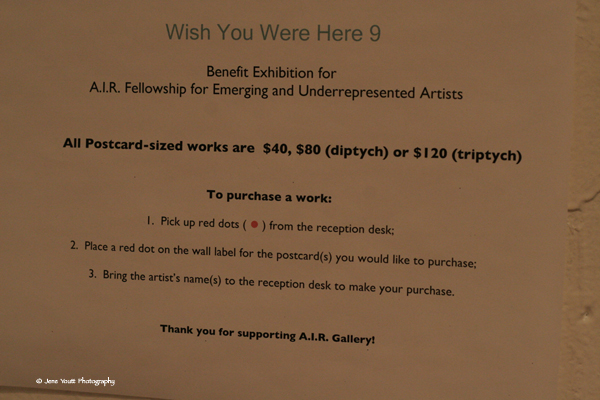
sign
from the press release: A.I.R gallery is pleased to announce Wish You Were Here 9, on view in Gallery III from June 23- July 18 2010. the proceeds from this exhibition od this postcard-sized works support our mission to advance the status of women in the arts and benefit the A.I.R Fellowship program for emerging and underrepresented artist.
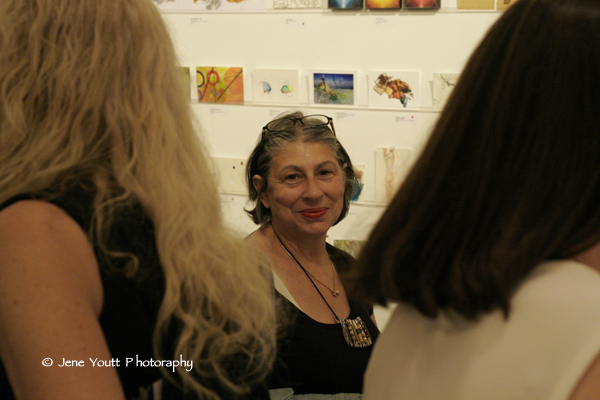
wish you were here 9
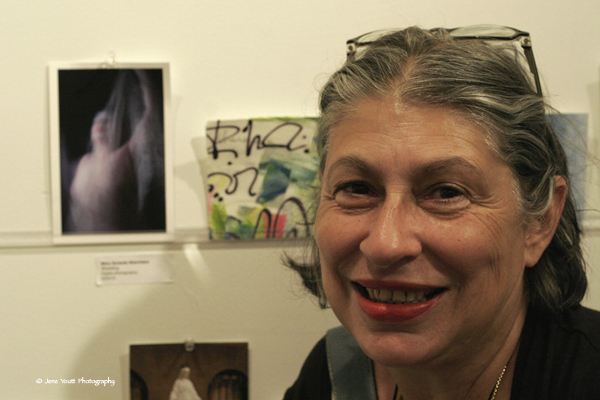
mary & postcard
so if you’re in the neighborhood do stop in as there is some really wonderful affordable art work with lots sold so far with lots to be sold. it’s really nice to see how others have dealt with the size restrictions and used their creativity. i’ve always been impressed with how others create, it makes me think about how i might solve the problem and how different someone else solves the same problem.
that evening ‘the 1st Thursdays in dumdo the galleries are open late so we wandered around the hallway down to the Amos Eno gallery to see a group show where i met an artist who’s work i linked to here on fuzzy Marina Reiter. i had missed her solo show ‘Endless Summer’ but we had a chance to talk to her tonight. life is really wonderful once you get out into it.
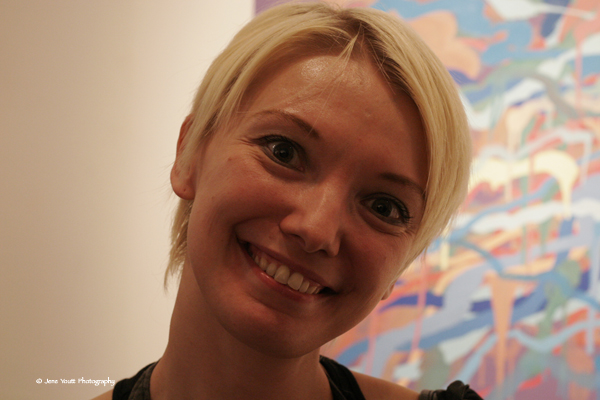
marina reiter
no that’s not her work in the background but a good picture of her, see below or her web site.
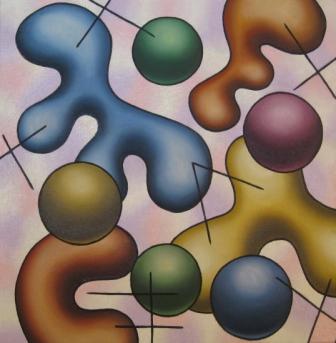
Marina is a painter who works in oils, something i had started when i painted. i love her work, maybe it’s the musically of it or the cleanness, something not often found these days in this messy world. talking to her is a joy because she gives one attention not like so many other artist at these kinds of affairs where they are looking around to the next person to talk to about themselves.
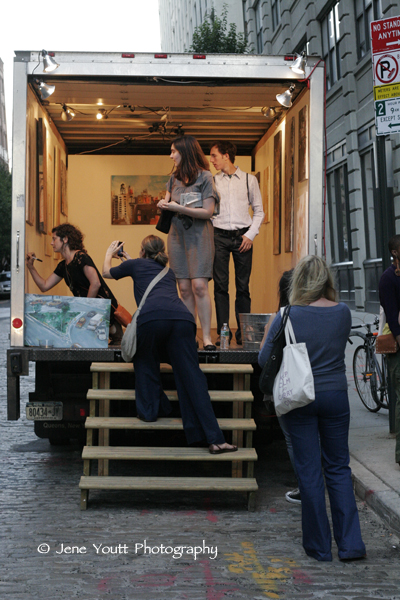
art truck
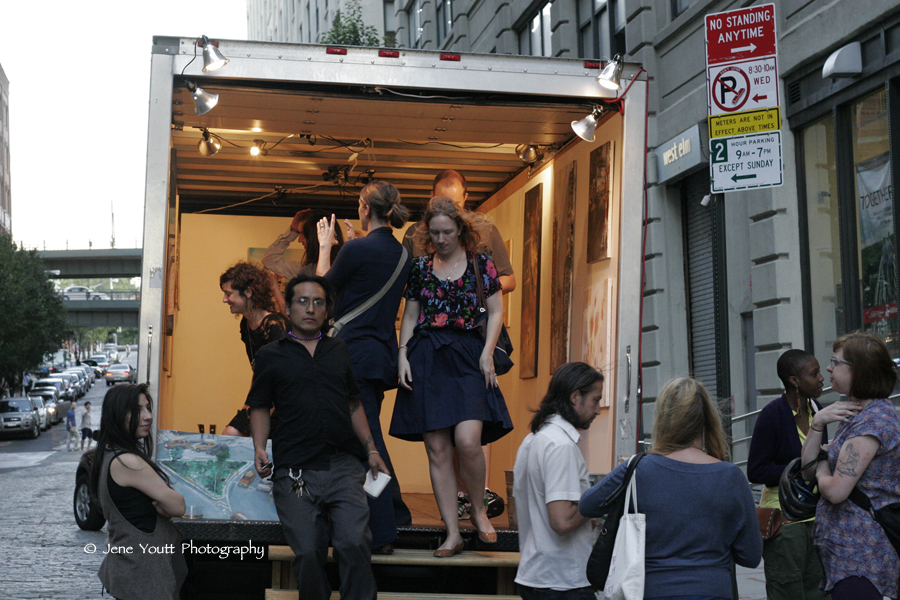
quite a crowd
wandering around we found an artist using her imagination as to showing her work not quite on the street but close to it. her name is Orianne Cosentino and she’s a painter. that’s her signing the truck wall. so it’s pretty wonderful just being out and about seeing all there is to see.
after a couple of sips of wine and the time of night hunger creeps up on one so we went off to find a place to eat. i had passed by a very cute place at 55 Water Street during nyp festival called 55 water street. i was very disappointed in the food, so much so i’d never eat there again. the provincial stuffed chicken i had was over cooked with a canned tomato sauce spiced with hot sauce and lumpy mashed potatoes. mary had a mediocre penne in a cream sauce.

windy night for eating lobster
but we were luck we weren’t trying to eat a lobster outside as was this woman on a windy evening. mary found this shot looking through the window venetian blinds. they did finally move inside, guess it got too much for them.
so life can be interesting even when not the best, the important thing is for one to be there now.
so long for now lots of other news will have to wait because i’ve a meeting to go to.
if you’ve got some spare change, why not attend Polaroids auction
June 18, 2010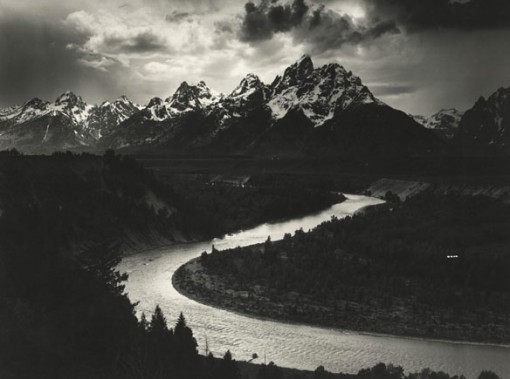
adams Tetons & Snake river
“Tetons and Snake River” by Ansel Adams is one of the many images to go under the hammer later this month. Photo by Ansel Adams.
“Over a thousand photographs from the Polaroid Collection, which includes images from some of the biggest names in photography, like Ansel Adams, Dorothea Lange, Edward Weston, Andy Warhol and Robert Mapplethorpe, will be put up for auction later this month.
Famed auction house Sotheby’s will put 1,200 historic photos under the hammer as part of Polaroid’s court-approved bankruptcy sale. The sale will include the most comprehensive collection of Ansel Adams photographs (400 Polaroid and non-Polaroid images) ever sold.
“It is the largest and best collection of works by Ansel Adams to ever come on the market, representing a broad spectrum of most of his career,” said Denise Bethel, Sotheby’s photography expert.
Masterpieces such as Adams’ “Bridalveil Fall” (valued at up to $100,000) and the massive “Moonrise, Hernandez, New Mexico” (valued as high as $500,000) will go to the highest bidder. The sale also includes Dorothea Lange’s iconic Depression-era “Migrant Mother, Nipomo, California,” which is valued at up to $80,000.
Working as a consultant for Polaroid, Adams helped build the company’s photography collection by acquiring works from masters like Lange, Weston and Imogen Cunningham, as well as those of contemporaries whose work he admired.
Many of the most well-known photographs from the 16,000+ images in the Polaroid collection will go up for sale, and they are expected to fetch a total of over $7 million. Sotheby’s will showcase the images for six days before they are auctioned on June 21-22 in New York.”
thanks to karin & raoul for this post

 Fuzzypictures's Weblog