| Written by Roger Finch |
| Tuesday, 24 August 2010 01:33 |
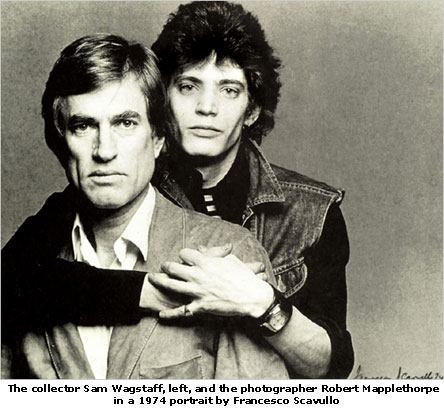 Sam Wagstaff TheCollector New York City – Mr. Sam Wagstaff was one of the first private art collectors to start buying photographs as early as 1973, long before there was a serious market for them. His photography collection came to be regarded not only for its scholarship. It was also original and unorthodox, and turned out to be extremely valuable. Mr. Wagstaff sold it to the J. Paul Getty Museum in 1984 for $5 million, a fortune at the time, establishing that institution’s collection of photographs, now among the finest in the world. But the Wagstaff mystique deepens around his relationship to Robert Mapplethorpe, his lover, to whom he was also mentor and career impresario. Mr. Mapplethorpe, 25 years his junior, was the bad boy photographer who scandalized the National Endowment for the Arts with his formal and highly aestheticized homoerotic photographs, which were given a retrospective at the Whitney Museum of Art in 1988, securing his legacy. Still, obscenity charges were brought against the Cincinnati Museum of Art when it mounted an exhibition of Mr. Mapplethorpe’s work in 1990. Mr. Wagstaff himself affectionately called him “my sly little pornographer.” Mr. Mapplethorpe, a young artist from a working-class neighborhood in Queens, was making elaborate constructions with beaded jewelry when he and the patrician Mr. Wagstaff, who had been a well-known curator at the Wadsworth Atheneum Museum of Art in Hartford, met at a party in Manhattan in the early 1970s. Throughout the film, interviews with more than a dozen people who knew them both provide an intimate and anecdotal picture of their lives, both individually and together. In particular, Patti Smith, the poet and rock star, offers tender descriptions of her friendship with both men. Ms. Smith’s friendship with Mr. Mapplethorpe began in 1967 when they were both art students at Pratt Institute in Brooklyn. They were living together near the Chelsea Hotel in the early 1970s when Mr. Mapplethorpe first brought Mr. Wagstaff to meet her. “Sam came in and seemed totally at home in my mess,” she recalls. “We liked each other immediately. He had such a great sense of humor and had such a nonpretentious and nonsanctimonious spiritual air.”
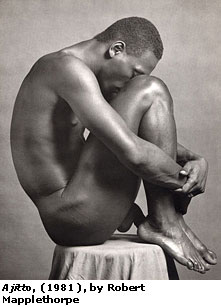 Robert Mapplethorpe Ajitto Dominick Dunne met Mr. Wagstaff when they were both young men in New York, and he talks about the dichotomy between Mr. Wagstaff’s life in the closet in the 1950s and his more public profile later with Mr. Mapplethorpe. “Sam Wagstaff was the New York deb’s delight,” he says in the film. “He was probably one of the handsomest men I ever saw. Tall and slender and aristocratic-looking. And he was funny. And he was nice. And the girls went absolutely nuts over him.” Gordon Baldwin, a curator at the Getty Museum, recalls in the film that Mr. Wagstaff was proud of his aristocratic background and says Mr. Wagstaff told him more than once that his family had owned the farms where the Metropolitan Museum is now, at the time of the Revolution. “It was pretty clear that he came from a starchy background,” he said. Mr. Wagstaff certainly made up for lost time. In the early 1970s, he “became an eager participant in the excesses of the age,” says Joan Juliet Buck, the writer who narrates the film with a lofty voice, reading adulatory, if not lapidary, biographical prose that delivers the facts about Mr. Wagstaff’s life in a tone aimed at, well, posterity. He was “always in rebellion against his conservative and upper class background,” she notes. “He often held drug parties in his Bowery apartment,” Ms. Buck says at one point, as if holding her nose at the very idea. “He used drugs for sex and he liked the alternative perspectives they offered.” Philippe Garner, a director of Christie’s in London and a friend of both men, says in the film: “My guess is that Robert gave Sam the courage to explore areas of his personality, to savor a darker kind of lifestyle than he would have done on his own. He unlocked a dark genie within him.” Despite Mr. Wagstaff’s sybaritic activities and his relationship with Mr. Mapplethorpe, unconventional at the time, he managed to amass a world-class photography collection and also to shape the other man’s career. From the humble Polaroids Mr. Mapplethorpe was making when they first met to his more provocative and refined photographs, which now command $300,000 a print at auction, the influence of Mr. Wagstaff’s taste and aesthetic sensibility on his work is undeniable.
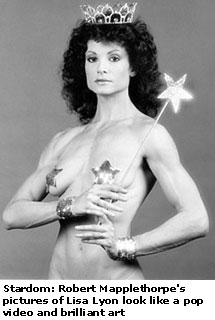 Robert Mapplethorpe Stardom The film’s title, “Black White + Gray,” has several meanings. Most, if not all, of the photographs in the Wagstaff collection were black and white. Most of Mr. Mapplethorpe’s best-known work is black and white too, and many of his nude subjects were African-American. But more specifically, the title refers to an exhibition called “Black, White and Gray” organized by Mr. Wagstaff as a curator at the Wadsworth Atheneum in the early 1960s. The show included works by Barnett Newman, Ellsworth Kelly, Ad Reinhardt and Jasper Johns, among others. The show “sent shock waves through popular culture and heralded fashion’s embrace of Minimalist aesthetics,” Ms. Buck says in her narration. At the time Vogue magazine published an eight-page feature on James Galanos’s couture, with Mr. Wagstaff’s exhibition as the backdrop. “Back in the 1960s, curators like Sam, Frank O’Hara and Henry Geldzahler were much more like artists than a lot of curators on the scene are today,” Raymond Foye, the publisher of Hanuman Books, an independent press, says in the film. The film’s narration tends to cast Mr. Wagstaff in nothing less than Olympian terms: “His aesthetic underscores an unequal vision grounded in passion, intelligence, sexuality and clever financial speculation,” Ms. Buck recites as rare self-portraits by Mr. Wagstaff are shown. “He had few rivals in his time. And none at all today.” The intimate, never-before-shown photographs of Mr. Wagstaff and Mr. Mapplethorpe throughout “Black White + Gray” make great social anthropology, and the interviews with Ms. Smith, Mr. Dunne and others give depth and warmth to an otherwise stiff, if earnest, portrait. Both Mr. Wagstaff and Mr. Mapplethorpe died of AIDS, Mr. Wagstaff in 1987 and Mr. Mapplethorpe in 1989. One snippet of footage shows a shy and endearing Ms. Smith reciting a short poem of hers in an interview on the BBC in 1971: “New York is the thing that seduced me. New York is the thing that formed me. New York is the thing that deformed me. New York is the thing that perverted me. New York is the thing that converted me. And New York is the thing that I love too.” . . . By Philip Gefter |
Archive for the ‘films’ Category
The Man Who Made Robert Mapplethorp
August 24, 2010Fassbinder: Berlin Alexanderplatz’ at KW Institute
August 24, 2010for those people who’ve kept up with my eclectic postings know this i some of my all time fav films. it’s a long one for sure 16 hours. i first saw it on PBS when they were a public educational television station, now they are just a tape playing house showing safe nature films and raising money to line the executives pockets. i’ve been there done that. has anyone who’s seen the replacement of Bill Moyers and Now know


On March 17, 2007, KW Institute for Contemporary Art will open Fassbinder: Berlin Alexanderplatz – An Exhibition. The show will present this unusual and fascinating work in a way that enables visitors to choose their own mode of approach. In fourteen separate rooms, the episodes and the epilogue of Berlin Alexanderplatz will be screened in permanent loop. In addition, all the episodes will be shown in chronological order and full length on a central big screen. Visitors can thus decide how they approach Berlin Alexanderplatz: they can divide its unusual length up into pieces, watch episodes several times, or return to the exhibition whenever they like, as the entrance ticket entitles holders to repeated visits. The parallel screening of all the episodes in one place will highlight Fassbinder’s impressive visual idiom and his artistically challenging, free and innovative use of images.
The epilogue to Berlin Alexanderplatz marks a high point in Fassbinder’s creative work, combining visual and narrative planes in a complex collage that anticipates contemporary artistic positions. The exhibition also presents stills from the film’s 224 scenes. Moreover sketches from Fassbinders storyboard will be on view for the first time ever. A further, highly personal document are the tapes on which Fassbinder himself recorded his script for the film and which have never previously been made accessible to the public.
The exhibition is accompanied by a catalogue (in German; approx. 600 pages), edited by Klaus Biesenbach, with essays by Susan Sontag and Rainer Werner Fassbinder. The catalogue includes extensive illustrations. Furthermore the publication contains the complete screenplay as well as the biography, blbliography and filmography. Curator: Klaus Biesenbach.

KW Institute for Contemporary Art is regularly listed among Germany’s foremost modern art institutions and attracts international media coverage. KW has no collection of its own but instead views itself as a laboratory for communicating and advancing contemporary cultural developments in Germany and abroad by means of exhibitions, workshops and resident artists’ studios, as well as by collaborating with artists or other institutions and by commissioning works.
Founded in the early 1990s by Klaus Biesenbach and a group of young art enthusiasts, the institution is located on the site of a abandoned margarine factory in Berlin’s Mitte district. It symbolizes, perhaps more than any other institution, the city’s development into a center of contemporary art in the decade after the fall of the Wall. As well as presenting the first solo shows or major new projects of outstanding international artists such as Doug Aitken, Dinos & Jake Chapman, Paul Pfeiffer, Santiago Sierra and Jane & Louise Wilson, KW also introduced emerging new artists from Berlin and elsewhere in Germany to a wider public.
Visit KW Institute for Contemporary Art at: www.kw-berlin.de
new rules for shooting in NYC on DASC properties
July 28, 2010here’s a link to the new rules governing filming and photography in Department of Citywide Administrative Services properties
The Department of Citywide Administrative Services (DCAS) and its predecessor City agencies have for more than twenty years allowed and supported film production activities on properties and within facilities under the jurisdiction of the agency. Given the frequency and complexity of filming activities by both amateurs and professionals, it has become necessary to codify the process that has been followed over time.
DCAS has adopted rules that govern filming and photography conducted on properties and within facilities under its jurisdiction, which require permits from the Mayor’s Office of Film, Theatre and Broadcasting. These properties and facilities include various City buildings, such as the Manhattan and Brooklyn Municipal Buildings, all Borough Halls, and City and State Courts.
In order to conduct film or photography shoots in DCAS properties and facilities, DCAS approval must first be obtained prior to obtaining a required permit from MOFTB. Forms and documents required for DCAS review and approval must be submitted to the DCAS Film Office no later than four business days prior to the date on which prepping or rigging for shoots is set to commence.
Upon approval, a non-refundable fee of $3,200.00 shall accompany any application submitted to MOFTB for a required permit for filming or photography in DCAS properties and facilities. The fee shall be in the form of a certified bank check or money order, payable to the New York City Department of Finance.
The required fee shall be imposed for each instance in which prepping or rigging commences, is followed by shooting and/or photography for such production, and then is concluded by wrapping, de-rigging, and/or related activities.
The rules were initially published for comment in The City Record on August 25, 2009, and a public hearing was held on October 2, 2009. The adopted rules include changes made as a result of the comments submitted prior to and during the comment period and public hearing by members of the public, filming industry representatives, and City agency officials. The final adopted rules were published in The City Record on November 23, 2009.
The rules are in effect as of December 23, 2009. Click here to read the adopted rules in full.
Other links:
 List of DCAS-Managed Buildings
or see the City of NY Mayor’s office of film,theater and broadcasting
Technicolor donates archive to George Eastman Museum
March 28, 2010
Rainbow-Paint-Splatters
ROCHESTER, NY.- George Eastman House International Museum of Photography and Film announced a major gift to the museum — the historic archive of Technicolor dating from 1915 to 1974. The donation includes rare cameras, documents and drawings, photographs, printers and processing machines, corporate records, and other important materials that represent the history of Technicolor’s groundbreaking contributions to motion pictures. This collection joins the Eastman House’s current Technicolor holdings of early research papers, technology, and the world’s largest collection of Technicolor camera negatives, including The Wizard of Oz and Gone With the Wind.
courtesy of: Art Knowledge News
Live Nudity at the Museum of Modern Art in NYC
March 19, 2010NEW YORK, NY.- The human form, disrobed and displayed in all its glory, is arguably the most enduring motif in the history of Western art. Museums dedicated to art both ancient and modern are filled with nudes rendered every which way: painted, chiseled, molded, sketched and photographed.
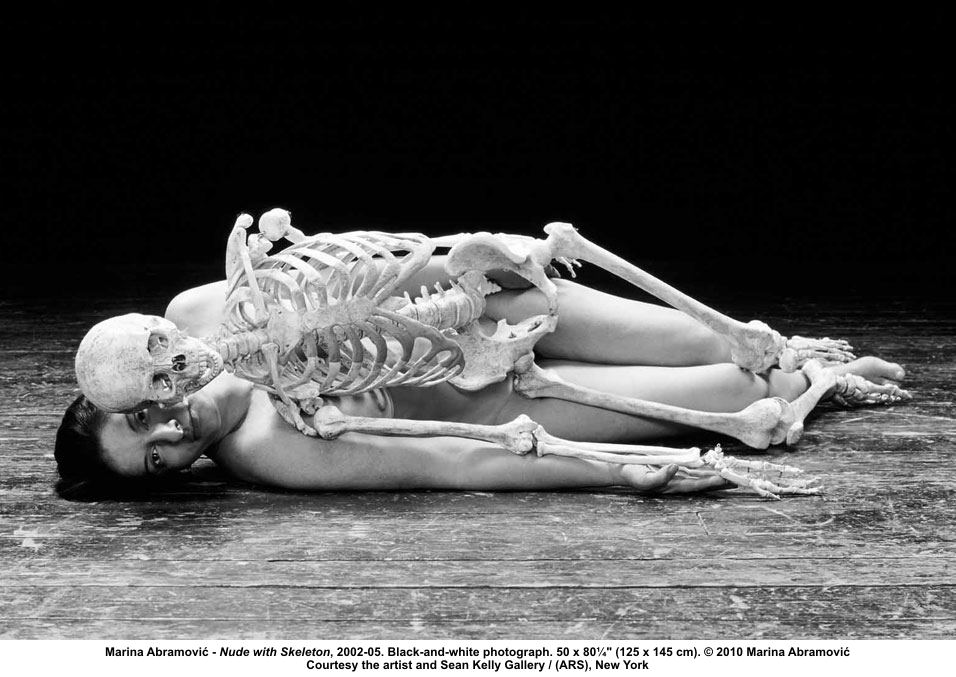
They’re just usually not living and breathing. But New York’s Museum of Modern Art (MoMA) will host daily performances of five seminal works by Marina Abramović, three of which feature performers in the altogether. In Imponderabilia (1977), two players stand opposite each other, au naturel, in a narrow doorway. Visitors must brush past them to enter the exhibition—an early, if awkward, example of interactive art. On exhibition 14 March through 31 May, 2010.
and if you time your visit right you can also see a rareity from Germany in “World on a Wire”, 1973. Germany. Directed by Rainer Werner Fassbinder. Pictured: Barbara Valentin. Courtesy: Rainer Werner Fassbinder Foundation.
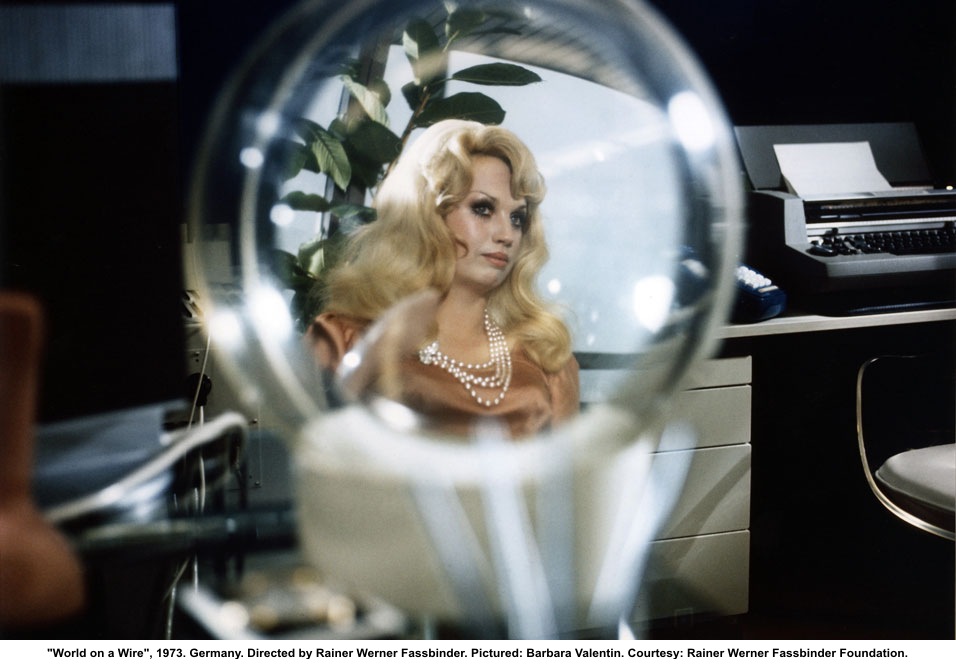
NEW YORK, NY.- ‘World on a Wire’ (1973), written and directed by Rainer Werner Fassbinder (German, 1945–1982) and based on the novel Simulacron-3 by American author Daniel F. Galouve, will have a weeklong run at MoMA, from April 14 through April 19, 2010. Originally made for German television in 1973, Fassbinder’s revolutionary adaptation has only been shown in America once before, in 1997, as part of a comprehensive Fassbinder retrospective at The Museum of Modern Art.
while i’ve never understood all of his films i’ve always found him interesting and knowing that Michael Ballhaus did some of the cinematography is an education in it’s self.
I first fell in love with Fassbinder for his “Berlin Alexanderplatz” done in 14 episodes, 1980 and shown on PBS when PBS filled it’s mandate of bringing quality television to the airways. now PBS is just a shadow of it’s former self especially the new york stations. i think the nyc stations should be taken off the air.

 Fuzzypictures's Weblog