Archive for the ‘fashion’ Category

hoboken art walk and studio tour 2012,

November 12, 2012

you can flood the city, fill the path tunnels with water, ruin almost everyones weekend without power but art walks go on.  mary and i will be showing our work at the hoboken nj art walk and studio tour at the Monroe Center, 720 Monroe Street, Hoboken NJ on Sunday November 18, 2012 from noon to 6pm.

if you’re in the neighborhood do stop by and say hello.

be there or be square

jene

Edward Steichen, the Conde Nash years 1923-1937

April 20, 2011
Seine river

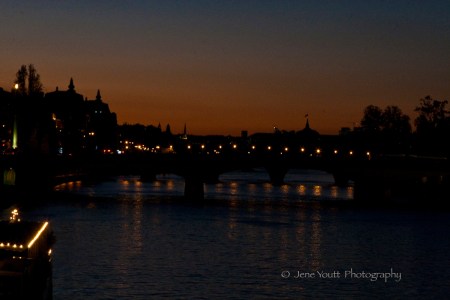
Paris, Seine river

when mary and i first visited Paris we were very lucky except for the grey sky’s most everyday, after all  it was at the end of October a bit chilly and who cared it was Paris and we were together. the streets seeped with history and the museums budged with art and cafes everywhere with fresh baked croissants.

we rented an apartment through Craigs List and sight unseen were located on the right bank two blocks from the Louvre, somewhere around the Rue du Roule talk about luck and location whoo. by the way Paris has a great jazz radio station with even a feed from WBGO here in Newark NJ. the apartment was small but clean with a kitchenette and a double bed.

but not everyday was gloomy there were some lovely days and being with my honey made up for any rainy days

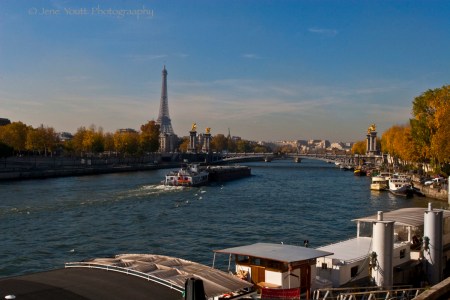
Seine river with Eiffel tower

Museum passes in hand we headed out into the great city of lights to see what we could discover. no we didn’t do the Louvre first as we wanted to be outside enjoying Paris. we walked around a lot since we were in the middle of everything. mary was taking a photography class back in NJ so she had homework assignments, not a bad place to do your homework.

but this isn’t about Paris yet connected in every way in my mind. we discovered the photographic exhibit called Edward Steichen In High Fashion, The Conde Nash Years at the Jeu de Paume Museum, organized by the Foundation for the Exhibition of Photography, Minneapolis and The Musee de L’Elysee,Lausanne.  We never had a clue it would be there nor did we know too much about Steichen’s work.

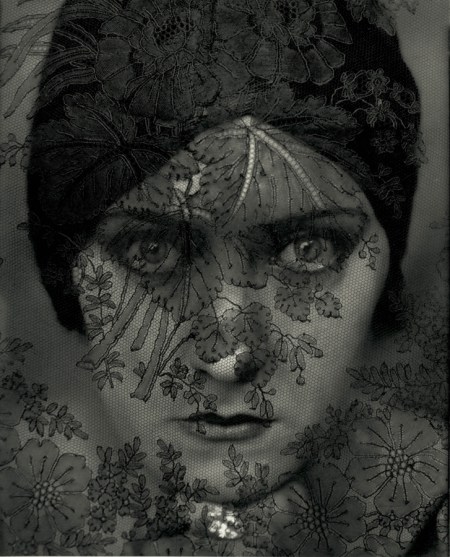
the photography  exhibit blew me away and how much of it that was on display wow. the portrait of Gloria Swanson 1924 has to be seen in person it’s just amazing. all of the prints were wonderfully done as one would expect from an artist such as Steichen even though he’s long gone. along with all the prints there was a movie interview with him in his studio which i fell in love with because it showed all his lighting equipment and he sat next to a huge camera sort of a Steichen at work type of thing. the floor was covered with big black wires powering the plato convex spotlights, floods etc of that period.

At the end of the exhibit comes the book store and trinket shop. i picked up the accompanying book and wanted to buy it right away but alas i am just a dumb american who can’t read French, besides it’s a pretty big book to lug around europe. Steichen worked in B&W photography which is pretty amazing in it’s own right. What he did with his limited space and flats is pretty amazing.

so i am in a book buying binge now and i ordered one from amazon having just finished it this week. i must say it to is a wonderful book especially for people who never had an opportunity to see the traveling exhibit which has long gone into retirement. i wish i had been able to read the book and then see the exhibit again. i think would have gotten more out of the exhibit at the time but one can’t, at least i haven’t found a way to time travel yet.

i recommend this book to anyone who has a love of B&W photography or fashion history, it’s a real treasure.

some say artist working in commercial endeavors looses touch with the art. we all got to eat and would like other people to enjoy our work, i always feel that i am sending my children to a foster home when someone buys a picture. Steichen had this to say  in a letter to

Mrs Chase;

“in connection with our idea about dignified and distinguished presentation of ‘Beauty’ pictures if they can be done in Duotone they will be greatly enhanced. there are some works of art in the Louvre that if presented in a peep show would be condemned s pornographic. in the Louvre they are art – make Vogue a Louvre.”

don’t we all just want to be loved for what we do? i’ve fallen in love here with a master of B&W photography and this book shows why he’s considered such.

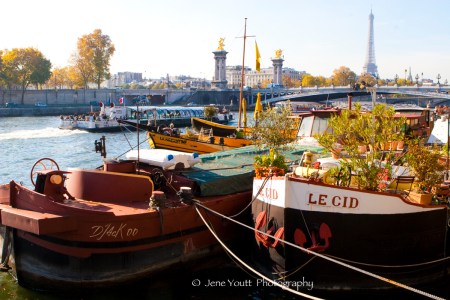
this is the next place i want to stay in Paris or maybe Amsterdam

house boats

jene

www.jeneyoutt.com

Studio St. Petersburg by Deborah Turbeville

March 16, 2011

recently i bought three photography books at amazon and have been asked to review my purchases, so i might as well do it here as well. this will be the first one i write about.

since i am a self-taught photographer i don’t have much organized photography education so what ever i pick up it’s from here and there. i came to Deborah Turbeville’s photography in an oblique way which was through a wonderful man and teacher, well actually Milton was a salesman at B&H when i met him, who worked in the darkroom developing area.

Milton Spieel was his name who has passed through my life and so many other countless photographers. RIP. he always had a story or joke to tell and if you asked a question an answer. one day i guess we were talking about picture styles and i brought up my dance series of fuzzypictures and he told me about one of his customers, Deborah Turbeville who he knew from Willoughby’s photo which was the place to go in the 70’s 80’s for photography, then located on 32nd street.

Deborah would tell Milton to not tell her assistants how to operate the photo equipment she would send them in for. one day she was in the store buying some gear and had her portfolio with her and asked Milton if he wanted to see it? ‘Sure’ he said,  well he wasn’t impressed because of her style, he said he would have thrown it in the garbage. Milton did mention she did a book on Newport RI Remembered that made her friends, so i’ve kept my eyes open for it and have ordered it today.

well Deborah got the last laugh on Milton, she has many photography books in print while Milton is feeding the worms. Studio St Petersburg  is the first book i have of hers. Mary and i were lucky to have seem one of her photography exhibits at the Staley-Wise gallery down in soho, heres a link to my short review. she is a unique photographer to say the least.

deborah turbeville

Deborah Tuberville

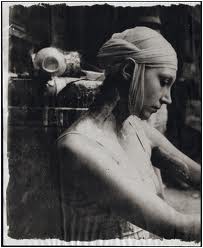
my guess on taste would be like caviar as it needs to be acquired before one can really appreciate it. Mary and i both enjoyed the Past Imperfect exhibit and seeing her work as large prints is amazing. Deborah Tubeville was born 1938 in new england and moved to new york when she was twenty. See her profile in Professional Photographer as she really is a legend.

but i love her work because it’s not so much about photography but more about feelings. When Jackie Onassis commissioned her to photograph the unseen Versailles, the late president’s wife urged the photographer to ‘evoke the feeling that there were ghosts and memories.’ Turbeville began by researching the palace’s ‘mistresses and discarded mistresses’, then photographed not just the palace’s grand chambers and vistas but its store rooms and attics.

well that’s what Studio St. Petersburg is about for me the feelings of the past guess that’s why her exhibit called past imperfect. our memories of the past events place and people are clouded over by so many uncontrollable things. so to see photographs that take this cloudiness into consideration and make the viewer work to see and understand what might be the story presented is pretty cool.

deborah tubeville

although there is no need for back story in this picture. i think it’s pretty understandable.

deborah tubeville

one might wonder what ever happened here in this old house? what history

might have walked these halls, looked from these windows?

but what first attracted me to Tubeville was her sensuality that came through to me in her fashion work.

deborah turbeville

tubeville 2

she like so many other fashion photographic icons had her own style that didn’t conform to the norm which is why it’s so refreshing to see anytime. timeless comes to mind. Studio St Petersburg just makes me want to go see that city even more. do i think i’ll find what she did? no i am no fool.

today is so different from yesterday, but today in Japan we have another atomic power problem. to think of all those brave russian souls who perished fighting the Chernobyl disaster or crippled with its aftermath makes me sad.

of course it wasn’t too many months or weeks ago that atomic energy power plants were in the news as an attractive alternative for the united states energy follies, as there isn’t any real energy policy put forth by our government. oh well

sorry about all this rambling on about one thing or another that might not have been relevant to photography. well maybe x-ray photography  but that’s not what i was discussing here.

i hope i might have opened up another creative connection for you, books by Deborah Tubeville for my readers. sorry no new naked women today but as the masthead says opinions, and i’ve got plenty.

jene youtt

www.jeneyoutt.com

Stieglitz, Steichen, Strand @ the Metropolitan museum

March 1, 2011

wow what a triumvirate of photography i thought when i heard of this exhibit being put on by the Metropolitan Museum of Art. this is going to be something special to see i told mary on our way up to the museum on a cold February afternoon.

when we were in paris we had an opportunity to see Steichen’s the ‘Conde Nash years‘ exhibit at the Musee de l’Elysee and i recently bought the accompaning  book as the one at the show was in french and i don’t read french. the photos in that show were marvelous along with a movie taken during one of his photo shoots. talk about lights, wires, cameras everything was huge. a portrait of Gloria Swanson under a hat net was fabulous in person, really popped out at you, but given the restrains of book printing it looks ordinary in the book.


Gloria Swanson


see video of exhibit from florida

well this show considering who is represented is ordinary i was quite disappointed. the last major exhibit we saw in the photographic exhibit space was Robert Franks ‘The Americas’ which took up the four rooms and the hallway. the Stieglitz, Steichen, Strand exhibit only took up three rooms and the hallway. oh well

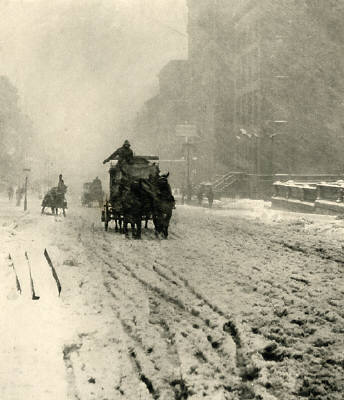
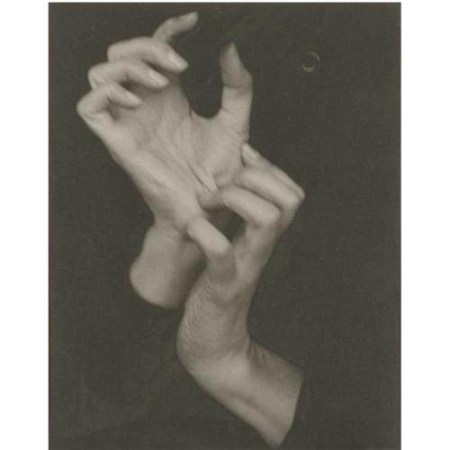
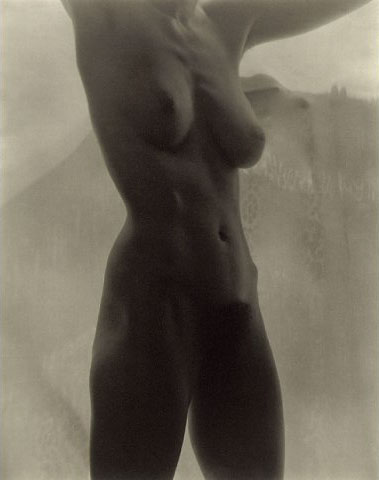
with Stieglitz being the oldest and father figure of the group encouraging their exterminating with new mediums and styles and giving them a place to publish their work in Camera Work, a copy which is under glass at the exhibit but can be purchased as a complete book on-line or in stores. Stieglitz is in the first of the rooms. in a way i thought each of these photographers could have filled the entire space with their own work. Stieglitz had early New York City and Georgia O’Keeffe to photograph, not bad subjects at all especially O’Keeffe’s hands, very powerful.


5th Ave


Georgia-OKeeffe-Hands


O'keeffe figure study


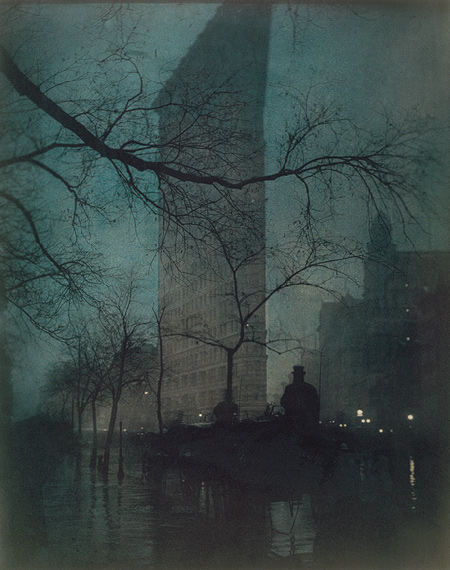
but to see the actual prints of these photographers and maybe a glimpse of their creative minds is pretty cool. what were they thinking comes to mind. in this digital world we are living in, i think some of what is important THE PRINT is being lost. seeing Steichen’s three prints of ‘The Flatiron” building side by side was very informative. Steichen used a mixed process of Gum bichromate underneath a Platinum print as his background as a painter made him willing to mix processes to achieve a desired effect.


The Flatiron


The Flatiron


mary and i both looked at each other after reading this repeating our in joke ‘he’d never get to be a member of Soho Photo with antics like this.’ which comes from my experience with their membership committee when i was denied membership due to one white mat not matching the others in the portfolio. never mind the attitude that the photo asks for, no really demands a certain paper or process. oh well i can’t open a closed mind nor would i care to look inside of one.

my first exposure to photography books was ‘The Family of Man’ which Steichen produced while at The Museum of Modern Art to coincide with the photographic exhibit hailed as the most successful exhibition of photography ever assembled in 1955. way before my developing mind could grasp the concept. i was just beginning to see girls never mind a family of men.

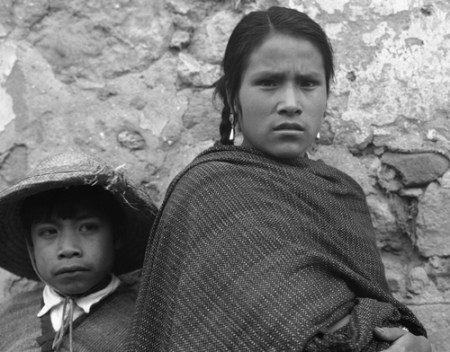
Paul Strand had a whole other artistic direction, although he to was a painter, where he began to develop his belief in the humanistic value of portraiture. not that he didn’t take pictures of his surroundings traveling around mexico and new england  but i think we engage what we see or is it the other way around.


Blind

Mexican children


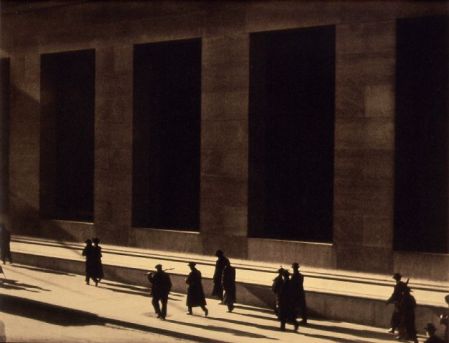
Wall street


the whole exhibit as small as it is, is about coming of age see the nytimes review and if you’re at least bit interested in photography i suggest dropping by and seeing for yourself these outstanding prints. remember the Metropolitan Museum od Art is a pay what you can museum.

have a good day

jene

www.jeneyoutt.com


Diogenes daughter revealed living in NYC

February 9, 2011

this going to be a rambling post because that’s what i am feeling now. i don’t have my best listener here, it’s been 9 days since shadow passed away. i am slowly putting her stuff away bit by bit. why am i saving it? don’t really know, maybe i’ll want another dog but not soon.

life is moving along, i shouldn’t have any complaints now, no one to listen to them anyways. what ever problems i have i’ve created them myself because of the way i deal with or not deal with life. at least now i can turn up the music loud; Blondie ‘no exit’ and drown out the world without worrying about hurting doggies ears.

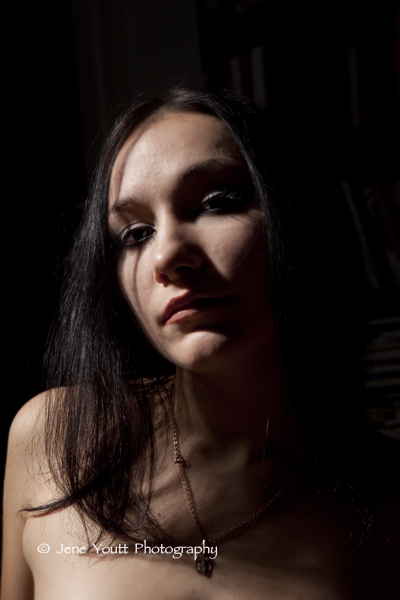
odd how these days come and go. yesterday was a lovely treat. i got a nice present in the form of a phone conversation that i didn’t expect. a young model came over to the studio wanting to work with me. she saw my work on a model mayhem page and asked to do a shoot. hey why not?

portrait of a young girl with gold chain

young woman portrait

i do portraits but i also wanted to explore women’s lingerie. open my horizons as it were. when i was a young man the only thing i thought about it was how fast i could get it removed but as i’ve aged i appreciate them more. i like to get pretty things for my honey, i think mary gets embarrassed when we go shopping for undergarments but i like the way she looks in them. it’s still a process of getting them off her but i like to know how pretty she looks under her clothes.

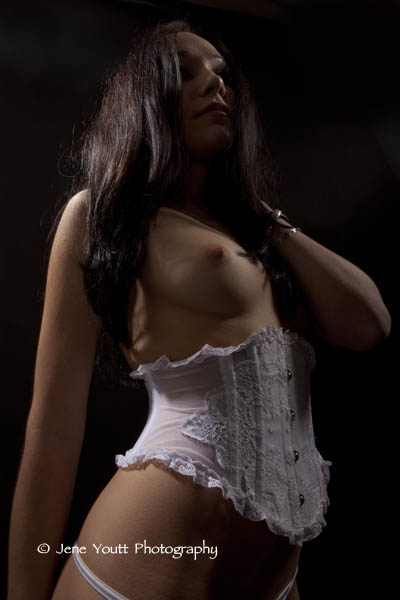
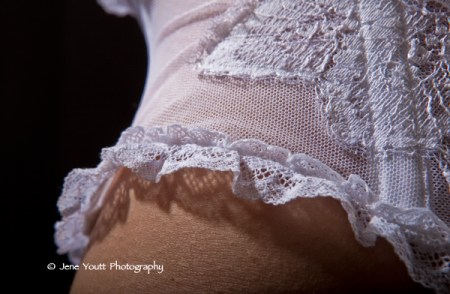
people contact me about all kinds of shoots and at some point i have to ask ‘ have you seen my portfolio? ‘ so it’s nice to find someone who has and likes to improv as i do. we began with her dressed in a white corset outfit and like every other thing in life new beginnings are delicate dance.

young woman

cute huh. but we were both pretty bored with this setting  so we moved the chair out of the way and i decided to explore something i’ve been think to do.

white corset

then CB we move in for our close up

young girl in white corset

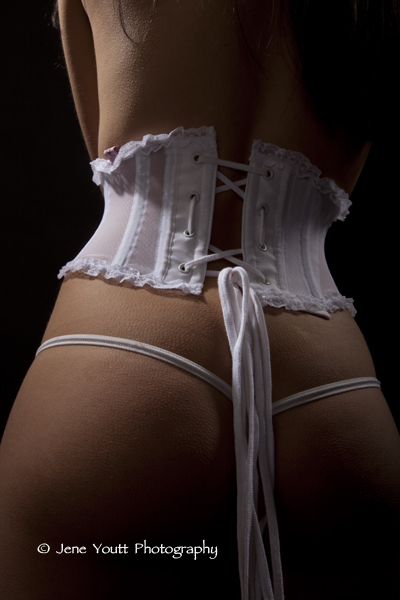
white corset back

closer

close-up

corset laces

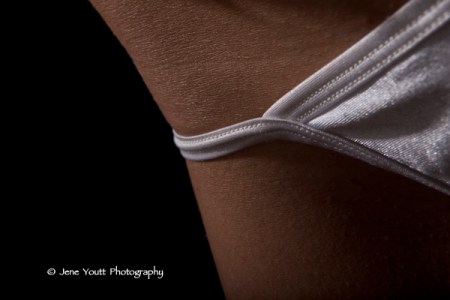
and i became fascinated with how close i could get with my lens, it not being a micro, and still get an erotic feeling to this session. so i moved the model around looking for interesting compositions. as i said we were both exploring, it’s not brain surgery.

white thong

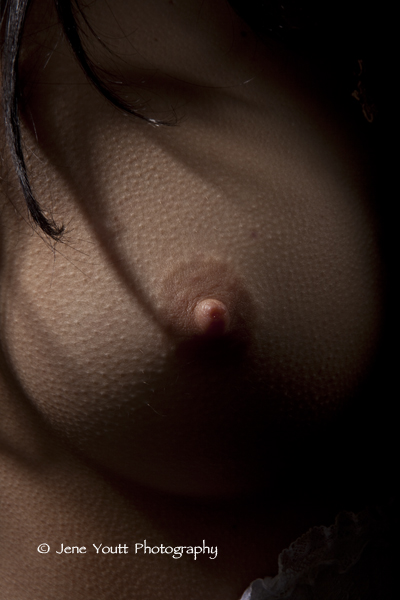
but i would suggest if you’re photographing nudes it might be wise to do it in a warm studio. yes the lights do help somewhat and i wasn’t cold wearing a t-shirt but it might effect the pictures if it’s a bit chilly.

woman's boob with shadow

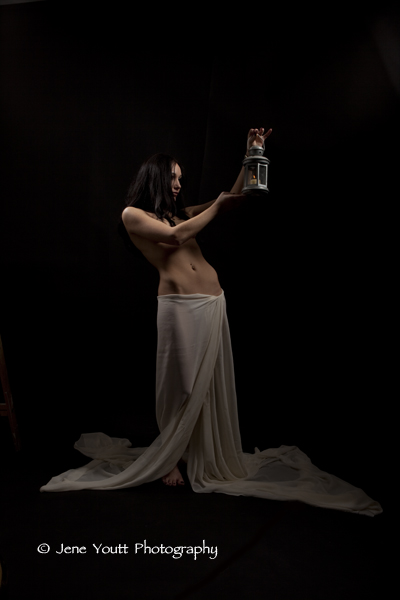
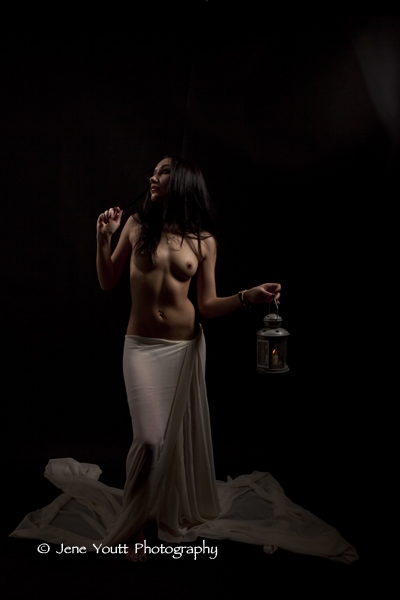
notice a lovely picture of goose bumps. we both like this picture but it’s not going to get this model any work without an explanation. oh well. then she asked if we could do something with a lantern she had seen on a shelf. ‘sure why not?’

Diogenes daughter

she didn’t know who Diogenes was but i am sure people won’t even ask seeing this picture. she loved this when she saw it. i am not sure if i like this one or the one below better.  she loved this picture as one she could send home to mom. that’s nice, i like helping young girls sending wholesome pictures back home from new york, ‘look mom what i’ve been up to?’

i did think she could show this picture to her grand children as to how she looked as a young woman, maybe not something you share with your children but grand children seem safely removed. they might never imagine what you looked like as a youngster.

Diogenes daughter listens

but what the heck we both had fun and no animals were hurt in the process.

jene

no pants subway ride – january 9, 2011, all are invited

January 7, 2011


All are invited to participate in the 10th Annual No Pants Subway Ride. The event will take place at 3:00 PM on Sunday, January 9. Everything you need to know is in this post. Please read it carefully!

REQUIREMENTS FOR PARTICIPATION:

1) Willing to take pants off on subway
2) Able to keep a straight face about it

**THIS IS A PARTICIPATORY EVENT. DO NOT SHOW UP UNLESS YOU PLAN TO TAKE YOUR PANTS OFF. THIS INCLUDES THE MEDIA.**

DETAILS

When: Sunday, January 9 at 3:00 PM, Sharp! (Over by around 5:30)
Where: Six meeting points spread out all over New York City. Details below.
Bring: A backpack/bag and a metro card.
Wear: Normal winter clothes (hat, gloves, etc)
Facebook: You can RSVP to the Facebook Event

Complete logistics below:

HOW IT WORKS

There are six meeting points this year. Take your pick.

Astoria: Meet at Hoyt Playground – Google Map
Brooklyn: Meet by the Old Stone House – Google Map
Downtown Manhattan: Meet at Foley Square – Google Map
Queens: Meet at the Unisphere in Flushing Meadows Park – Google Map
Uptown Manhattan: Meet at the Great Hill in Central Park – Google Map
Williamsburg / Bushwick: Meet at Bushwick Park (AKA Maria Hernandez Park) – Google Map

Everyone should meet at their chosen meeting point at 3 PM. Please be on time. Feel free to be early.

At the meeting points, participants will be organized into groups and assigned a specific train car. Once everyone is divided up we will all head to nearby subway station[s]. Do not talk to others once you enter the subway system. No one knows each other.

Sit in the car as you normally would. Read a magazine or whatever you would normally do. Your team leader will have already divided you into smaller groups, assigning your group a specific stop where you will depants.

As soon as the doors shut at the stop before yours, stand up and take your pants off and put them in your backpack. If you’d like to use a briefcase, purse, grocery bag, or whatever instead of a backpack that’s fine too. If anyone asks you why you’ve removed your pants, tell them that they were “getting uncomfortable” (or something along those lines.)

Exit the train at your assigned stop and stand on the platform, pantless. You will wait on the platform for the next train to arrive. Stay in the exact same place on the platform so you enter the next train in the same car as you exited the last train.

When you enter, act as you normally would. You do not know any of the other pantless riders. If questioned, tell folks that you “forgot to wear pants” and yes you are “a little cold.” Insist that it is a coincidence that others also forgot their pants. Be nice and friendly and normal.

All train routes will converge on Union Square. Your exact route will be explained at the meeting point, and may involve a transfer.

You can wear fun underwear if you like, but nothing that screams out, “I wore this because I’m doing a silly stunt.” Wear two pairs of underwear if it makes you feel more comfortable. Don’t wear a thong or anything else that might offend people. Our aim is to make people laugh, not piss them off.

If you haven’t already, please take a moment to read about previous No Pants Subway Rides.

Please leave your cameras at home and resist the temptation to snap photos with your iPhone, etc. while the event is happening. Take as many as you like before and after the event, but during the ride we really want people to enjoy the experience of participating rather than documenting. It detracts from the mission if everyone is taking photos of each other rather than keeping a straight face. Don’t worry, we have photographers assigned to every meeting point who will take great photos.

This is always a blast, and we look forward to seeing you there. You may bring along friends if you like, but make sure they get a chance to read all of these instructions.

See you on the 9th!

(Information for participating in other cities is here.)

Be aware that by participating, you recognize that Improv Everywhere is not liable in the event you are injured, arrested, or worse. By choosing to participate you are still responsible for your actions.

Corinne Day, Photographer of Kate Moss, Is Dead

September 2, 2010
By DOUGLAS MARTIN Published: September 1, 2010
Corinne Day, whose frank, unadorned photos of a teenage Kate Moss in the early 1990s helped inaugurate a new era of gritty realism in fashion photography that came to be called “grunge,” died Friday at her home in Denham, a village in Buckinghamshire, England.
Dafydd Jones/WireImage

Kate Moss, left, and Corinne Day at the National Portrait Gallery in London in 2007.

The cause was a cancerous brain tumor, said her agent, Susan Babchick. According to her Web site, Ms. Day was 45, but public records indicate she was 48.

Ms. Day’s passion to record the most profound human experiences with a camera was never more evident than the day in 1996 when the tumor was discovered after she had collapsed in New York. She promptly asked her husband to shoot pictures of her, and they continued the project through her treatment and decline.

“Photography is getting as close as you can to real life,” she said, “showing us things we don’t normally see. These are people’s most intimate moments, and sometimes intimacy is sad.”

Ms. Day built her reputation on unrelenting visual honesty. She refused to airbrush the bags from under models’ eyes or de-emphasize their knobby knees. She eschewed pretty locations or even studios in favor of shooting people in their own environments.

see the rest of the NYTimes article here

Vogue “ITALIA” Takes On The Gulf Oil Spill

August 12, 2010

With Photographer Steven Meisel
Written by Lisa Orkin Emmanuel, APWriter
Wednesday, 11 August 2010 01:51

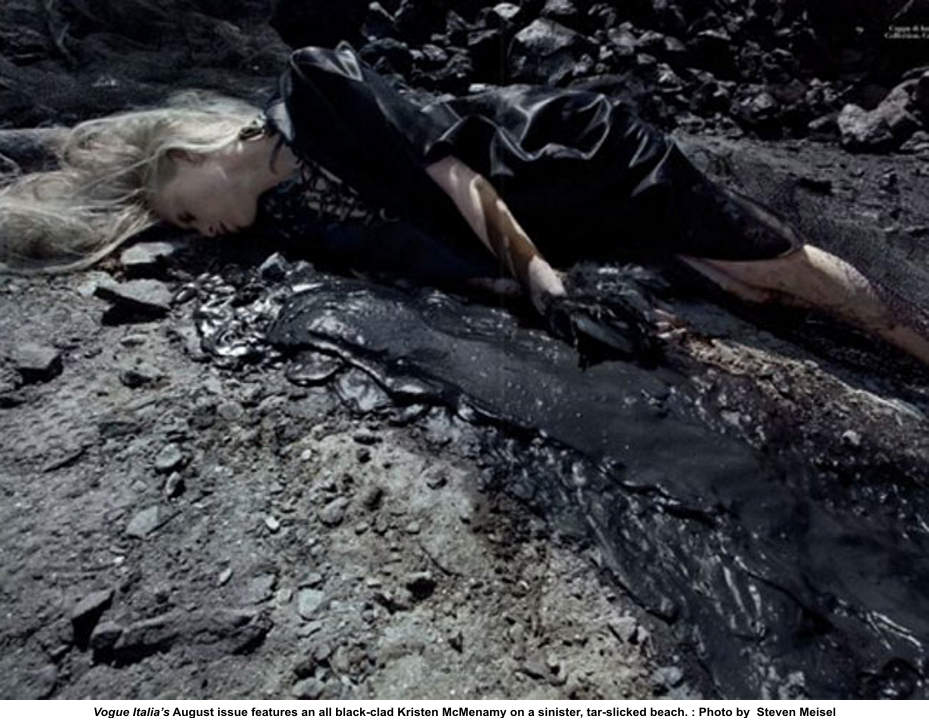
Vogue Italia’s August issue features an all black-clad Kristen McMenamy on a sinister, tar-slicked beach. : Photo by Steven Meisel

Vogue-Italia-August-Cover

Vogue-Italia-August-Cover

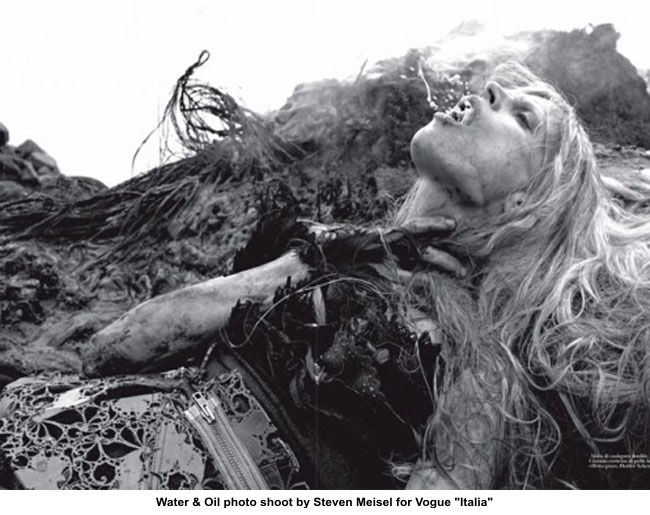
MIAMI (AP).- The model is in black, prone and dirty on jagged rocks, netting draped around her legs like a dead sea creature. There she is again, lying on her back in a feathered dress, and in close up, her hair and face sleek with oil. A stirring photo spread in the August issue of Vogue Italia was inspired by the Gulf oil spill, leaving readers wondering if the magazine crossed from evocative to insensitive. Editor-in-Chief Franca Sozzani understands the debate stretching from blogosphere to beaches and said the motivation is straightforward. “The message is to be careful about nature,” she said by telephone from Milan, Italy. “Just to take care more about nature. … I understand that it could be shocking to see and to look in this way these images.”

The spread, featuring Kristen McMenamy, is titled “Water & Oil” and was shot in Los Angeles by a leading fashion photographer, Steven Meisel. In another of the photos, the gray-haired McMenamy is covered in oil, spitting up water while clutching her neck.

Water-and-Oil-Steven-Meisel-Vogue-Italia

Water-and-Oil-Steven-Meisel-Vogue-Italia

Virginia Contreras of Navarre, Fla., said the photos were making light of the disaster. “I think they are making light of the oil spill. Everyone isn’t going to the beaches and people have lost their jobs here because of the oil,” she said.

Sozzani said the shoot reflects the magazine’s effort to “find an idea that comes from real life. … There is nothing political. There is nothing social. It’s only visually. We gave a message but in a visual way.”

Some bloggers weren’t pleased. Dodai Stewart, deputy editor of Jezebel, called the spread inappropriate. “I didn’t feel it made a statement,” she said in an interview. “I felt that they used the oil spill as a backdrop. There was one picture that had feathers. … What makes a stronger statement about oil-slicked birds is an oil-slicked bird.”

Miranda Lash, curator of modern and contemporary art at the New Orleans Museum of Art, said artists should be free to take on any topic. “When I look at it, I feel pain. It evokes pain and a feeling of loss and sadness because this is going to hurt my region for a very long time,” Lash said.

Beth Batton, curator of the permanent collection at the Mississippi Museum of Art in Jackson, Miss., said in an e-mail that the spread humanizes the condition of the Gulf coast animals and environment. “Looking at Steven Meisel’s photographs, you know something is terribly wrong because, as sensual as the images are, the human mind understands the toxicity of the oil that has coated model Kristen McMenamy’s skin, hair, and feathery gloves,” she said.

On Twitter, type in keywords Vogue Italia and you’ll get various opinions.

Brandie Hopstein, who lives in New Orleans, tweeted about the shoot after seeing the photos days ago. “There is this oil spill going on. It’s not going to be slipped under the rug,” she said. “I happen to love the shoot.”

Angelia Levy of Silver Spring, Md., tweeted that the spread was “kind of iffy, but it’s provocative.” She said she wasn’t offended, and questions whether an American magazine would have run it. “There is no way that would go down,” Levy said. “It seems distant for them so they can afford to have models rolling around in oil.”

While we’re not sure, we have to assume Meisel shot this spread as a response to the environmental tragedy that is the 107-day old Gulf oil spill. And while the irony of using clothing worth thousands of dollars that was probably flown halfway around the world for the shoot is not lost on us, we can’t help but think that if this isn’t art, we don’t know what is….said Art Knowledge News

By: Lisa Orkin Emmanuel, Associated Press Writer / Associated Press Writer Melissa Nelson in Pensacola, Fla., also contributed to this report.

courtesy Art Knowledge News

jene

Richard Avedon’s Lively Fashion Images at the Museum of Fine Arts, Boston

August 12, 2010

Richard Avedon’s Lively Fashion Images at the Museum of Fine Arts, Boston

Written by Vincent Baldino
Wednesday, 11 August 2010 01:53
BOSTON, MA.- Richard Avedon (1923–2004) was the man who brought fashion photography to life. Instead of perpetuating static images of human mannequins posing stiffly in magazines, Avedon depicted his models as real women whose energy and exuberance complemented their modern lifestyles. Considered one of the great image-makers of the 20th century, he redefined fashion photography and his lasting contributions are explored in the traveling exhibition Avedon Fashion 1944–2000, a major retrospective devoted exclusively to his work in this medium. On view in the Foster Gallery at the Museum of Fine Arts, Boston (MFA), from August 10, 2010, through January 17, 2011, the exhibition highlights approximately 140 objects, including photographs, magazines, engravers’ prints, and contact sheets that span almost six decades of his successful career.
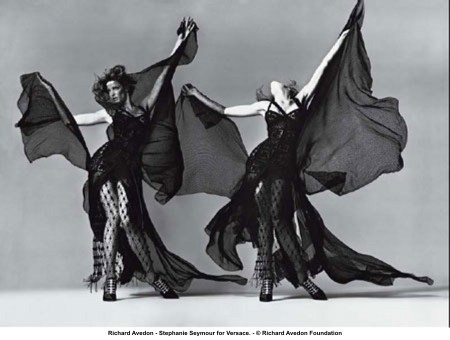
Richard-Avedon-Seymour-Versace

Richard-Avedon-Seymour-Versace

Avedon Fashion 1944–2000 examines Avedon’s years as a photographer who helped shape the image of the fashionable woman, drawing from thousands of pictures he took as staff photographer for Harper’s Bazaar and Vogue. It unfolds by decade, with the greatest emphasis on the classic work from the 1950s and 1960s, when Avedon’s distinct vision of the ideal American woman revolutionized magazine photography.

“Richard Avedon was one of the greatest photographers of all time, who forever transformed the way we look at fashion. The MFA is delighted to be able to showcase his supremely stylish and important work,” said Malcolm Rogers, Ann and Graham Gund Director of the Museum of Fine Arts, Boston.

Richard Avedon – Veruschka, dress by Kimberly, New York, January 1967. – © Richard Avedon FoundationThe exhibition begins with elegant, romantic, and lively images taken in Paris, where he visited extensively from 1947 to 1965 on assignment for Harper’s Bazaar.
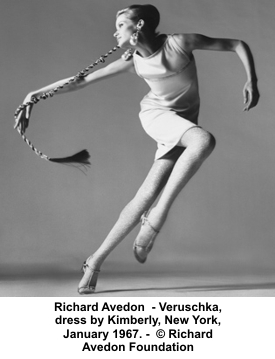
Richard-Avedon-Veruschka

Richard-Avedon-Veruschka

Despite the bleakness of the post-war years, Paris still represented the height of sophistication, and Avedon infused his photographs with a sense of optimism, helping the City of Light reclaim its position as the capital of the fashion world. The photographer created imaginative narratives—sometimes continued through several issues of the magazine—highlighting couture collections and featuring his favorite models: Dorian Leigh, her sister Suzy Parker, Sunny Harnett, Dovima, Carmen, Elise Daniels, and even his wife, Doe Avedon. He took these smartly outfitted women out of the studio and photographed them in French locales: Daniels, dressed in a Balenciaga suit, watching street performers in the Marais district in 1948; Harnett, in an evening dress by Grès, playing roulette at the Casino in Le Touquet, France, in 1954; and Parker, draped in a Grès gown, sitting near cancan dancers at the Moulin Rouge in 1957. Avedon’s famous night scenes in Paris, which began in 1954, broadened his creative range. Like movie sets, the complex fashion shoots he directed used generators to light up entire city blocks, allowing him to capture stylish bon vivants enjoying Parisian nightlife.

During his early years at Harper’s Bazaar, fashion photographs by Avedon were more than just a vehicle to market luxurious clothing to post-World War II American women—they were the embodiment of a dynamic lifestyle. His expressive images celebrated spirited women laughing, jumping, and dancing—even roller skating in Paris—all while wearing the most beautiful clothes.

“Those candid snapshots were in direct contrast to what was being done. I came in at a time when there weren’t any young photographers working in a free way. Everyone was tired, the war was over, Dior let the skirts down, and suddenly everything was fun. It was historically a marvelous moment for a fashion photographer to begin. I think if I were starting today, it would be much harder,” said Avedon in 1965.

The son of a women’s clothing store owner (Avedon’s Fifth Avenue), Avedon became fascinated with fashion photography as a boy. As a young man, he joined the Merchant Marine (1942–44), where he was assigned to the photography division. After leaving the service, Avedon enrolled in design classes at the New School for Social Research taught by Alexey Brodovitch, the art director of Harper’s Bazaar. In 1944, at age 21, Avedon joined the magazine, primarily as a photographer for Junior Bazaar. Shortly thereafter, he became an official staff photographer, working with the now legendary figures Carmel Snow, Brodovitch, and Diana Vreeland.

During the height of his career, Avedon became fashion photography’s most influential and prolific practitioner. His style was energetic and playful, with a flair for the dramatic, and while Avedon’s location shoots were groundbreaking, his major studio shots were also ingeniously inventive. The photographer illustrated the excitement of the “new look” of Dior—featuring cinched waists and voluminous circle skirts—by showing his model twirling on a Parisian street (Renée, “The New Look of Dior,” Place de la Concorde, Paris, August 1947). He developed the “Avedon blur” using variable focus, a technique creating a subtle background scene while highlighting the model in the foreground, as seen in an image of a well-turned ankle showing off a fur-trimmed bootie in front of the softly visible Eiffel Tower (Shoe by Perugia, Place du Trocadero, Paris, August 1948). Avedon also liked to show models “behind-the-scenes”—sitting at a café, seemingly in tears (Elise Daniels, turban by Paulette, Rue François-Premier, Paris, August 1948); assessing an outfit in the mirror (Dorian Leigh, evening dress by Piguet, Helena Rubenstein’s apartment, Île Saint-Louis, Paris, August 1949); or shown within the backdrop of a studio set (Suzy Parker, evening dress by Dior, Paris, August 1956). In many of his photographs, dogs and other animals share center stage with the models—Dovima in a Balenciaga suit and Sacha, an afghan, sitting next to one another outdoors at the Café des Deux Magots, Paris (1955), or Dovima in a Dior evening dress, shown alongside elephants at the Cirque d’Hiver (1955)—one of the photographer’s many iconic images.

Avedon was one of the most engaging image-makers of the 20th century. He revolutionized fashion photography with his dynamic images that set an ideal of the modern American woman. His enormous success led to great fame, and the status he attracted helped define the role of the high-profile fashion photographer that we are familiar with today,” said Anne Havinga, the MFA’s Estrellita and Yousuf Karsh Senior Curator of Photographs, who is responsible for the show in Boston with Emily Voelker, the MFA’s Estrellita and Yousuf Karsh Assistant Curator of Photographs. The exhibition was curated by Carol Squiers, curator, and Vince Aletti, guest curator, for the International Center of Photography (ICP), in conjunction with The Richard Avedon Foundation, New York.
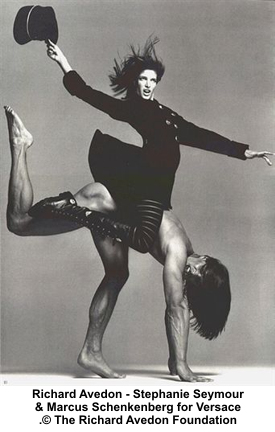
Richard-Avedon-Stephanie-Seymour

Richard-Avedon-Stephanie-Seymour

Avedon’s innovative approach enlivened the vocabulary of fashion photography, and even made him famous. The 1957 movie musical Funny Face is loosely based on Avedon, who served as the visual consultant for the production. Starring Fred Astaire as “Dick Avery,” a photographer working in New York and Paris, it co-starred Audrey Hepburn as his muse, a model chosen for her spirit and intelligence. Avedon’s own models were not only beautiful, but also embodied the idealized American woman, who had wit, personality, confidence, and a sense of adventure. They also reflected Avedon’s awareness of social and cultural changes. He was the first major photographer to use models of color, such as China Machado, a Portuguese-Chinese beauty he featured in the 1950s, or Donyale Luna, a sinewy model of African, Mexican, Egyptian, and Irish descent he worked with in the 1960s. His images elevated many of his models to celebrity status, especially in the 1960s and ’70s, when he worked with Jean Shrimpton, Lauren Hutton, Anjelica Huston, Twiggy, Penelope Tree, and Veruschka. In the 1980s and ’90s, his photographs helped bring supermodel fame to Kate Moss, Naomi Campbell, and Stephanie Seymour.

Avedon Fashion 1944–2000 includes a wide range of photographs that document the 1960s era, when advances in technology and demands for social reform became part of the evolving modern American experience. Among them are Avedon’s pictures of models wearing the “mod” fashions of the period at Cape Canaveral near an Atlas missile, or in the spacesuit-inspired fashions of André Courrèges, as seen in the famous April 1965 Harper’s Bazaar, the magazine’s 20th anniversary edition, which Avedon guest edited. The cover featured a Pop Art-inspired photograph by Avedon of Shrimpton in a day-glo pink helmet—the same photograph that appears on the cover of the exhibition’s catalogue, Avedon Fashion 1944–2000 (Abrams, New York, 2009). The photographer also embraced changing social mores with his forays into imagery that included nudity, or were discreetly erotic, as seen in his depiction of a suggested “ménage a trois” (Natty Abascal and Ana-Maria Abascal with model Helio Guerreiro, bathing suit by Brigance, Ibiza, Spain, September 1964).

In 1966, Avedon joined Vogue, where Vreelend had become its editor-in-chief. He captured the youthful brashness of the 1960s and turned Brooke Shields, Isabella Rossellini, and Barbra Streisand into fashion icons. With Vreeland’s approval, he also sought out quirky, unconventionally beautiful models, such as the wide-eyed waifs Penelope Tree and Twiggy, for his compelling photographs featuring Pop Art and “mod”-inspired fashions. Avedon’s work was included in most issues of Vogue until the mid 1970s. Vreeland was dismissed from the magazine in 1971, but Avedon stayed on, taking every cover photograph after 1980 until he quit in 1988. Avedon also photographed many imaginative advertising campaigns during his long career for clients including Versace, Calvin Klein, and Dior. In 1992, he was named the first staff photographer for The New Yorker, where his post-apocalyptic, wild fashion fable “In Memory of the Late Mr. and Mrs. Comfort,” featuring model Nadja Auermann and a skeleton, was published in 1995. In these later years, Avedon continued to contribute to Egoïste, a journal of fashion and the arts, where his photographs appeared from 1984 through 2000. He also pursued his own work as a portraitist, photojournalist, and the author of photography books until his death in 2004. His innovations are still evident in portraiture and fashion photography today.

Visit the Museum of Fine Arts, Boston at : http://www.mfa.org/

posted from Art KnowledgeNews

jene