Archive for the ‘art’ Category

just to keep things interesting; a female nude

June 30, 2010

female nude from a session a while ago.

female nude

female nude

interesting landscape of hills and valleys one could almost imaging skiing across this terrain if covered in snow. but then again the human body is always interesting coming or going.

female nude

more hills and valley's

in both of these images i had to retouch her body. the top image she had shaving bumps in the folds of her raised leg and some other stuff going on but this was the simpler of the two images. the bottom i had to remove panty lines from her rear and legs and touch up stretch marks on her breast, seems even young women get them. all bodies have some imperfections bumps, pimples or discolored areas. no big deal but that’s the price i pay for being a small operation. so much goes into just taking a picture and showing them.

advice to young female models: take care of yourself, cream your skin, it’s your best asset.

oh well

jene

Heat Waves in a swamp,The Paintings of Charles Burchfield

June 25, 2010

NEW YORK, NY.- The Whitney Museum of American Art focuses on the work of the visionary artist Charles Burchfield (1893-1967) in an exhibition curated by acclaimed sculptor Robert Gober. Heat Waves in a Swamp: The Paintings of Charles Burchfield features more than one hundred watercolors, drawings, and paintings from private and public collections, as well as selections from Burchfield’s journals, sketches, scrapbooks, and correspondence. Organized by the Hammer Museum, in collaboration with the Burchfield Penney Art Center in Buffalo, the exhibition provides the most comprehensive examination to date of an underappreciated modernist master. Whitney senior curatorial assistant Carrie Springer is overseeing the installation in the third-floor Peter Norton Family Galleries, where it will be on view from June 24 through October 17, 2010.

Born in 1893 in Ashtabula Harbor, Ohio, and raised nearby in Salem, Burchfield spent most of his adult life in upstate New York, in Buffalo, where he moved in 1921, and the neighboring suburb of Gardenville. Working almost exclusively in watercolor on paper, his principal subject was his experience of the natural world, which led him to create deeply personal landscapes that are often imbued with highly expressionistic light. His works quiver with color and the almost audible sounds of humming insects, rustling leaves, bells, birds, and vibrating telephone lines. In 1945 he noted, “It is as difficult to take in all the glory of a dandelion, as it is to take in a mountain, or a thunderstorm.”

Charles-Burchfield-Autumnal-Fantasy

Contemporary artist Robert Gober has curated previous exhibitions, most notably The Meat Wagon at the Menil Collection in Houston, in 2005, drawn from the diverse selection of works in the Menil’s holdings. With this exhibition, Gober – who discovered that his interest in Burchfield was shared by Hammer Director Ann Philbin and coordinating curator/Hammer Deputy Director Cynthia Burlingham – is for the first time curating a large-scale monographic show of another artist’s work. The exhibition is arranged chronologically, with each room presenting a distinct phase of Burchfield’s career. Exploring both physical and psychological terrain, Gober has augmented the selection of Burchfield’s works with extensive material that sheds light on the artist’s thoughts about his work and artistic practice. Burchfield (with much help from his wife, Bertha) left a trove of well-maintained sketches, jottings, notebooks, journals, and ephemera spanning his entire career. This material is now part of the Burchfield Penney Art Center at Buffalo State College.

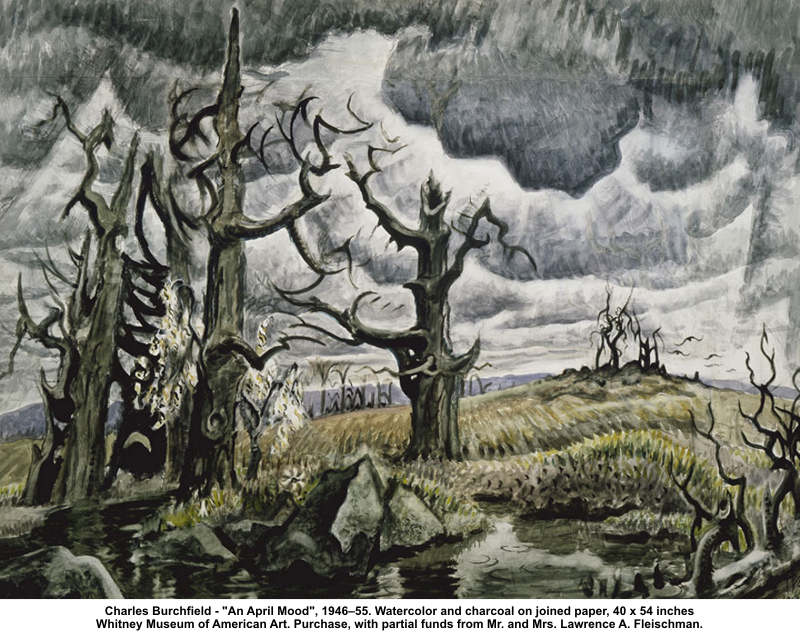
an april mood

Charles Burchfield – “An April Mood”, 1946–55. Watercolor and charcoal on joined paper, 40 x 54 inches Whitney Museum of American Art. Purchase, with partial funds from Mr. and Mrs. Lawrence A. Fleischman.
The title of the show, Heat Waves in a Swamp, comes from the title of a Burchfield watercolor. Gober writes of Burchfield in his catalogue introduction: “He loved swamps and bogs and marshes. He loved all of nature and was torn as a young man between being an artist and being a nature writer. He liked nothing more than to paint while literally standing in a swamp. Liked the mosquitoes and the rain and the decay of vegetation. I felt early on that this title had a metaphorical sweep that captured Burchfield’s enthusiasms at their deepest and best.”

Charles Burchfield – “Black Iron”, 1935 (detail) Watercolor on paper, 281⁄8 x 40 in. Private collection.The exhibition begins with work Burchfield created in 1916 while living in Salem, Ohio, and follows his career with particular attention to transformative and reflective moments in his life and work. Among the earliest works is a 1917 sketchbook entitled “Conventions for Abstract Thoughts,” which includes a series of symbolic drawings depicting human emotions. The abstract forms in these drawings would reappear in Burchfield’s work for years to come.

A room is dedicated to a series of works that were shown in a 1930 exhibition at The Museum of Modern Art, Charles Burchfield: Early Watercolors, 1916 to 1918, the first show at MoMA devoted to a single artist. Correspondence between Burchfield and MoMA’s legendary curator/director Alfred Barr will be shown alongside the work. As Gober notes, “Burchfield’s complex communion with nature, as seen in these early watercolors, would resurface later, becoming the inspirational touchstone for the work of the last two decades of his life.”

From 1921 to 1929 Burchfield worked as a designer at the M. H. Birge & Sons wallpaper factory in Buffalo. His designs, like all his art, were based in nature and reveal such diverse influences as Japanese woodcuts by Katsushika Hokusai and Ando Hiroshige, Chinese scroll paintings, and the illustrations of Arthur Rackham. Burchfield’s work as a wallpaper designer during the 1920s is featured in a room that includes watercolors from the same period hanging on walls covered in a reprint of one of his designs. When the opportunity arose to show his paintings at the Frank K. M. Rehn Galleries in New York, Burchfield gave up his job and decided to paint full time.

Burchfield accepted commissions from Fortune magazine to paint railroads in Pennsylvania, sulphur mines in Texas, and coal mines in Virginia. Many of his paintings of this period deal with the rural and industrial worlds around him and present these worlds in a less fantastical way than in his earlier watercolors. By the mid-1930s, Burchfield was celebrated for his realist depictions of the American landscape. In 1943 Burchfield faced a creative crisis as he was approaching fifty and the country was in the middle of World War II. At that point he began to look back at his earlier watercolors and to expand them. The exhibition reunites two pivotal paintings, both completed in 1943 within a month of each other, although one was begun in 1917 and the other in 1934. These two paintings, The Coming of Spring and Two Ravines, were the works that marked Burchfield’s transition from crisis to the extraordinary achievements of his last two decades. Gober notes, “He felt that his work had lost the intensity of his early watercolors, and in his struggle to make works that he felt reflected the best possibilities for his creativity, he took early drawings and physically expanded them to make these two landmark works.”

Although he struggled with health problems during the 1950s and 60s, until his death in 1967, Burchfield created some of his most vibrant and fascinating works toward the end of his life. As Gober writes, “The works from this period of Burchfield’s life are immersed in what he perceived as the complicated beauty and spirituality of nature and are often imbued with visionary, apocalyptic, and hallucinatory qualities. In these large, late watercolors, Burchfield was able to execute with grace and beauty many of the painting ideas that he had developed as a young man…And in so doing, he transformed himself and his practice, producing one of the rarest events in the life of any artist: great art in old age.” Visit The Whitney Museum of American Art at : http://www.whitney.org/

www.artknowledgenews.com

see  a review in todays nytimes ‘Nature, up close and personal.’ http://www.nytimes.com/2010/06/25/arts/design/25burchfield.html?th&emc=th

Adobe Portrait Commissions Available

June 23, 2010

here is something i came across the other day that might be of interest to some of you. i know nothing more about it than what is written here. good luck

Sun Jun 20, 2010 10:28 am (PDT)

Adobe Portrait Commissions Available
If you are interested in doing a series of portrait posters in any 20/21st
century art style or media preferably the one of the Pop Art Portrait Styles
or anything that can be produced by Adobe Photoshop, Adobe Illustrator ,
Coreldraw, Paintshop Pro or a similar software package, please contact me to
receive more information and a few dozen examples of the submissions we have
received .

Examples of Pop Art Portrait Styles
http://www.google. com/images? um=1&hl=en& client=gmail& rls=gm&tbs= isch:1&sa= 1&q=Pop+Art+ Portraits& aq=f&aqi= g1g-m1&aql= &oq=&gs_rfai=<http://www.linkedin .com/redirect? url=http% 3A%2F%2Fwww% 2Egoogle% 2Ecom%2Fimages% 3Fum%3D1% 26hl%3Den% 26client% 3Dgmail%26rls% 3Dgm%26tbs% 3Disch%3A1% 26sa%3D1% 26q%3DPop% 2BArt%2BPortrait s%26aq%3Df% 26aqi%3Dg1g- m1%26aql% 3D%26oq%3D% 26gs_rfai% 3D&urlhash= 97uU>

Clearly the Andy Warhol style is preferred and the most easy to use, but
other unique styles are also of interest including caricatures. This project
has now been running for 9 years and over 70% of the posters that have sold
very well are variations of the Warhol Art Style.

Graphic, charcoal, crayon, pastels, pencil and ink portraits are also of
interest. As are acrylic and oil portraits but the end product is posters.
Original art may be bought for Israeli Art Museums but this is secondary to
the primary objective of turning a portrait into a poster…The print run
for the Icon series is 8,000 with commission of $1.00 per copy per digitally
signed copies which will then be numbered and embossed by hand and $2.50 for
copies signed by the artist. Up to 1000 copies will be signed by hand by the
artist in London. (at our expense entirely) All printing in London is
audited by a Big Four Auditor ( E & Y) . Payment in full and immediate is
made when the print run is completed and the hand signing of the posters is
completed. We expect at least 16 different posters from each artist in more
or less the same style and background themes..

If your style of art is original and you are interested in trying the
portrait in it. I would be more than happy to consider your portrait style
for current and future commissions.

The 4 Icon Series are
1. Jewish and Zionist Icons ( the main series) anyone who has appeared on an
Israeli Stamp
http://www-personal .umich.edu/ ~szwetch/ Stamps.of. Israel/<http://www.linkedin .com/redirect? url=http% 3A%2F%2Fwww- personal% 2Eumich%2Eedu% 2F%7Eszwetch% 2FStamps% 2Eof%2EIsrael% 2F&urlhash= GXZy>
( click on the stamp and it will enlarge)
2. Icons of the 20th Century ( 100 Time Magazine Icons)
3. Thinkers of the 20th Century ( again as listed by Time Magazine)
4. Supplementary List ( Open to Suggestions)

If you are interested in more information and couple of dozen examples of
submissions we have received over the last 8 years that have been turned
into posters , please send me an email to my gmail address.
Roger Golden .
Rogergolden8@ gmail.com


Dr Roger Golden
Golden Art Group
New York / Jerusalem/ London

Address for drop shipments and correspondence is
Dr Roger Golden
Golden art Group
Yefet Street 199/9
Tel Aviv 68061
Israel

The Golden Group have been International Interior Decorators since 1912.

The Golden Group is an active buyer of art ,particularly pieces that can be
hung that says “Have a Good Day”. For more details please ask for them. We
accept unsolicited consignment which we deal with within 4 days. Please
ensure that your parcels are described as “Media consignment ” and its value
is recorded as “nominal”. We are very active buyers of reasonably priced
art ( below $1000 a piece) for the Interior Decorating Business. We weekly
receive 8 to 12 consignments and buy over 85%. We only buy art that we
physically see, Over the last decade we have found digital images to be
extremely unreliable..

if you’ve got some spare change, why not attend Polaroids auction

June 18, 2010

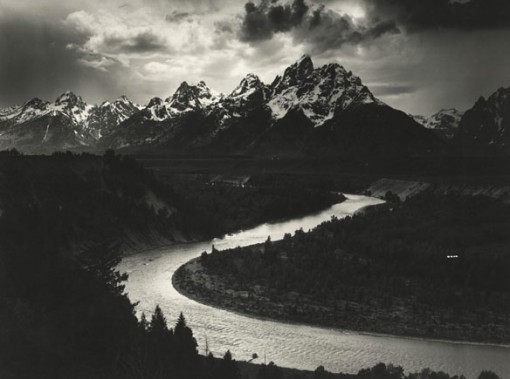
adams Tetons & Snake river

“Tetons and Snake River” by Ansel Adams is one of the many images to go under the hammer later this month. Photo by Ansel Adams.

“Over a thousand photographs from the Polaroid Collection, which includes images from some of the biggest names in photography, like Ansel Adams, Dorothea Lange, Edward Weston, Andy Warhol and Robert Mapplethorpe, will be put up for auction later this month.

Famed auction house Sotheby’s will put 1,200 historic photos under the hammer as part of Polaroid’s court-approved bankruptcy sale. The sale will include the most comprehensive collection of Ansel Adams photographs (400 Polaroid and non-Polaroid images) ever sold.

“It is the largest and best collection of works by Ansel Adams to ever come on the market, representing a broad spectrum of most of his career,” said Denise Bethel, Sotheby’s photography expert.

Masterpieces such as Adams’ “Bridalveil Fall” (valued at up to $100,000) and the massive “Moonrise, Hernandez, New Mexico” (valued as high as $500,000) will go to the highest bidder. The sale also includes Dorothea Lange’s iconic Depression-era “Migrant Mother, Nipomo, California,” which is valued at up to $80,000.

Working as a consultant for Polaroid, Adams helped build the company’s photography collection by acquiring works from masters like Lange, Weston and Imogen Cunningham, as well as those of contemporaries whose work he admired.

Many of the most well-known photographs from the 16,000+ images in the Polaroid collection will go up for sale, and they are expected to fetch a total of over $7 million. Sotheby’s will showcase the images for six days before they are auctioned on June 21-22 in New York.”

thanks to karin & raoul for this post

jene

japan residency anyone?

June 17, 2010

i am disappointed that my age cuts me off from this as i really love japan and the japanese people. oh well good luck youngsters.

CALL FOR ARTISTS / AIAV Residence Program

Akiyoshidai International Art Village has supported cultural and philosophical exchange among international artists through the artists in residence program since its inauguration in 1998. The aim of the Residence Support Program is to support young artists’ experimental artistic activities, crossing the borders of art disciplines and nationalities. The artists will be carefully selected by the Selection Committee of the Residence Program of Akiyoshidai International Art Village. We strongly hope that selected artists will actively communicate with local people in Yamaguchi, participate in different projects, including workshops, lectures, school visits and exhibitions.

Akiyoshidai International Art Village
Residence Program: trans_2010-2011
http://aiav.jp/programs/2010/trans_apply/

Residency period
11 January – 21 March, 2011 [70days]

Number of artists accepted
2 artists of any nationality living outside Japan
1 artist living in Japan or living abroad with Japanese nationality
(Please see the guideline for details.)

Support
– Travel expenses
– Accommodation at AIAV
– Studio
– Production expenses = 230,000 yen (individual) / 280,000 yen (group)
– Per diem = 2,800 yen × day
– Insurance
(Please see the guideline for details.)

How to apply
Please download the guideline and application from the AIAV website:
http://aiav.jp/programs/2010/trans_apply/
Please read the guideline carefully and fill in the application.

Applications should be addressed to

Akiyoshidai International Art Village
Residence Program: trans_2010-2011
50 Akiyoshi, Shuho-cho,
Mine-shi, Yamaguchi
754-0511 JAPAN

*We will not accept applications via e-mail, telephone or fax.

Deadline
Applications must be received by 31 July, 2010.

Result
Result will be announced in the beginning of October 2010

If you had any questions, contact us any time.

Email: trans2010@aiav.jp
TEL: +81 837 63 0020
FAX: +81 837 63 0021

—–Inline Attachment Follows—–

_______________________________________________
opportunities mailing list
opportunities@chashama.info
http://lists.chashama.info/mailman/listinfo/opportunities

Guggenheim Foundation and YouTube Seek Budding Video Artists

June 16, 2010

ever want to push the limits of your creativity, even though or maybe because you own one of canon’s video dslr, i just found out to my disappointment than my 5D MII doesn’t shoot 60 fps while the newer cameras do, it’s just they aren’t full frame. nobody wants to talk about the 5D MIII coming out with this capability or any other thing they might have forgotten.sometimes i just want to switch to nikon but the thought of changing all those lenses and stuff is rather intimidating.

but this isn’t what this post is about my disappointment nor canon’s  latest opps factor. this is about an opportunity for you
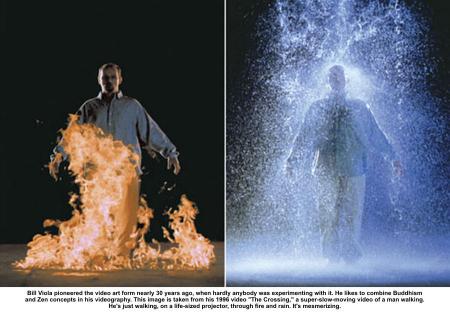
bill viola video artist

bill viola

Bill Viola pioneered the video art form nearly 30 years ago, when hardly anybody was experimenting with it. He likes to combine Buddhism and Zen concepts in his videography. This image is taken from his 1996 video “The Crossing,” a super-slow-moving video of a man walking. He’s just walking, on a life-sized projector, through fire and rain. It’s mesmerizing.

New York, New York – For artists, being included in a museum exhibition generally means first having to penetrate the well-guarded gates of a prestigious art gallery. But now the Solomon R. Guggenheim Foundation and YouTube are aiming to short-circuit that exclusionary art-world system, at least briefly, in much the same way that other hierarchical systems have been blown apart in the Internet age. Beginning Monday anyone with access to a video camera and a computer will have an opportunity to catch the eye of a Guggenheim curator and vie for a place in a video-art exhibition in October at all of the foundation’s museums: the Solomon R. Guggenheim in New York, the Deutsche Guggenheim in Berlin, the Guggenheim Bilbao in Spain and the Peggy Guggenheim Collection in Venice.

The project, called YouTube Play and conceived as a biennial event, is intended to discover innovative work from unexpected sources. It is open even to entrants who don’t consider themselves artists, and actively encourages the participation of people with little or no experience in video. “People who may not have access to the art world will have a chance to have their work recognized,” said Nancy Spector, deputy director and chief curator of the Guggenheim Foundation. “We’re looking for things we haven’t seen before.”

For YouTube the project is one in a series of experiments in tradition busting. In late 2008 it created the YouTube Symphony Orchestra, which allowed any musician to audition for a concert at Carnegie Hall conducted by Michael Tilson Thomas; the previous year it helped create the CNN/YouTube debates, giving everyone with a Web cam a chance to ask a question of a presidential candidate.

“What we’re doing is removing the middle man,” said Hunter Walk, director of product management for YouTube. “Whether it be Carnegie Hall or the Guggenheim, we’re giving people a way to see the aspirational light on the hill. And not just online but in the physical world too.”

While the company does not publicly discuss it, some of its officials say it is also hoping that collaborations with august institutions like Carnegie Hall and the Guggenheim Foundation will attract high-end advertisers.

Applicants will be able to submit their videos (only one entry per person) starting Monday, uploading them on a channel created for the initiative, also called YouTube Play (youtube.com/play). The works must have been created within the past two years and cannot be longer than 10 minutes, made for commercial use or excerpted from longer videos. The deadline for submissions is July 31.

A team of Guggenheim curators will look at all the submissions — the foundation is expecting many thousands, Ms. Spector said — and narrow them down to 200, which will be seen by a jury of nine professionals in disciplines like the visual arts, filmmaking and animation, graphic design and music. (Ms. Spector, who will be a juror herself, is putting the group together.) Although the jurors will know the names of entrants, Ms. Spector said, the makeup of the jury should be diverse enough to prevent art-world or other biases from infecting the process.
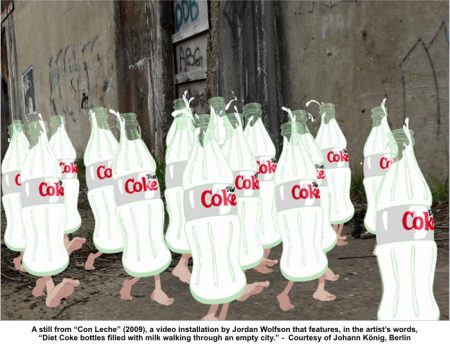
con leche

Then, in October, the jurors’ final selection of 20 videos will be on simultaneous view at all the Guggenheim museums. And the 200 that made it through the first round will be available on the YouTube Play channel.

There will be no first prizes or runners-up among the 20, Ms. Spector said, “because this is not about finding the best, but making a selection that represents the most captivating and surprising work.”

That work could come, the foundation and YouTube say, from any quarter. “Within the last few years you can get a camera and for a few hundred dollars get the tools to create Hollywood magic,” Mr. Walk said. And Hewlett-Packard, which is collaborating on the project, is not only providing hardware to all the Guggenheim museums for displaying the videos, it is also offering online tutorials on YouTube Play to teach skills like editing, animation and lighting to the video-naïve.

While Ms. Spector and YouTube say they created the project as a way of breaking down traditional art-world boundaries, some in that world question how meaningful it really is.

“Hit-and-run, no-fault encounters between curators and artists, works and the public, will never give useful shape to the art of the present nor define the viewpoint of institutions,” said Robert Storr, dean of the Yale University School of Art, the organizer of the 2007 Venice Biennale and a former senior curator at the Museum of Modern Art, in an e-mail message from Europe.

“It’s time to stop kidding ourselves,” Mr. Storr added. “The museum as revolving door for new talent is the enemy of art and of talent, not their friend — and the enemy of the public as well, since it refuses to actually serve that public but serves up art as if it was quick-to-spoil produce from a Fresh Direct warehouse.”

But those involved in the project, naturally, see it differently. “If this is all the Guggenheim did, it would be a problem,” Ms. Spector said. “There are many layers to our programming. And we can’t say at this point that this won’t spawn ongoing relationships with people we discover through this process. One can only hope that it will.”

By : Carol Vogel, NY Times

jene

sold another print this weekend but need to replace it because fedex broke the frame and glass. shipping art is dangerous, maybe i should take up painting again?

hollywood portraits photographers auction

June 16, 2010

well it seems we, you and i, missed an education here but we can still take a look at the catalog of images here.

Auction of the World’s Largest Collection of Original Vintage Glamour Photography

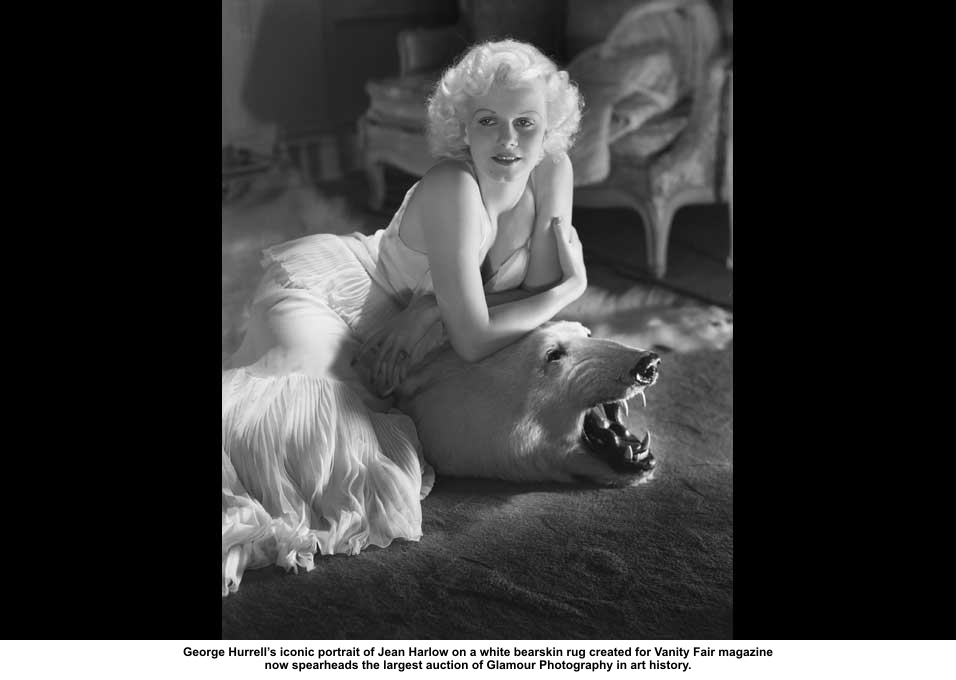
Jean Harlow

JEAN HARLOW

CALABASAS, CA.- George Hurrell’s iconic portrait of Jean Harlow on a white bearskin rug created for Vanity Fair magazine now spearheads the largest auction of Glamour Photography in art history. The original camera negative, as well as a custom print of this incomparable photograph is regarded as Hurrell’s most important portrait and is estimated to sell for well over $20,000. The multi-million dollar Michael H. Epstein and Scott E. Schwimer collection, which contains tens of thousands of the best examples of Hollywood fine art, will be auctioned by Profiles in History March 26-27, 2010. Worldwide bidding begins at 12:00pm (noon) PST both days.

i’ve always loved hollywood portraits and have a few books of them myself. this auction of George Hurrell works and his life always amazes me. how i’d love to be able to produce work like this. to think these images were printed way before photoshop was born.

there were postproduction skills such as photographic printers, guys and gals, though maybe it was an all boys club, who only did printing. the softness of the faces, another lost art of filters, maybe a good lecture to visit next photo expo. but what ever the effect just makes my knees weak.

for more info on this collection see here.

thanks to art knowledgenews.com

new female nudes

June 5, 2010

just fooling around the other day with a new aspiring female model that another photographer had booked for this shoot  inviting me along to share expenses . dave and i have worked together in the past on projects but i had never worked in his studio before. i have a way of taking over a shoot if it’s just left to my devices and dave has no problem letting me do whatever it is that i do.

female headshot

having fun

i try and shoot using one light while dave uses 3 or 4 lights, hey we are all different and there is no one right way of working. but i think for these shots i need to have a backlight for separation. but because of the low ceiling height and the size of dave’s strobes hanging one would not work, so i a though this morning about making a 45 degree reflector for my white lightnings. it should be simple enough, ding! where have i heard that noise before? was i when i bought the xr7 which still isn’t on the road yet?

female nude

pattern

this is where i get bored just popping off photos , how many naked women remain interesting to just look at. i am sure it’s different for everybody but i have a woman at home that i am particular about. so here i used a cloth with large weave to project this pattern.

female nude

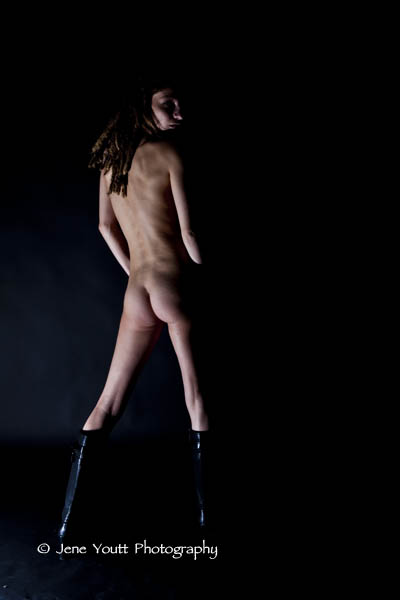
standing naked

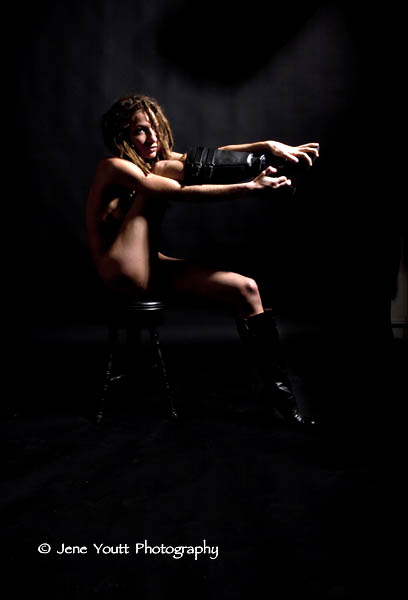
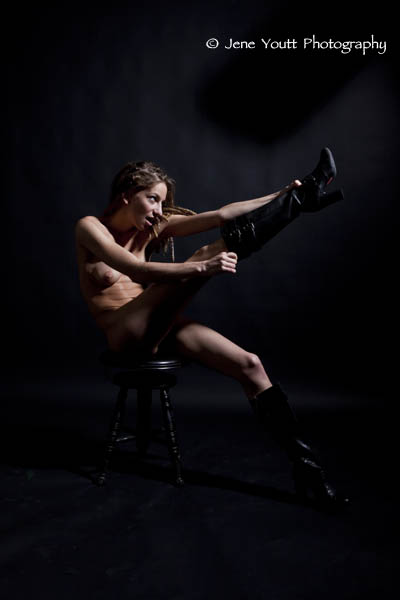
so as i kept tripping over her boots i asked her to put them on, at least i’d know where they were. then adding a chair always looking for interesting patterns.

boots 1

nude female

boots 2

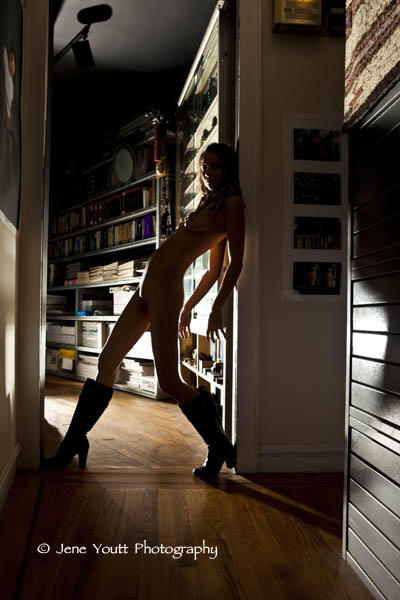
then i got bored again as dave continued to shoot and dug around for a new location in the studio picked this one as a homage to helmut newton at least i like to think so.

female nude

nude leaning

while this image is far from perfect, way too much spill on the background, i had nothing to control the spill with, oh well lets shoot and see what happens. time is money. i guess when i find another interesting model i’ll revisit this location.

so i really don’t have much time to update my web site nor do i want to because i am not really fond of it. i post my new stuff here.

jene

Opportunities RFP for Chashama Windows program at Donnell Library

June 5, 2010
Exhibit Across from the MOMA
chashama–giving artists the space to create
(New York NY)
Since 1995, chashama has championed the movement to repurpose vacant properties in New York City; recycling them into temporary artist studios and gallery spaces, while simultaneously invigorating the surrounding community landscape with an influx of culture, creativity and business.
chashama invites you to submit a proposal to our Windows at the Donnell Library program, for the 2010-2011 season. The Donnell Library is located at 20 West 53rd St. across the street from iconic Museum of Modern Art. We are interested in proposals large enough to fit all seven windows or as small as one windowpane.
Deadline: Rolling.
We will consider applications in the order in which they are received. However we only have 8 openings available.

Required Application Materials:
*Completed application form (pages *4 through 7 of this document).
*1-2 page project proposal.
*1 page (or less) technical requirements.
*Resume/short bios of key participants.

*Work sample ‘slide list’ or list of cue points with descriptions that provide context for the images.

*Work sample (images of previous work, may be on CD)  note: paper CD/DVD sleeves are preferred to cases.
To apply, visit http://www.chashama.org/downloads/donnell_rfp.pdf and follow the instructions.
Mail Materials to:
chashama
ATTN: Donnell Windows
201 East 42nd Street, 32nd Floor
New York, NY  10017

Website: www.chashama.org

Civill Rights exhibit at International Center of Photography

May 25, 2010

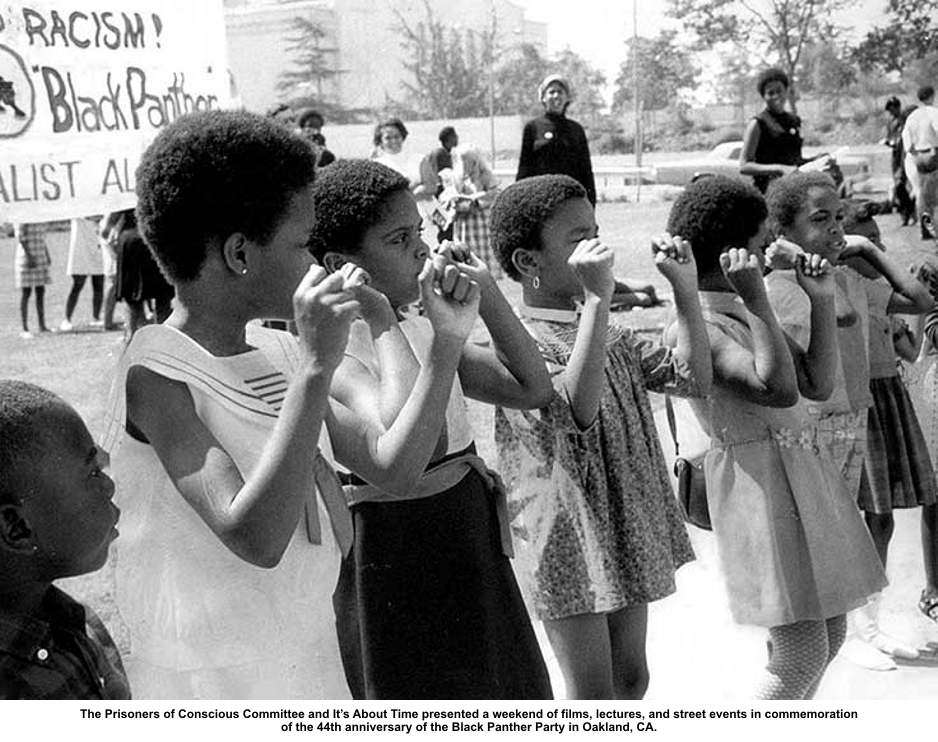
NEW YORK, NY.- A new exhibition at the International Center of Photography, IPC,  offers an innovative view of the Civil Rights Movement and the catalytic social role played by changing portrayals of African Americans in the 1950s and ‘60s. Through a rich juxtaposition of visual images—including photographs, television and film clips, magazines, newspapers, books, pamphlets and posters—the exhibition shows how strategic interventions in these mediums of visual culture helped to transform prevailing attitudes toward race in America. The exhibition, organized by guest curator Maurice Berger, is titled For All the World to See: Visual Culture and the Struggle for Civil Rights, and will be on view through September 12, 2010.

http://www.artknowledgenews.com/

jene