Archive for the ‘art’ Category

In praise of war correspondents, via LA Times

March 2, 2012

Op-Ed, LA Times

February 24, 2012|By Timothy M. Phelps

The deaths of Marie Colvin, Anthony Shadid and other journalists is tragic. But to pull back from war zones would leave untold the stories that must be chronicled.

  • The New York Times foreign correspondent was a two-time Pulitzer Prize winner known for telling the stories of people whose lives were disrupted by war in the Middle East. He was 43.
The New York Times foreign correspondent was a two-time Pulitzer Prize… (Julia Ewan / Washington Post)

Marie Colvin and I covered our first combat together in 1986, after the U.S. bombed Libya. She was 30, pretty, ambitious and talented. She soon had Col. Moammar Kadafi and his aides in her thrall and parlayed her many scoops for United Press International into a job as a foreign correspondent for the Sunday Times of London.

I last saw her a year ago, in Cairo during the revolution. Three decades of bearing witness to war showed in her face: I recognized her only from her black eye patch, which she had worn since a hand grenade destroyed her left eye in Sri Lanka in 2001. She seemed sadder and lonelier, and it was no wonder, given what she had been doing all those years.

Other correspondents cover conflicts for a few years and move on. Marie made war a steady diet. She was at the front lines in Iraq (during three different wars), Chechnya, Gaza, Lebanon, Afghanistan, Sri Lanka, Libya and many other places. She had defied death so many times, she seemed immortal. But then, on Wednesday, she was killed by a rocket while covering the conflict in Syria.

Her death came less than a week after that of Anthony Shadid, also in Syria. The New York Times correspondent — a friend from the old days and a former colleague — had sneaked into Syria to report on the violence there and apparently succumbed to an asthma attack triggered by the horses of the guides leading him back to Turkey.

Marie would not have been in the rocket’s path, and Anthony would not have been near those horses, if they had not considered it their duty to tell the world what was happening to the civilians of Syria.

Anthony’s calling card was his fluency in Arabic and the elegance of his writing. People in the Arab world are often portrayed one-dimensionally in the Western press, partly because correspondents are able to talk to them only through an interpreter. Born in Oklahoma City and educated at the University of Wisconsin in Madison, Anthony went to Cairo as a reporter for the Associated Press, determined to master the language of his grandparents and to use his skills to convey the complexity of life in the Middle East. In his quest to do so, he was shot in the shoulder while covering the West Bank in 2002 and captured by the Libyan army and held for a week last year.

I am often asked why journalists willingly put themselves in harm’s way. Anthony was a star, with two Pulitzer Prizes, who had nothing left to prove. Marie, who had been married but was childless, had more combat experience than any general but had no desire to stop.

Part of the reason war correspondents keep going is that there is thrill in danger, a thrill exacerbated by the closeness of death. But the larger, much more important answer is that they feel an overwhelming sense of duty to those whose lives have been torn apart by conflict. Would President Obama have intervened in Libya last year if U.S. journalists had not been covering the plight of the people of Benghazi? Could more coverage from the Western press have whipped up sentiment to stop a genocide in which 800,000 people died in Rwanda in 1994? What will stop the Syrian army from continuing to shell and shoot its own people if the stories of people like the 2-year-old baby whose death Marie chronicled in the days before her own death aren’t being told?

Shadid told NPR’s Terry Gross recently about an earlier illegal foray he made into Syria, saying he felt he had to go because “that story wouldn’t be told otherwise.” That story was so important, he said, “that it was worth taking risks for.”

But not, as war correspondents often say to one another, worth getting killed for. As if we could prevent death by making that distinction.

A number of journalists lost their lives covering the war in Iraq. But not a single U.S. staff correspondent was killed by hostile fire during eight years of war. Now, in less than a year we have lost, among others, photojournalists Tim Hetherington and Chris Hondros in Libya, and Anthony and Marie, along with French photographer Remi Ochlik, in Syria.

Losing these courageous journalists is tragic. But there is also reason to worry about another tragedy in the offing: the pulling back of media outlets from covering wars.

Part of the reason is cost. Covering wars can be expensive, as we discovered in Iraq. There, Western news agencies took serious security precautions, buying expensive armored cars, hiring armed guards and carefully calibrating their reporters’ movements with the help of security consultants. That wasn’t feasible in fast-moving Libya, and it is impossible in Syria, where reporters have to operate mostly undercover because of restrictions on their movements.

Still, some editors, concerned about safety and facing shrinking budgets, have begun to pull back. Indeed, Marie’s editor told her mother he had told her to leave Homs, that it was too dangerous. Marie had promised to leave after one more day. Now, with Homs surrounded and without a functioning morgue, it is unlikely she’ll return home even in death.

No editor wants to place a correspondent in jeopardy. But I know that Marie and Anthony would not want their deaths to be used to justify retreating from dangerous but important journalism.

Timothy M. Phelps, an editor in The Times’ Washington bureau, covered the Middle East for Newsday from 1986 to 1991.

hopefully this is going to be the last in this tragic series. this news is being fed to me and i’ve no idea why. because of my temporary health problem i am not shooting anything myself so i must feel that loss and it’s connecting with these human losses. that’s the only thing i can figure out but hey i never said i was the brightest bulb around.

but i’ll move on as does life.
jene youtt

Edith Bouvier, French reporter wounded in Syria, has been evacuated:

March 2, 2012
By Dylan Stableford | The Cutline – 5 hrs ago

Bouvier (AP)

Edith Bouvier, a French reporter wounded in the attack that killed American reporter Marie Colvin and French photographer Rémi Ochlik and injured several others in Homs, Syria, has been successfully evacuated to Lebanon, according to France 24.

One of Bouvier’s family members told the channel that she is “fine.” Bouvier, who suffered a broken leg in the attack, had been trapped in the besieged city for eight days. French photographer William Daniels, who was with Bouvier, also arrived safely in Lebanon, the station said.

French president Nicolas Sarkozy–who earlier this week erroneously announced that Bouvier had been evacuated with Paul Conroy, another photographer injured in the attack–told reporters in Brussels on Thursday that he had spoken to Bouvier via phone, and that the French government was coordinating her return home.

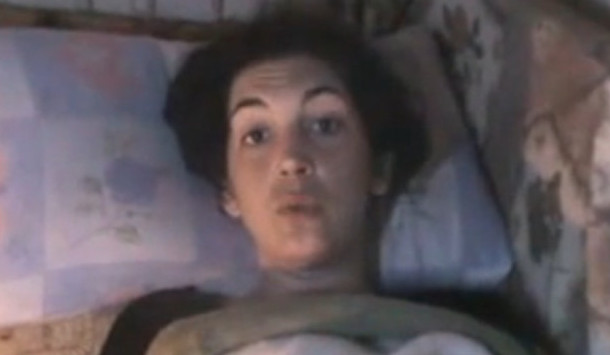
Following the Feb. 22 attack, Bouvier and Conroy posted a pair of YouTube videos, pleading for help from their government. Conroy said they had been injured in a “rocket attack,” and were being treated by a local medical team. He added that they were not being held captive, but that Bouvier, in particular, was in need of extensive medical attention.

The bodies of Colvin and Ochlik remain unaccounted for.

“We are relieved that Edith Bouvier and William Daniels are now safe but are concerned that the Syrian government’s assault on Homs has made it impossible to retrieve the bodies of our colleagues Marie Colvin and Rémi Ochlik,” said Mohamed Abdel Dayem, the Committee to Protect Journalists’ Middle East and North Africa program coordinator. “We remain deeply concerned for the safety of all Syrian journalists who are risking their lives to report on the unrest across the country.”

this according to yahoo news. see

Other popular Yahoo! News stories:

Why Syria is so dangerous for journalists
Marie Colvin, war reporter killed in Syria, was a guest on Anderson Cooper’s show hours before death
Journalists mourn NYT foreign correspondent Anthony Shadid, who died in Syria

more on the deaths and lives of photojournalist

March 1, 2012

Remembering 13 Unsung Heroes of Photojournalism

News stories of the deaths in Syria of American reporter Marie Colvin and French photographer Remi Ochlik totaled in the thousands last week. That was followed by hundreds of stories yesterday about the rescue of British photographer Paul Conroy, who was injured in the same attack in Homs, Syria that killed Ochlik and Colvin.

Lost in much of the coverage about Conroy’s rescue was the fact that 35 activists helped Conroy reach safety in Lebanon, and 13 of them died during the rescue mission. AP reported those deaths, which occurred when government troops attacked the activists.

Meanwhile, the death last Friday of Anas al-Tarsha, a young Syrian videographer and the fourth journalist to die in Homs within a week, was virtually unreported by the news media, except in Spain. The Committee to Protect Journalists, NPPA, Lightstalkers, and a few others also mentioned his death. The death of the fourth journalist, Syrian video blogger Rami al-Sayed, also received much less coverage last week than the deaths of Ochlik and Colvin.

In other words, Western journalists get into trouble, and it’s big news. Local journalists and fixers and others who get injured or killed along side them are too often relegated to the footnotes.

Of course, hundreds of Syrians have died and thousands more have been injured in Homs, where government troops have been shelling rebels and unarmed civilians alike for three weeks in order to keep the unpopular Syrian leader Bashar al-Assad in power.

But a disproportionate amount of Western media attention and outrage seems reserved for its own journalists, and it raises (again) the uncomfortable questions about the risks that Western journalists impose not only on themselves, but the locals who aid them. (The issue arose last spring, when a driver for four New York Times journalists went missing after they were detained at a checkpoint in Libya. It wasn’t until November that The New York Times quietly acknowledged the driver’s death.)

This isn’t to say that the deaths of Colvin, Ochlik or any other journalists are anything but a tragedy, regardless of their nationality. Nor is it to suggest selfishness or callousness on the part of individual journalists for whom drivers, fixers, or anyone else risks life and limb. (Conroy’s wife has told The Western Morning News that the photographer “is obviously very concerned for all the people who lost their lives in helping them out. It’s a real burden on him to know that so many people died.”)

What makes the issue so complicated is that journalists endanger themselves and others for good, defensible reasons. By bearing witness to the savagery committed by al-Assad, journalists are trying to help the Syrian people. And they are making a difference. The images and reports have turned the international community (with the glaring exceptions of China and Russia) against al-Assad, and put pressure on him to allow the Red Cross and Red Crescent in to help evacuate the dead and wounded.

That’s why al-Assad is targeting journalists with intent to kill them, while Syrian citizens are risking their lives to help those same journalists. The Syrians who died in the rescue of Paul Conroy undertook the mission voluntarily. But their deaths shouldn’t be his burden to bear alone, because they might have died for any journalist in Conroy’s predicament. To recognize and honor them for their sacrifice is to elevate and honor not only them, but all who put themselves at risk anywhere in the world to make the work of journalists possible.

story from PDN blog. see related stories.

HBO Picks Up ‘Witness,’ Documentary Series About Combat Photojournalists

February 29, 2012
Combat Photjournalist

HBO is getting “Witness,” a new documentary series that follows young combat photojournalists as they document conflicts in Mexico, Libya, Uganda and Brazil.

Deadline reports that the network will be produced by directors Michael Mann and David Frankham. Mann, who was also behind the HBO drama “Luck,” discussed the collaboration in a statement. “David Frankham and I share an admiration for combat photography that captures the universal — and sometimes the indescribable — in a single frame in the midst of chaos and danger,” he wrote.

HBO also said that “Witness” strives to show viewers “why, when everyone else seeks cover, the war photographer stands.”

The first episode was filmed in Juarez, Mexico, and three additional episodes of the series are in production.

as reported in huffington post

do we know who brings us the news? reporters & photographers die

February 28, 2012

i’ve been thinking these days about journalist/photographers in the news. about their untimely deaths just doing their jobs. how often have i/we looked at a picture online or in a newspaper words and thought nothing of the people who wrote it.

it’s just a picture taken far far away in another land that could be in another world. but it’s taken by someone who we never think of. do we even look at their byline?

so much of our daily lives are lived, sort of in this haze we call living, us in our zombie states of sleep we call awake. never really feeling life except for maybe an odd buzzing in our ear which we can easily ignore. that doesn’t mean when we lose something or someone it’s any less of a loose because it doesn’t touch us, nor grabs our arm and turns us towards the loss.

it’s a loss in the FORCE as George Lucus wrote in Star Wars, but we all know it by another name or a nameless name. something so personal that is unmentionable but yet there all the time. do we turn towards our own illusions of our immortality afraid to think about our constant companion of death.

all of life is impermanent as is our art and photographs. we live on through others remembrances. although at death our atoms are spread across the universe mixing with everything else in the soup of life we are only a memory somewhere. life is so fragile like a flower easily crushed or cherished.

i’ve never been in a life treating situation through my work so i can’t image people doing this every day. i’ve met news photographers both male and female who work for newspapers and magazines covering hot spots around the globe thinking nothing of it. at least i am never asked to share those thoughts of danger.

i’ve read in PDN where togs have begun using iphones and other consumer devices to capture world events to forward to their respective employers just so they don’t stand out from a crowd. i can’t imagine lugging around my 5D Mll through an artillery barrage in the streets somewhere, dodging bullets and shrapnel. guess that’s why the leica was so popular back then but times change, people are slower.

this is really about the people, words and pictures, they come from somewhere before they are served to us over eggs over easy. i don’t want to forget their efforts nor the people who support them the drivers and interpreters. yesterday i read where the driver who drove then journalist in libya was killed for being with them.

how cruel the people of the world are, what a waste of life being spread across the streets, alleys and hillsides of this earth enriching no one or only one. coming back from hawaii learning of a battle to unite the islands under Kamehameha 1, 800 men lost their lives either in fighting or being thrown off a cliff. what a waste of life was the first thought in my head.

why are men so cruel to each other?

i think how silly my work is in comparison to news gathers yet it does serve a purpose, if only for the lonely men looking for nude photos of young women. i hope i am able to catch the beauty i see before me, capture the emotion of the dance , power of nature around us and our frailty.

we need  art in the world to remind us of our humanity which seems so easy to forget,especially in hard times. where has reason gone? who’s blood will run across discarded cigarette butts in the gutter today? where are the men in suits to stop this carnage? there are way too many guns in this world in way too many uncontrollable people’s hands.

let us not forget the people who kill and those victims they kill for both need our love and understanding.

i know this isn’t art but important anyways, removing google history

February 23, 2012

from the Electronic Frontier Foundation

February 21, 2012 | By Eva Galperin

How to Remove Your Google Search History Before Google’s New Privacy Policy Takes Effect

[UPDATE 2/22/2012] It is important to note that disabling Web History in your Google account will not prevent Google from gathering and storing this information and using it for internal purposes. More information at the end of this post.

On March 1st, Google will implement its new, unified privacy policy, which will affect data Google has collected on you prior to March 1st as well as data it collects on you in the future. Until now, your Google Web History (your Google searches and sites visited) was cordoned off from Google’s other products. This protection was especially important because search data can reveal particularly sensitive information about you, including facts about your location, interests, age, sexual orientation, religion, health concerns, and more. If you want to keep Google from combining your Web History with the data they have gathered about you in their other products, such as YouTube or Google Plus, you may want to remove all items from your Web History and stop your Web History from being recorded in the future.

Here’s how you can do that:

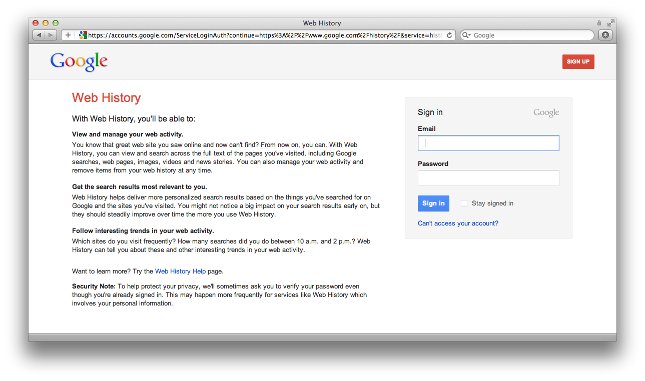
1. Sign into your Google account.

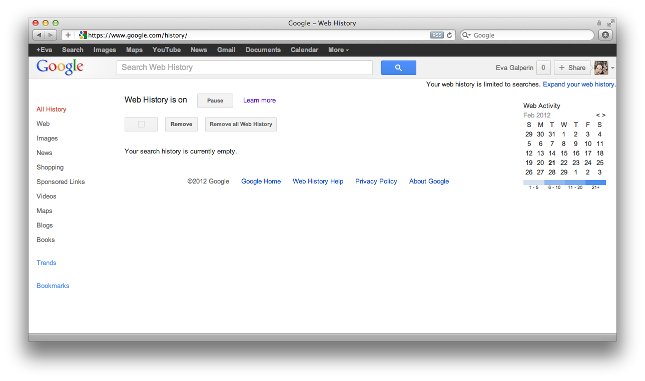
2. Go to https://www.google.com/history

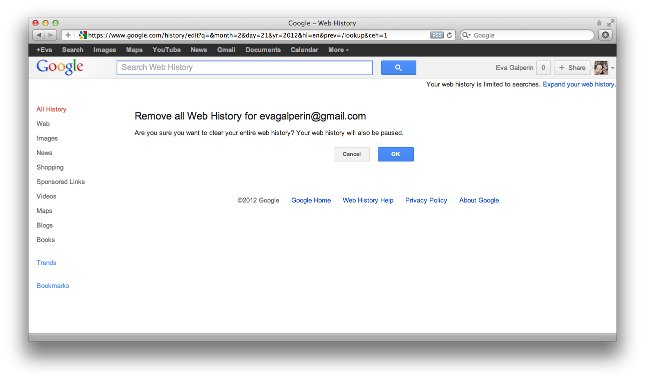
3. Click “remove all Web History.”

4. Click “ok.”

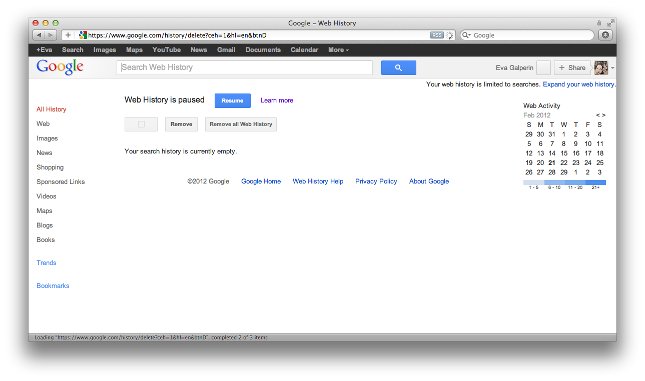
Note that removing your Web History also pauses it. Web History will remain off until you enable it again.

[UPDATE 2/22/2012]: Note that disabling Web History in your Google account will not prevent Google from gathering and storing this information and using it for internal purposes. It also does not change the fact that any information gathered and stored by Google could be sought by law enforcement.

With Web History enabled, Google will keep these records indefinitely; with it disabled, they will be partially anonymized after 18 months, and certain kinds of uses, including sending you customized search results, will be prevented. If you want to do more to reduce the records Google keeps, the advice in EFF’s Six Tips to Protect Your Search Privacy white paper remains relevant.

If you have several Google accounts, you will need to do this for each of them.

remember the new logo

past & future famous logos

February 22, 2012

The Past and The Future Of Famous Logos

MC Winkel · Abgelegt: Design und so,Illustrationen,Netzkram | 21.02.2012

“A brief review of the history of famous logos and predictions of how they will look like in the future made by Stock Logos.”

all these and more can be seen here at whudat. no wonder my LG phone is so cheaply made with neanderthal technology. this information came to me via creative pro  a great site for designers etc.

jene youtt

ahh those were the days

February 19, 2012

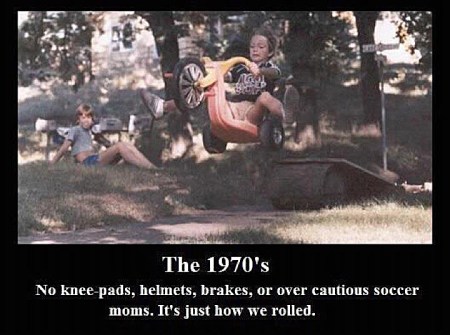
free wheeling fun

i remember my son riding his ‘hot wheels’ down the concrete ramp in the park with all the other boys whizzing around laughing. pure joy. one of the greatest toys ever.

Stanley Kubrick’s New York photos, early stuff

February 19, 2012

Stanley Kubrick’s New York: Incredible Photos of Life in the 40s

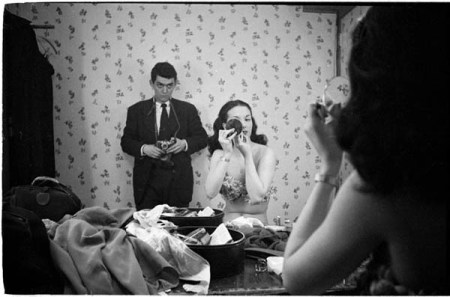
self portrait with show girl rosemary williams 1948

Stanley Kubrick—who wrote and directed Lolita, Dr. Strangelove, 2001: A Space Odyssey, A Clockwork Orange and The Shining—was one of America’s most influential filmmakers. Directors ranging from the Coen Brothers to Tim Burton paid visual homage to his works in their own films, and no less than Steven Spielberg said: “Nobody could shoot a picture better in history.”
In fact Kubrick’s special skill behind the camera and his ability to create visual intrigue were evident long before he was a Hollywood icon. Even at the age of 17, Kubrick was an immense talent. In 1945, for $25, he sold a photograph to Look magazine of a broken-hearted newsvendor reacting to the death of President Franklin D. Roosevelt. A few months later Kubrick joined Look’s staff to become the youngest staff photographer in the magazine’s history. He continued to work for Look until 1950 when he left to pursue filmmaking.

student at columbia university 1948

It was during this period that Kubrick’s respected—and often-imitated—style first became apparent. His photographs are vintage Kubrick: a complex blend of composition, drama, light and mystery.

Now, for the first time, fine art prints of Kubrick’s work as a photojournalist are available for sale. Previously only available for viewing in museum archives or in books about Kubrick, curators at the Museum of the City of New York and art advisors at VandM examined over 10,000 negatives of Kubrick’s photos to hand select 25 for this limited edition sale on VandM.
Images in this collection show the drama—both human and artistic—that infuse Kubrick’s work. Included are: the photograph used on the cover of the Kubrick book, Drama & Shadows, of a young woman making her way down a steep set of stairs while carrying a pile of books precariously tilting books; showgirl Rosemary Williams intently applying makeup as the equally intent young Kubrick photographs her. His subjects are as varied as the city he worked in: he catches Broadway actress Betsy Von Furstenberg studying her lines; prizefighter Walter Cartier in the corner between rounds; Dwight Eisenhower, also between rounds—after World War II, before he became President of the United States—when he was Columbia University’s president, and performers from Ringling Bros. and Barnum & Bailey Circus.
All images are available as prints through VandM.com

see the rest of the images here  at twisted sifter.

i am jet lagged, clock weary and eyes are exhausted after our plane ride back from hawaii. burned way too many disks and i know i didn’t capture the island we experienced. oh well excuse me for not being with it.

jene youtt

Color it Red, photo contest winners, ‘ Woman in Red ‘ woos them again

February 15, 2012

well after i posted my computer problems i received this email from Timothy Anderson who runs Red Dog News, a photography e-mail news letter notifying me that i won a prize in his contest ‘Color it Red’ i haven’t been doing much in the way of publicizing my work last year, sort of contest burn out. but when we get back to the frozen chosen NYC we are putting together a show in Lancaster Pa for this summer.

To all who receive this email, congratulations! You are all going to be in the Gallery Show at RedDogNews.com.
Please click here to see where you finished, as well as the prize you will be receiving. I just want each and every one of you to know, the judging was extremely close, and I had to utilize several tie-breakers to reach the final results. You should all be VERY proud.
The results will be announced in this Friday’s Red Dog News. I will be pleased to look over their physical addresses for places 1, 2, 3, 4, 5, 9, 10.
Please look over the results for misspellings, etc., and let me know if thee are any corrections.
Thank you so much for being a part of this contest.
Tim
not a bad bunch of togs to be involved with. i am always interested in what other people create. thank you judges.
so here is the link to winning pages of winners but i’ll post the list and sponsors below

Color It Red (the votes are in!)
Click here to see the gallery…

After sorting through 296 images from 62 photographers, it still took a tie-breaker to determine the first through fourth placings in the 2012 Red Dog News, Color It Red photography contest. Thank you to all the entrants.
In order of finish (with prizes listed) here are the winners:
1. Fran Matthews, Red Magnolia, Epson R2880 photo printer
2. Bobbie Goodrich, Tango Argentina, Think Tank Airport Airstream
3. Jim Shirey, Close Friends, Lensbaby Composer Lens
4. Lisa Collard, Untitled #18, Silverfast Ai Scanning Software
5. Jerry Downs, Oriental Poppies, Nik Color Efex Pro 4
6. Cathy Panebianco, Hunter, Photoshelter six-month membership
7. Susan Graham, Dance With the Flowers, Red River Paper $100 Gift Certificate
8. Jene Youtt, Woman in Red, O’Reilly Books, $100 Gift Certificate
9. Stephanie Houston, Study in Red #2, Think Tank Camera Strap
10. Kimber Wallwork-Heineman, Serendipity, Think Tank Camera Strap

Honorable Mention, with inclusion in the Red Dog News, Color It Red Gallery Exhibition:
Marti Belcher, Young Monk Novice
Marguerite Garth (3), The Forsaken #15, The Forsaken #14, The Forsaken #24
Lia Moldovan, Airborne
David Wiley, Butterfly Love
Lon Bixby, Misty Red
Elsa d’Ellis (2), Cactus Moon, Hummingbird’s View
Susan Graham, Baby Boomer Red
Eva Lewarne, Night Reader
Cynthia Walpole, Magenta-Throated Woodstar #5439
Stephanie Houston, Study in Red #3
Jim McDonough, Buoys in Red
Cathy Panebianco, Bird Dog

Thank you to the sponsors for their kind donations for Color It Red 2012!  

Epson-Exceed Your Vision  Camera Bags & Accessories  Since 1997

Lensbaby Camera Lenses    


jene youtt