Archive for April, 2012

Naked before the camera in New York

April 5, 2012

Well one of the true signs that spring has arrived in the city are  bulbs and bosoms busting out all over. i must say this is one of my favorite times of year. the other being fall with it’s colors and smells of dried leaves. so i guess it’s only fitting that so many wonderful naked photography shows are in town in some of the swanky neighborhoods and some not so naked.

the Gagosian Gallery has Avedon, murals & portraits opening May 4 through July 6 2012 always a show to see of course, here i s a sample of avedons notes to his printers of adjustments on prints. who needs photoshop?
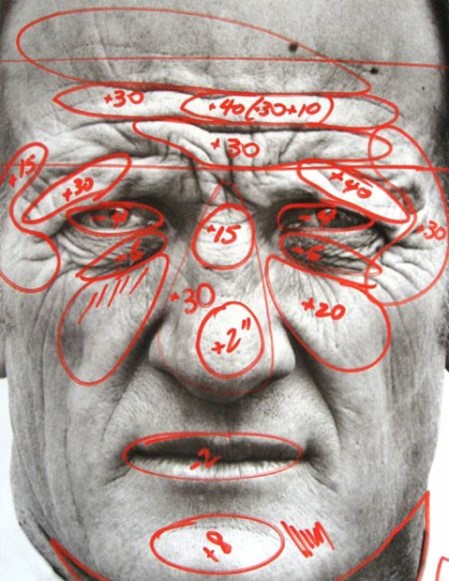
printers notes

as is this one below at Metropolitan Museum of Art which is naked. they even have naked penis at the museum. why does america have such a taboo on penises. is it because the law makers are male and they hate to be compared to one another, but have no problem looking and comparing woman’s breasts?

tomorrow we are going to MOMA to see Cindy Sherman exhibit and dinner out courtesy of a friends invitation.

By Peggy Roalf  Thursday, April 5, 2012

The nude body, one of the subjects photographers have celebrated since the camera was invented, is presented in its many guises at an exhibition that opened last week at the Metropolitan Museum of Art.

While the body has been a central feature in art through the ages, the realism of photography could not help but capitalize on its erotic possibilities—and the show gracefully presents this theme along with some surprising examples from anthropological, medical, and forensic documentations of the mid- and-late 19th century, including an 1860 photograph of a hermaphrodite by the great French photographer, Nadar.
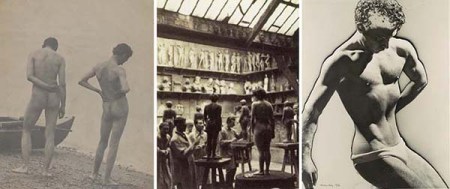
A photograph of a reclining nude female by Julien Vallou de Villeneuve from 1853, which defines the notion of an “hourglass figure,” was made expressly to sell to artists who painted the female form. The use of photography by artists at the time is well known, and many took up the camera for this purpose themselves. One beautiful image of this genre is a photograph by the painter Thomas Eakins of male bathers from around 1883. But male nudity was rather strictly controlled and due to its scarcity, photographs that became available were avidly collected including an 1890s example of what could be considered soft-core porn, by the Italian photographer Guglielmo Plushow.

Man Ray’s 1930 Male Torso introduces Modernism in the middle section of the show, which also includes two classic nude studies by Edward Weston of Charis Wilson, on the sand, both from 1936. Other standouts from this period are Distortion #6, 1932 by Andre Kertesz, which prefigures the distorted nude figures that British photographer Bill Brandt became known for at the end of the 1940s (three of which are included), and a photograph by Irving Penn from 1949 that rivals the prehistoric Venus of Willendorf for its stately corpulence.

The exhibition takes some surprising turns in presenting scenes from the “Age of Aquarius,” including a 1971 photograph by Garry Winogrand of a Central Park be-in; an early 1970s shot by Larry Clark from “Teenage Lust;” and a pair of transgressive performance documents by Hanna Wilke, done at PS 1 in 1978 while the building was still in shambles. But the show is at its best in presenting the earliest uses of photography in capturing images of the naked human body for consumption by artists, scientists, collectors, and voyeurs.

Images above: Row 1, left to right: Thomas Eakins, Thomas Eakins and John Laurie Wallace on a Beach, ca. 1883; Brassai, L’academie Julian, 1932; Man Ray, Male Torso, 1930.
Row 2, left to right: Andre Kertesz, 
Distortion #6, 1932; Irving Penn, Nude No. 1, 1949; Robert Mapplethorpe, Patti Smith, 1976. All courtesy the Metropolitan Museum of Art.

Naked Before the Camera continues through September 6th at the Metropolitan Museum of Art, 1000 Fifth Avenue, at 82nd Street, NY, NY.

i’ll have my clothes on for the shows and dinner, nothing like a hot piece of pasta falling in ones lap.


jene

Yesterdays work, more like my daily blunders

April 3, 2012

like calvin, of calvin and hobbs who thinks about sledding down hill that his brain is trying to…….. well that is the way i think at times. maybe if i do this then that will happen or that. i just never really know, well do we ever? someday all this will be over or it will continue without me.

i remember my first time as a photographer. our family had a classic Kodak Brownie 2a box camera, i don’t remember my age but i was younger than today i took the camera out into the backyard along with Ginger our golden cocker spaniel for a photo session. Ginger ran around opposite me and i pushed the shutter. we had a great time, i must have been copying something i’d seem somewhere. ‘thomas’ the character from blow up would have been proud of me.

except for one thing i overlooked, advance the film. thank goodness for digital photography, but like all technical things it does have it’s rules and while some think everything can be fixed in photoshop i am here to say not really. the idea i started out wanting to do was photograph a woman in a tight black dress against a white background. that i did

Diletta Carutti in a little black dress

so here is a beginning, a  nice italian dress draped on Diletta Carutti the model, an acquaintance of ours who’s working for Art Strong bags and emmanuel fremin galley.

mary when out and bought some cute cheap hats at tjmax for the shoot, i’ve yet to edit them yet way too many images and it’s overwhelming, like editing wedding images.

i am beta testing photoshop 6 which has some very powerful upgrades but my ‘puter switches back and forth between PS4 & 6 so it keeps me on my toes and i was tired last night. i don’t usually edit images right after a shoot, i let them develop on their own.

the dress is great like most of italian things, never had a bad meal in italy maybe they exist but food, wine and coffee seem to be a religion over there.

people live differently in europe. europeans dress up to go out for a cappuccino at the local cafe. not like here in new york where sweat pants and t- shirts are the norm.

and the shoes, i’ve two pair of italian shoes that make me feel like a king.

but today i’ll dwell on my mistakes which i’ve fixed somewhat with style and photoshop. i read a query last night from someone wanting terry richardson type of images. he’s a very trendy type of paparazzi photographer being in more of his pictures than not. reminds me of wee gee i’ve written about here. my question is why? the snapshots are just that, snapshots.ugh

black hat blond hair

great hat although we didn’t get a chance to use the other one as this worked out fine. for not being a model Diletta worked out pretty cool very playful.

seems she’s had years of dance training soooo you’ll see more of her in my dance portfolio.

a few adjustments were needed here on the back of the hat needed brightning while the dress needed to come down, it waas a dark blue and i wanted black.

maybe a little flesh tone tweaks and cropping.

but the day wore on and i was getting stupid, well more than usual. so i moved her around closer to the beauty dish and not even thinking snapped away just like my first session wit ginger.

at least this camera was smarter than i a moved forward every time but didn’t adjust for the lighting changes as that was my job. duh

oh well thank goodness it’s not a wedding so a do over is possible until i learn my lesson.

coy

but she’s wearing a bracelet………… where is the stylist when you need one, oh we don’t have…… one that’s my job also

now it gets interesting and the painter in me comes out.

the look

don’t worry it gets worst, that is unless you like this type of image

what was i thinking, it couldn’t be about what’s for lunch

so this is todays work. i remember a fellow down south having a conversation with one of our actors that they both seemed to enjoy until the fellow ask what the actor did for a living?’ i am an actor’ was the reply.  the fellow paused and took a good long look at the actor and said ‘that don’t seem something a grown man would do for a living’.

well that could be said about me i guess. WORK is that what they call it?

jene youtt

Humans think we are so special, that seems to be the first step for trouble

April 1, 2012

A universe without purpose

New revelations in science have shown what a strange and remarkable universe we live in.

The illusion of purpose and design is perhaps the most pervasive illusion about nature that science has to confront on a daily basis. Everywhere we look, it appears that the world was designed so that we could flourish.

The position of the Earth around the sun, the presence of organic materials and water and a warm climate — all make life on our planet possible. Yet, with perhaps 100 billion solar systems in our galaxy alone, with ubiquitous water, carbon and hydrogen, it isn’t surprising that these conditions would arise somewhere. And as to the diversity of life on Earth — as Darwin described more than 150 years ago and experiments ever since have validated — natural selection in evolving life forms can establish both diversity and order without any governing plan.

As a cosmologist, a scientist who studies the origin and evolution of the universe, I am painfully aware that our illusions nonetheless reflect a deep human need to assume that the existence of the Earth, of life and of the universe and the laws that govern it require something more profound. For many, to live in a universe that may have no purpose, and no creator, is unthinkable.

But science has taught us to think the unthinkable. Because when nature is the guide — rather than a priori prejudices, hopes, fears or desires — we are forced out of our comfort zone. One by one, pillars of classical logic have fallen by the wayside as science progressed in the 20th century, from Einstein’s realization that measurements of space and time were not absolute but observer-dependent, to quantum mechanics, which not only put fundamental limits on what we can empirically know but also demonstrated that elementary particles and the atoms they form are doing a million seemingly impossible things at once.

And so it is that the 21st century has brought new revolutions and new revelations on a cosmic scale. Our picture of the universe has probably changed more in the lifetime of an octogenarian today than in all of human history. Eighty-seven years ago, as far as we knew, the universe consisted of a single galaxy, our Milky Way, surrounded by an eternal, static, empty void. Now we know that there are more than 100 billion galaxies in the observable universe, which began with the Big Bang 13.7 billion years ago. In its earliest moments, everything we now see as our universe — and much more — was contained in a volume smaller than the size of a single atom.

And so we continue to be surprised.We are like the early mapmakers redrawing the picture of the globe even as new continents were discovered. And just as those mapmakers confronted the realization that the Earth was not flat, we must confront facts that change what have seemed to be basic and fundamental concepts. Even our idea of nothingness has been altered.

We now know that most of the energy in the observable universe can be found not within galaxies but outside them, in otherwise empty space, which, for reasons we still cannot fathom, “weighs” something. But the use of the word “weight” is perhaps misleading because the energy of empty space is gravitationally repulsive. It pushes distant galaxies away from us at an ever-faster rate. Eventually they will recede faster than light and will be unobservable.

This has changed our vision of the future, which is now far bleaker. The longer we wait, the less of the universe we will be able to see. In hundreds of billions of years astronomers on some distant planet circling a distant star (Earth and our sun will be long gone) will observe the cosmos and find it much like our flawed vision at the turn of the last century: a single galaxy immersed in a seemingly endless dark, empty, static universe.

Out of this radically new image of the universe at large scale have also come new ideas about physics at a small scale. The Large Hadron Collider has given tantalizing hints that the origin of mass, and therefore of all that we can see, is a kind of cosmic accident. Experiments in the collider bolster evidence of the existence of the “Higgs field,” which apparently just happened to form throughout space in our universe; it is only because all elementary particles interact with this field that they have the mass we observe today.

Most surprising of all, combining the ideas of general relativity and quantum mechanics, we can understand how it is possible that the entire universe, matter, radiation and even space itself could arise spontaneously out of nothing, without explicit divine intervention. Quantum mechanics’ Heisenberg uncertainty principle expands what can possibly occur undetected in otherwise empty space. If gravity too is governed by quantum mechanics, then even whole new universes can spontaneously appear and disappear, which means our own universe may not be unique but instead part of a “multiverse.”

As particle physics revolutionizes the concepts of “something” (elementary particles and the forces that bind them) and “nothing” (the dynamics of empty space or even the absence of space), the famous question, “Why is there something rather than nothing?” is also revolutionized. Even the very laws of physics we depend on may be a cosmic accident, with different laws in different universes, which further alters how we might connect something with nothing. Asking why we live in a universe of something rather than nothing may be no more meaningful than asking why some flowers are red and others blue.

Perhaps most remarkable of all, not only is it now plausible, in a scientific sense, that our universe came from nothing, if we ask what properties a universe created from nothing would have, it appears that these properties resemble precisely the universe we live in.

Does all of this prove that our universe and the laws that govern it arose spontaneously without divine guidance or purpose? No, but it means it is possible.

And that possibility need not imply that our own lives are devoid of meaning. Instead of divine purpose, the meaning in our lives can arise from what we make of ourselves, from our relationships and our institutions, from the achievements of the human mind.

Imagining living in a universe without purpose may prepare us to better face reality head on. I cannot see that this is such a bad thing. Living in a strange and remarkable universe that is the way it is, independent of our desires and hopes, is far more satisfying for me than living in a fairy-tale universe invented to justify our existence.

Lawrence M. Krauss is director of the Origins Project at Arizona State University. His newest book is “A Universe From Nothing.”

http://www.latimes.com/news/opinion/commentary