so here’s something for you west coast people looks to me to be a super duper exhibit. i remember a story about James Dean when he was starting out he was asked if he had any publicity pictures. he replied ‘ yea just some B&W images shot by a friend.’ who of course turned out to be Herb Ritts. not to mention one has to have talent to advance in this world, except a couple of my ex-bosses but they are long gone now. i think in order to survive one must be quick on their feet, lucky, have a vision, and the tenacity to stick it out.
seems everyone is getting naked these days must be pans pipes floating on the air.
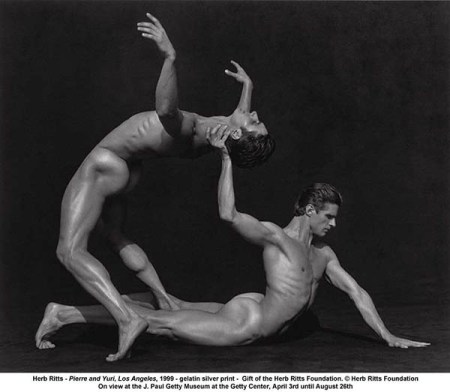
Herb-Ritts-Pierre-YuriLOS ANGELES, CA.- Herb Ritts (American, 1952–2002) was a Los Angeles based photographer who earned an international reputation for his unique images of fashion models, nudes, and celebrities. From the late 1970s until his untimely death from AIDS in 2002, Ritts's ability to create photographs that successfully bridged the gap between art and commerce was not only a testament to the power of his imagination and technical skill but also marked the synergy between art, popular culture, and business that followed in the wake of the Pop Art movement of the 1960s and 1970s. On view at the J. Paul Getty Museum at the Getty Center, April 3rd through August 26th, Herb Ritts: L.A. Style explores Ritts’s extensive photographic career, including a selection of renowned and previously unpublished photographs, as well as his directorial projects. A major portion of the works in the exhibition was newly acquired by the Getty Museum through purchase and in the form of a generous gift from the Herb Ritts Foundation.
“Through hard work and an imaginative vision, Herb Ritts fashioned himself into one of the top photographers to emerge from the 1980s,” says Paul Martineau, curator of the exhibition and associate curator of photographs at the J. Paul Getty Museum. “This exhibition will reconsider and broaden our understanding of Ritts’s career, particularly in the areas of fashion and figure studies.”
By the mid-1980s, Ritts’s aesthetic had coalesced into a distinctive style. His creative output was enormous, and he appeared to be able to switch gears effortlessly between his jobs in fashion and portraiture and his personal work with the nude. After shooting a commercial job, Ritts often took advantage of the location, props, and models to make his own pictures. To accommodate his growing business, Ritts established a studio in Hollywood and assembled a creative team of assistants, stylists, and printers who strove to exceed his high expectations. Like his contemporaries, Ritts rarely printed his own work. Through a pain staking selection process, he editioned his best pictures and had them printed in gelatin silver or platinum, varying the papers, levels of contrast, and tone to realize his artistic vision.
Ritts’s portraits of celebrities such as Richard Gere, Britney Spears, Mel Gibson, and Madonna introduce the exhibition. His anti-glamour style of portraiture made celebrities look more natural and allowed them to reveal inner qualities, making them more accessible to fans. By the late 1980s, Ritts’s reputation as a shaper of fame made him a celebrity in his own right, and the iconic status of such photographs as Richard Gere, San Bernardino (1977) and Madonna, Hollywood (1986) made a photograph by Ritts a rite of passage among Hollywood insiders.
The exhibition continues with Ritts’s fashion photographs, many of which drew inspiration from painting, sculpture, film, and the work of such leading fashion and portrait photographers as Richard Avedon, Horst P. Horst, George Hurrell, Irving Penn, and Louise Dahl Wolfe. Ritts had an extraordinary ability to synthesize and incorporate these influences into a new and easily recognizable style. As hundreds of magazine spreads demonstrate, Ritts kept top fashion editors happy by providing dazzling pictures designed to sell clothes along with others that simply celebrated beauty. Ritts also made use of locations around Los Angeles and especially loved Southern California’s natural light. For instance, Ritts harnessed the forces of nature, strong sunlight and gale-force wind in Versace, Veiled Dress, El Mirage (1990) to create an unforgettable image that communicates feminine strength and beauty.

 Turning to Ritts’s work with the nude, the exhibition examines how Ritts—along with his contemporaries Robert Mapplethorpe and Bruce Weber—provoked a radical change in how the nude was depicted. His forte was an ability to analyze the body from a variety of angles and create compositions that abstracted it in ways that communicate strength and poise. Working mostly outdoors, Ritts enjoyed relating the body to the natural world and rendered his nudes with a verve and elegance that became the dominant hallmarks of his pictures. In Man with Chain, Los Angeles (1985), model Tony Ward is seen bending at the waist, as if struggling under the chain’s massive weight. The extraordinary sense of movement is not only forward but also upward in a tortuous S-curve that has been long associated with the dramatic, writhing bodies of seventeenth-century Baroque painting and sculpture.
Ritts’s work also includes portraits of well-known athletes and dancers. In the exhibition are a series of photographs of the critically acclaimed American dancer and choreographer Bill T. Jones. In these photographs, Ritts captured Jones while he danced, framing him against a pure white background, making his muscled body look like a piece of sculpture. He also photographed famous athletes including Michael Jordan, Magic Johnson, and Olympic gold-medalist Greg Louganis. For Louganis’s portrait Ritts positioned the diver on a makeshift pedestal and placed a low spotlight on him. The carefully arranged pose and lighting show off Louganis’s muscled torso and back, while the prominent shadows recall the mysterious aura of film noirs of the 1940s.
Although Ritts had no prior experience with film, Madonna convinced him to direct his first music video for her song “Cherish” (1989), which is included in the exhibition along with other music videos and commercials. Ritts enjoyed the creative challenge that film presented, allowing him to extend the sense of movement so important to his still photography to the moving image. From 1989 until 2002, Ritts directed thirteen music videos and more than fifty commercials. Some of his music industry clients included Michael Jackson, Janet Jackson, Mariah Carey, Britney Spears, and Shakira, while his commercial clients were mainly fashion and cosmetic companies such as Chanel, Lancôme, Estée Lauder, and Calvin Klein.
Ritts’s intimate portraiture, his modern yet classical treatment of the nude, and his innovative approach to fashion brought him international acclaim and placed him securely within an American tradition of portrait and magazine photography that was begun by Richard Avedon and Irving Penn.
Visit the J. Paul Getty Museum and the Getty Center at : http://www.getty.edu/


 Fuzzypictures's Weblog