Archive for April, 2012

Home Depot Homebrew of $643 Profoto Globe

April 29, 2012

Home Depot Homebrew of $643 Profoto Globe Saves You Enough to Buy a Paul Buff Einstein to Put it On


For the second time in a week, a Paul Buff mod that is so simple I wonder why I hadn’t thought of it earlier. This one is via Houston-based photographer Stephen Hébert.

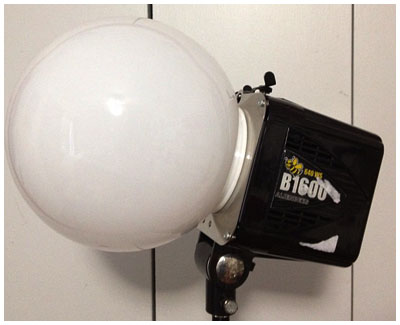
This Home Depot version of the famed Profoto Globe will set you back all of $10. I have seen people hacking these for Profoto lights using SP-systems mounts and/or gaffer’s tape. But the fact that they mount right to an AB or Einstein is, like, poetic justice or something.

If you are really slick (and handy) you might want to try to drill some holes around the base for heat venting. And I am guessing the color temp is, er, “close enough.”

But having enough money left over from the savings to buy the actual flash (and an additional $130 in other accessories) is icing on the cake.

thank you strobist  photo blog by david hobby a must read for photographers. and it’s free think of that, knowledge freely given for the effort of reading it.

Better not miss this chance to shoot the Venus transit

April 28, 2012

A Checklist for Photographing the Transit of Venus
By Michael Covington – 5/16/2004

What to expect from the transit of Venus.
Picture taken with a Celestron 5, 32-mm eyepiece, Nikon Coolpix 990 camera,
and Baader sun filter, sharpened with Registax.
Image of Venus added with Photoshop.

On the morning of June 8th, you may be one of the first people in history
to take a digital image, or even a good photograph, of a transit of Venus.
For the first time since 1882, Venus will pass in front of the Sun as seen
from Earth.

In the eastern United States, Venus will be about to leave the Sun’s face at sunrise.
(The West won’t see the event at all.)
Venus will reach the edge of the visible Sun about 7:05 a.m. Eastern Daylight Time
and will be completely off it by 7:25, give or take two or three minutes
depending on location.

The picture shows what to expect. I faked it by using Photoshop to alter one of my
existing sunspot pictures. As you can see, Venus in transit looks much larger than Mercury.
In fact, with a suitable sun filter, you’ll probably be able to see it without
a telescope.

Are you ready to photograph or image the transit of Venus? Here’s a checklist of
things to consider.

(1) How well can you photograph the Moon?

The Sun and Moon appear the same
size in the sky, so the Moon is a good object to practice on.
Possible techniques include:

A 35-mm camera body, without lens, at the
focus of a telescope whose focal length is about 600 to 2000 mm
(most portable amateur telescopes are in this range, but some Newtonians
won’t reach focus because they don’t accommodate the depth of the camera body);

A digital camera or video camera
aimed into the eyepiece of a telescope with a magnification of
about 30 to 70 (this is called afocal coupling and the camera must
be focused to infinity, autofocus off, flash off);

A modified webcam or a Meade Lunar-Planetary Imager at the focus of a telescope
(in this case, only the smallest telescopes will cover the full face of the
Moon or Sun, but that’s probably okay).

A camera with a long telephoto lens (at least 300 mm with 35-mm film).

(2) How do you control vibration?

Digital cameras, webcams, and the Meade Lunar-Planetary Imager
have a real advantage because
they don’t have a mirror to introduce vibration.
With SLR cameras, experiment. Often, at higher shutter speeds,
such as 1/250 second, vibration isn’t much of a problem.

(3) Do you have a suitable solar filter?

The filter must go in front of the telescope and be made of aluminized optical glass
or aluminized Mylar (not stretched too tight). Bear in mind that the Sun will be low
in the sky, and your usual filter may be too dense. If you can separate the
two layers of a Mylar filter, be prepared to do so.

If you prefer optical glass, you might want to invest in a “light” sun filter
(density about 4.0 instead of the usual 5.0), which transmits 10 times as much light
but is still safe to use.

(4) How well can you photograph the Sun?

You can practice photographing the Sun with sunspots every day.
Note that if you are using afocal coupling, you’ll need to make sure stray light
is excluded; some camera-to-eyepiece adapters are designed only for use in the dark.
Draping a strip of black cloth around the connection is the cure for light leaks.

(5) Is the transit going to be visible at your location?

I don’t just mean your part of the country, but your exact site, because the Sun
will be very low in the sky, and trees may interfere.
To be certain, practice the day before.

(6)How are you going to process the images?

I often use Registax to sharpen my images.
But in lunar and solar work, it’s not practical to stack a series of images the way we do when photographing planets.
The reason? Air turbulence affects different parts of the image differently at any given moment, and when you’re covering a wide field (even 1/10 of the face of the Moon), successive images don’t stack very well. It’s better to pick the one sharpest image and process it with unsharp masking or wavelet transforms.

(7) When you get your picture, what are you going to do with it?

E-mailing an image to your local newspaper – while it’s still hot news – is often very
much appreciated, and it’s a great way to promote astronomy in your town.

thanks astromart via prophotodaily

jene
i phone or i phobia, smart phones or another dumb idea

April 22, 2012

well it’s that time in our lives we need to get new phones. it’s not a simple choice these days, so much to consider. it use to be go down to the independent verizon store to see what they have. well verizon replaced all those stores, staffing them with their own salespeople. i learned that last time as i ventured downtown to my favorite phone store, yes i am a loyal customer, to see everyone replaced. those salespeople talked us into taking an LG phone which is crap. i wouldn’t buy another product from that company which use to be called goldstar.

the reason i continued shopping at this phone store they would throw in a free car charger on my purchases. the verizon store never gave anything away. i once had an opportunity to pick up a T Mobile franchise that paid $265 commission on each phone connection and that location was doing 20 or so phones a day. but it meant i had to be there and i wanted to be other places.

now with verizon staffing their own stores i guess the lucrative commissions are gone. oh well so did the service.

always choices…………..

so here i sit gathering information. being a photographer do i go with an iphone?  dan burkholder has done a lot of work creating artistic images with this phone and has written the book  IPhone Artistry and i’ve seen the print from his i phone and apps he won the soho photo gallery alternative image contest with. very nice.

but apple seems to be a moral problem with me. now i am a long time apple user starting with a Mac C ll computer. my first computer was a commodore 64 but i did use the macintoshs at a desktop publishing store during that time writing my resume the constant job search.

one of my problems is will apple produce another work station along the lines of my mac pro? or will they phase these out replacing them with imacs, which can’t be color calibrated. personally i don’t believe this will happen but it wouldn’t be the first time a company changed directions as seems to be a rumor. after all isn’t this what kept apple in business through all those lean years?

then there is apple’s manufacturing and related products. see the lengthy New York Times article  ‘how the U.S. lost out on iphone work’ or the human cost of producing ipad or iphones again another  NY Times article  and other foxconn articles. i wonder where the wall street journal is in all of this, oh probably in england testifying before parliament .

when did apple change? i knew apple computers were made in good old usa but hadn’t given it too much thought after that.  i just kept buying their products. making savior  steve jobs a rich man, after all wasn’t bill gates and the dreaded ‘death star of microsoft’ the real enemy, making us use internet explorer, ugh?

but something change at ‘death star’  bill and his wife melinda did go on to start the bill and melinda gates foundation but what have they done for us lately? oh changed parts of the world and helped people, how could the proponent of evil and master of  ‘death star’, who couldn’t see the future of computing and never came up with these cool things we carry around with us call I what-evers.

but steve had apple’s billions stashed in the bank and a vision as to how we should live using his products,  see latest sec report to see everything steve had, now apple is the ‘new death star’ another black hole and dark spot in the earth. people line up around the block to be the among the first to get their hands on I whatever.

who has the last laugh now steve, oh tim clark with his reported $376 million salary a meer pittance compared to apples worth at $500 billion, see ebersole’s blog on all you could do with that stash. but i guess my readers could compile their own list. what would you do with $500/376 billion dollars?

do i really need to add to apples coffers and make the plunge to iphone or ever a smart phone with data. heck i’ve just started using my phones calendar to record appointments and alarms, it does help keep me focused and on time. will i give up my bulky dslr and join the multitudes who how up phones at events. at rock concerts they’ve become the new matches held aloft at the end.

this post is about my quandary about buying a phone, any phone, not about steve over bill and melinda or even tim, who, could spend all their money anyway? it’s not about a government bail out of the auto industry, these people all have money. oh verizon wants $199 for an iphone plus a two year contract plus plan. can i afford this? hey now that i have all this time on my hands because i’ve retired i could get another job that’s if there are any around to pay for the PLAN.

our two grand children both have their own iphones, well if we make that choice then they can show us how to use them. i am sure the apple store has classes on their use for a buck or two. but we’ve also seen thee new 4G samsung stratosphere  which looks good and doesn’t cost us anything except a plan.

then there is motorola and american company producing phones here in america, droid 4 by  motorola. all these choices give me a headache as i’ve just started using my calendar on the phone i’ve got now. odd all the dates i set before daylight savings go off an hour late. oh well better late than never.

i talked to a young salesperson who related he had hacked into his phone to improve it, now when would i ever want to do that? at my age life is to short to bother with that. i just want a phone that is reliable doesn’t notify me ten seconds before turning it self off because of dead battery which my stupid LG phones does.

oh decisions decisions i think it’s time for a nap, wonder what ever happened to my teddy bear?

jene

Dutch drawings at Morgan Library, closes april 29, 2012

April 17, 2012

The Morgan Library & Museum Shows “Dutch Drawings From the Clement C. Moore Collection”

Written by Rupert Haffstader Tuesday, 28 February 2012 23:26

Attention: open in a new window.

New York City.- The Morgan Library & Museum is proud to present “Rembrandt’s World: Dutch Drawings from the Clement C. Moore Collection”, on view at the museum through April 29th. Bolstered by its recent political independence, economic prosperity, and maritime supremacy, the Dutch Republic witnessed an artistic flourishing during the seventeenth century, known as the Dutch Golden Age. “Rembrandt’s World” presents over ninety drawings by some of the preeminent artists of the period, among them Rembrandt Harmensz van Rijn and his followers Ferdinand Bol and Gerbrand van den Eeckhout, Abraham Bloemaert, Aelbert Cuyp and Jan van Goyen.

The Dutch Republic of the seventeenth century was a federation of seven states (Holland, Zeeland, Gelderland, Utrecht, Friesland, Overijssel, and Groningen). The exhibition focuses on artists who worked primarily in their native lands, rather than those whose careers took them to France, Italy, or elsewhere abroad, and highlights the broad spectrum of subjects, portraiture, marine views, landscapes, biblical and mythological narratives, genre scenes, and the natural world—that fueled their creative imaginations.

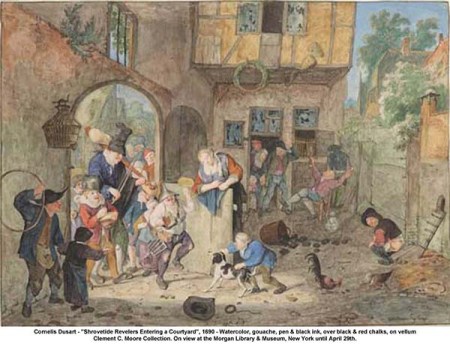
Among the finest drawings in the exhibition are portraits and figure studies, including two by Rembrandt. “A Beggar, Facing Left, Leaning on a Stick” is Moore’s most recently acquired Rembrandt, and is also the earliest chronologically, dating to 1628–29. Rembrandt executed the sheet during his Leiden period (1625–31), when he was preoccupied with the theme of beggars. This figure, with his tall hat, ample cloak, and walking stick, was deftly sketched with an economical use of pen and ink. Adjusting the pressure on his pen and with it the width of each stroke—thin for the shading of the figure’s face, thick for the darkest side of his hat—Rembrandt worked quickly and confidently to capture the essence of the man, and masterfully suggested the fall of light through a combination of areas of blank paper, such as the hat, and rapid parallel hatching in his face, left leg, and the ground at the left to suggest volume and shadow. “Two Men in Polish Dress Conversing” demonstrates Rembrandt’s powers of observation. An endless variety of people lived in and traveled through the Dutch Republic during this period, and the artist diligently recorded the bustling activity of the world around him. The men represented here are identifiable as Ashkenazi or Eastern European Jews by their long beards and costumes. By the 1640s when Rembrandt created this drawing, he had come to black chalk; this work belongs to a group of some sixty small clusters of figures shown in everyday pursuits. Hendrick Goltzius was one of the most important Dutch artists of the transitional period between the late sixteenth and early seventeenth centuries. His rapidly drawn “Portrait of a Smiling Young Boy” reflects a departure from the artist’s early Mannerist style in favor of greater naturalism following a trip to Italy in 1590–91. His bold, animated pen work masterfully captures the sitter’s lively, smiling eyes. The awkwardly drawn hands may constitute an autobiographic allusion: Goltzius’s own fingers were badly burned and his hand permanently crippled during childhood. David Bailly is represented by three accomplished works, including his 1624 “The Lute Player”. This drawing is one of at least three copies that Bailly made after a celebrated painting by Frans Hals (now in the Musée du Louvre, Paris). Minor differences, such as the straggly strands of hair on the lute player’s forehead and the position of his little finger on the neck of his instrument, suggest that Bailly used as his model an early copy of the original, perhaps by Frans’s brother, Dirck Hals, or his pupil, Judith Leyster. The table, which puts the viewer at a low vantage point, was entirely Bailly’s invention. As well as the portraits, the exhibition contains sections featuring seascapes by Herman Saftleven and Willem van de Velde the Elder, landscapes by Jacob de Gheyn II, Allart van Everdingen and Aelbert Cuyp, genre scenes by Willem Pietersz. Buytewech, Isaac van Ostade and Cornelis Dusart, flora and fauna by Herman Henstenburgh and Pieter Holsteyn II and religious and mythical imagery by Abraham Bloemaert and Rembrandt among others.
Today, The Morgan Library & Museum is a complex of buildings of differing styles and periods covering half a city block. It began as an intimate palazzo-like structure designed by Charles Follen McKim to serve as the private library of financier Pierpont Morgan. “Mr. Morgan’s library”, as it became known, was built between 1902 and 1906 to the east of his New York residence at Madison Avenue and 36th Street. In the years since the Morgan’s incorporation as a public institution in 1924, there have been several additions to the original library building. As the collections grew, the Annex was added in 1928, on the site of Morgan’s home. In 1988, the mid-nineteenth-century brownstone on Madison Avenue and 37th Street, where J. P. Morgan, Jr., lived was also added to the complex. A garden court was built in 1991 to unite all three buildings in the complex. A century after the completion of the McKim building, The Morgan Library & Museum unveiled the largest expansion and renovation in its history. The Renzo Piano design integrates the three landmark buildings with three intimately scaled new pavilions constructed of steel-and-glass panels to create an accessible, inviting setting. Pierpont Morgan’s immense holdings ranged from Egyptian art to Renaissance paintings to Chinese porcelains. For his library, Morgan acquired illuminated, literary, and historical manuscripts, early printed books, and old master drawings and prints. To this core collection, he added the earliest evidence of writing as manifested in ancient seals, tablets, and papyrus fragments from Egypt and the Near East. Morgan also collected manuscripts and printed materials significant to American history. Over the years—through purchases and generous gifts—the Morgan has continued to actively acquire rare materials as well as important music manuscripts, a fine collection of early children’s books and manuscripts, and materials from the twentieth century (as well as earlier periods). Nevertheless the focus on the written word, the history of the book, and master drawings has been maintained. Visit the museum’s website at … http://www.themorgan.org


Canon 5D Mlll product advisories, opps

April 17, 2012

Product Advisories

Many people have been reporting an issue with the 5D Mark III that Canon has now finally addressed. It seems that when the top LCD backlight is turned on in a dark environment, it’s possible that the camera’s automatic exposure will be affected and the resulting photos will not look correct. For video, this is a non-issue, but the fact that Canon is possibly going to fix or replace 5D bodies out there is a pretty big deal. They won’t go so far as to call it a recall, but it seems that essentially all cameras that have been released up to this point may suffer from the issue.

thanks to nofilmschool

To Users of the Canon EOS 5D Mark III Digital SLR Camera

Thank you for using Canon products.

The phenomenon described below has been confirmed when using the Canon EOS 5D Mark III Digital SLR Camera.
Canon is now examining the countermeasures and once the countermeasures are decided, we will post the information on our Web site.

Phenomenon In extremely dark environments, if the LCD panel illuminates, the displayed exposure value may change as a result of the AE sensor’s detection of light from the LCD panel.

Affected Product
Canon EOS 5D Mark III Digital SLR Camera

Support
Once the preparations are complete, we will be making an announcement on our Web site.

This information is for residents of the United States and Puerto Rico only. If you do not reside in the USA or Puerto Rico, please contact the Canon Customer Support Center in your region.

Please register the EOS 5D Mark III. By registering, we will be able to notify you via email when service updates are available. If you already registered, please ensure you are opted-in to receive the notification.

Thank you,
Customer Support Operations
Canon U.S.A., Inc

Contact Information for Inquiries
Canon Customer Support Center
Phone: 1-800-OK-CANON
1-800-652-2666
TDD: 1-866-251-3752
Email: carecenter@cits.canon.com
For additional support options: www.usa.canon.com/support

April 15, 2012

Simon Bates Photography's avatarSimon Bates Photography

I have been a Flickr user since 2007. Recently I admit to getting a little bored with it. Maybe there is a limit to image saturation, maybe because I am currently more engaged with my own work.

One of the good things that have come out of my time spent there is the discovery of LPV Magazine. An online and print magazine dedicated to contemporary documentary and fine art photography. LPV founder, Bryan Formhals has an entertaining article on wired.com which was originally published in 2010 on LPV.

Go read it.


View original post

Tim Hetherington’s legacy @ Yossi Milo Gallery

April 15, 2012

i know some of my readers might be sick of these musings about photojournalist and the price they pay. see wall street journal link  about best & worst jobs where photojournalist came in 166 out of 200, 1 being the best job and 200 the worst. also another interesting link is from the  Poynter.org about the training that journalist need to work in hostile environments. it’s a tremendous sacrifice for us to read so casually with our morning coffee.

what with the nyc weather being so nice taking a walk or bus ride here at Yossi Milo gallery is something one can do outside in the fresh air at least coming and going. Tim Hetherington work has affected me greatly ever since being exposed to it at NYPhoto festival a few years ago. i was standing in a darkened room alone, hearing helicopter gunships flying overhead and incoming small arms fire, seeing the reactions of  a rifle squad under fire. i was there, funny how memories work, it was quite emotional.  also see his ‘Restrepo’ another powerful video chronicling daily life at a firebase. but at another venue at nyphoto festival were his pictures of his squad members awake or tired or just  sleeping. very powerful…..but here is another chance to see tim’s pictorial work at Yossi Milo gallery. enjoy.

Tim Hetherington’s legacy: A mother’s perspective on her son’s war photography

By May-Ying Lam

View Photo Gallery: The late filmmaker Tim Hetherington’s first posthumous solo exhibition will be available for viewing at the Yossi Milo Gallery in New York through May 19.

“We’re not ready for this.”

“I felt like I was like fish in a barrel.”

“Did everybody from the country come to this valley? Is nobody else fighting anymore? Is every bad guy in my face?”

These are the voices from conflict photographer and film director Tim Hetherington’s Oscar-nominated documentary, “Restrepo.” Fired upon daily, Restrepo was one of the most dangerous outposts in Afghanistan’s Korengal Valley. Soldiers descended into its treacherous folds fully believing they would never emerge.

Now, take that same fear, and imagine you haven’t had years of combat training. Then imagine you have no gun and that your field of vision is reduced to a pinhole. You are a war photographer.

“I didn’t really worry,” Judith Hetherington, mother of “Restrepo” co-director Tim Hetherington said. “I didn’t because I don’t think we can do anything about it. Tim had chosen his path.” In nine days, it will be the one-year anniversary of his death in Libya. Thursday will be the opening of his first posthumous solo exhibition.

Tim Hetherington, who won World Press Photo of the Year in 2007, made international headlines when he and Getty photojournalist Chris Hondros were killed during an attack by Moammar Gaddafi’s forces while photographing on rebel front lines in Misurata, Libya, on April 20, 2011.


Libya, April 9, 2011. (Self-portrait by Tim Hetherington. – ©TIM HETHERINGTON / MAGNUM) “When someone dies, they die midsentence,” Judith said on the phone from her home in Manchester, England. From the day he passed away, Judith began carrying on not only his memory, but also his work. She has found an artist to remake his “sleeping soldier” series installation and found representation for his archive. A retired lawyer, she had begun a fine arts degree before he died.


Tim Hetherington on crutches in London on Dec. 20, 2007, after breaking his leg while shooting the Afghan war documentary “Restrepo.” He went back to Afghanistan and finished the film, which was nominated for an Academy Award. (Michael Kamber) Judith brought Tim’s work to the attention of Magnum Photos, a cooperative of giants of photojournalism, which now manages his vast archive. His first major posthumous solo exhibition will be held at the Yossi Milo Gallery in New York. Tim’s “sleeping soldier” video installation is now on display at the Corcoran Gallery of Art.

New York gallery owner Yossi Milo felt a huge responsibility for the work and wanted the show to be as closely aligned with Tim’s vision as possible. Because he only knew Tim briefly before his death, Milo did so by following sample prints and crops and with input from Magnum photographer and friend Chris Anderson. The result is a stunning view of Tim at his best.

First, there are Tim’s photos of rebels and civilians caught in the dragnet of the Liberian civil war. (It should be noted that for his four years of coverage, former president Charles Taylor issued an execution order for him and fellow journalist James Brabazon. This could be read as a sign that you are doing important work.)


Elliott Alcantara, Korengal Valley, Afghanistan, 2008. (Tim Hetherington – COURTESY OF YOSSI MILO GALLERY, NEW YORK) However, the real jewel of the exhibition is Tim’s “sleeping soldier” series. Warmth envelops these soldiers set in plywood cocoons with a fetal vulnerability. The photos run directly against the grain of an often clinical portrayal of war. “I think soldiers are used as symbols and often misunderstood,” Tim told the Independent in 2010.

Michael Kamber, a close friend and fellow war photographer, said Tim was always looking at the bigger picture. “A lot of us were looking at guys shooting guns, and he was doing a much broader thing. I think in Afghanistan, too, Tim was taking photos that were just as much about manhood, brotherhood.”

Milo said that future exhibitions of Tim’s photography and video work in Libya and the rest of his vast body of work would be forthcoming.

Although Tim was a brilliant visual mind, many will remember him foremost for his humanitarianism and selflessness. “I certainly would like to emulate him,” Judith said. “I find myself in his shoes all the time.”

By May-Ying Lam  |  03:16 PM ET, 04/11/2012

jene

Rembrandt self-portrait from Kenwood House now on view in NYC at The MET

April 13, 2012

NEW YORK, NY.- Kenwood House, the London museum that holds the art collection known as the Iveagh Bequest, is closed for renovations until fall 2013. By special arrangement, Rembrandt’s Portrait of the Artist (ca. 1665), which has never before traveled outside Europe, is on loan to The Metropolitan Museum of Art through May 20, 2012. This great canvas now hangs next to the Metropolitan Museum’s own Self-Portrait by Rembrandt of 1660, providing a rare opportunity to compare the two works which, although close in date, are utterly different in scale, format, and expression. Both were painted during a period of economic difficulties for the artist. The loan is also an occasion for the Museum to bring together in one gallery the late Rembrandts from the collection, including Aristotle with a Bust of Homer (1653), Hendricke Stoffels (mid-1650s), The Standard Bearer (1654), and Woman with a Pink (ca. 1660-64).

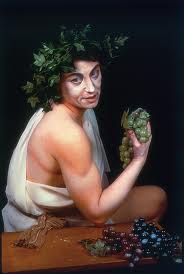
as some of you know i am a big fan of Rembrandt along with Caravaggio whom cindy sherman parodied his painting of Bacchus whom he parodied a number of times

caravaggio-sick-bacchus, self portrait

then again with

caravaggio bacchas, young italian boy

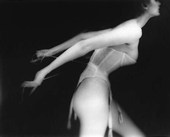
i do love painting which inspires my photography, well off to the met to see naked before the camera and Rembrandt, not a bad days plan. maybe we can go to the opening of Lillian Bassmans exhibit tonight at Stanley Wise Gallery.

About Lillian Bassman

Lillian Bassman was born in 1917 into an immigrant family of free-thinking intellectuals, and was brought up with a mindset that allowed her to live as an independent and unconventional woman.She worked as a textile designer and fashion illustrator before working at Harper’s Bazaar with Alexey Brodovitch, and ultimately becoming a photographer. Bassman’s fashion images are unique, and acheieve their effect through manipulation in the dark room. Appearing in Harper’s Bazaar from the 1940’s to the 1960’s, her work was categorized by their elegance and grace.Bassman had transformed these photographs into original works of art through her darkroom techniques in which she blurs and bleaches the images, investing them with poetry, mystery, and glamour.
take care: jene


Cindy Sherman @ MOMA, my reflections

April 12, 2012

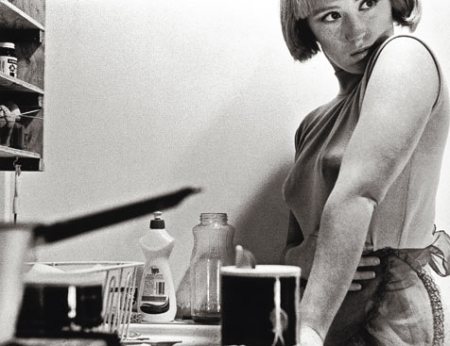
seeing  the spectacular exhibit at moma of Cindy Sherman’s work is impressive on many levels, first on the amount of prints and their physical size. it made me think about how it is when one starts off  working on a project we begin with smaller pieces because of affordability and i guess we don’t have the chops to tackle life size images much less larger than life.

what bothered me most were all the reflections in the glass  protecting the beautiful chromogenic prints. there wasn’t a place one could view the individual pieces were someone or something wasn’t reflected in the pictures glass. that was distracting enough but add to that were people crossing in front of you as you tried to read the descriptions written on the wall. does it take that much of an effort to walk around someone or a group in this instantgram world we are now confronted with? have people lost or not learned manners?

at home in the kitchen

but seeing such a massive show from one artist inspires me to keep on making what i do for myself. i keep telling mary to pursue her ‘self projects’ because i see them as exciting, well i see her as exciting but i won’t go into that now. it’s so hard for me as an artist to be working in the dark, but i think that’s where the most exciting of my work lays, when i don’t know where i am going but act as if i am following an inner voice. just do it.

after all aren’t we just energy converters.

as is sherman herself following in the footsteps of Claude Cahun ( 1894-1954) who was a forerunner of sherman and lady gaga. cahun was a french surrealist photographer,artist, writer, feminist, and radical activist who worked with ‘autoportraits’

claude cahun autoportrait with painted on nipples

‘All By Her Selves” is a comprensive retrospective curated by Francios Leperlier and Juan Vicente Aliaga originating at the Jeu de Paume in Paris now on view at the Art Institute of Chicago through June 3, 2012.

claude cahun

Cahun was born into a wealthy family of Jewish intellectuals from Nantes, France, but left in 1921 drawn to the frenetic, artistically and socially audacoius milieu of paris between wars. she considered herself  a born surrealist but was never accepted as part of the inner circle. nonetheless she did participate in several surrealist exhibits and was part of  the anit-fascist group ‘Contre-Attague.’

sherman as bacchus

but back to the sherman show. the amount of people who pass through moma’s door is amazing especially at $25.00 a head. the sherman show doesn’t have a special admission price as some shows do making even more money to do what with, buy art? one would think that the highpriest of moma art world would be able to solve the problem of the distracting reflections. is it a money problem? raise the price of the cafe’s latte’s or maybe just tilt the pictures downward, do something.

a personal story: i was lighting a CBS network news show overlooking a new york harbor celebration. the studio was enclosed in 1″ plexiglass with a panaroma view of the harbor. we did two shows that night one at sunset, or normal evening news show with the sun setting behind the anchor, a killer angle and the other one after dark same angle but different subject and fireworks. we used two different lighting systems one for each setup.

when the big muckymucks came down to test both looks we had nothing but reflections for the evening show from the lights reflecting in the plexiglass. horror on horror as everyone looked at each other. i hadn’t set this system up as someone eles had, but i was there and needed to fix it, i asked if i could have a moment to solve the problem. i got the stagehands to wrap some ‘blackwrap’ around the barndoors to eliminate the spill causing the ambient reflections.

when everyone came back and looked on camera a sigh of relief was uttered with jokes and laughter. problem solved everyone could go home and get a good nights sleep.

i can’t believe that not one at moma saw these reflections as a problem before the sherman exhibit opened. well maybe they didn’t care after all you’re inside and have paid your money.

i wonder how cindy feels? oh well. she’s probably in her studio creating another series based on reflections. one can only guess.

jene

Herb Ritt’s career examined Getty Museum, Los Angeles

April 5, 2012

so here’s something for you west coast people looks to me to be a super duper exhibit. i remember a story about James Dean when he was starting out he was asked if he had any publicity pictures. he replied ‘ yea just some B&W images shot by a friend.’ who of course turned out to be Herb Ritts. not to mention one has to have talent to advance in this world, except a couple of my ex-bosses but they are long gone now. i think in order to survive one must be quick on their feet, lucky,  have a vision, and the tenacity to stick it out.

seems everyone is getting naked these days must be pans pipes floating on the air.

Jene

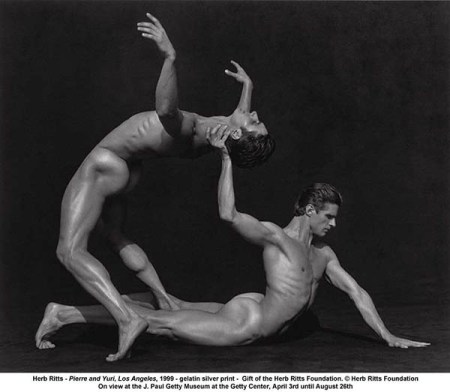
Herb-Ritts-Pierre-YuriLOS ANGELES, CA.- Herb Ritts (American, 1952–2002) was a Los Angeles based photographer who earned an international reputation for his unique images of fashion models, nudes, and celebrities. From the late 1970s until his untimely death from AIDS in 2002, Ritts's ability to create photographs that successfully bridged the gap between art and commerce was not only a testament to the power of his imagination and technical skill but also marked the synergy between art, popular culture, and business that followed in the wake of the Pop Art movement of the 1960s and 1970s. On view at the J. Paul Getty Museum at the Getty Center, April 3rd through August 26th, Herb Ritts: L.A. Style explores Ritts’s extensive photographic career, including a selection of renowned and previously unpublished photographs, as well as his directorial projects. A major portion of the works in the exhibition was newly acquired by the Getty Museum through purchase and in the form of a generous gift from the Herb Ritts Foundation.


“Through hard work and an imaginative vision, Herb Ritts fashioned himself into one of the top photographers to emerge from the 1980s,” says Paul Martineau, curator of the exhibition and associate curator of photographs at the J. Paul Getty Museum. “This exhibition will reconsider and broaden our understanding of Ritts’s career, particularly in the areas of fashion and figure studies.”

By the mid-1980s, Ritts’s aesthetic had coalesced into a distinctive style. His creative output was enormous, and he appeared to be able to switch gears effortlessly between his jobs in fashion and portraiture and his personal work with the nude. After shooting a commercial job, Ritts often took advantage of the location, props, and models to make his own pictures. To accommodate his growing business, Ritts established a studio in Hollywood and assembled a creative team of assistants, stylists, and printers who strove to exceed his high expectations. Like his contemporaries, Ritts rarely printed his own work. Through a pain staking selection process, he editioned his best pictures and had them printed in gelatin silver or platinum, varying the papers, levels of contrast, and tone to realize his artistic vision.

Ritts’s portraits of celebrities such as Richard Gere, Britney Spears, Mel Gibson, and Madonna introduce the exhibition. His anti-glamour style of portraiture made celebrities look more natural and allowed them to reveal inner qualities, making them more accessible to fans. By the late 1980s, Ritts’s reputation as a shaper of fame made him a celebrity in his own right, and the iconic status of such photographs as Richard Gere, San Bernardino (1977) and Madonna, Hollywood (1986) made a photograph by Ritts a rite of passage among Hollywood insiders.

The exhibition continues with Ritts’s fashion photographs, many of which drew inspiration from painting, sculpture, film, and the work of such leading fashion and portrait photographers as Richard Avedon, Horst P. Horst, George Hurrell, Irving Penn, and Louise Dahl Wolfe. Ritts had an extraordinary ability to synthesize and incorporate these influences into a new and easily recognizable style. As hundreds of magazine spreads demonstrate, Ritts kept top fashion editors happy by providing dazzling pictures designed to sell clothes along with others that simply celebrated beauty. Ritts also made use of locations around Los Angeles and especially loved Southern California’s natural light. For instance, Ritts harnessed the forces of nature, strong sunlight and gale-force wind in Versace, Veiled Dress, El Mirage (1990) to create an unforgettable image that communicates feminine strength and beauty.

artwork: Herb Ritts - Versace Dress, Back View, El Mirage, 1990 Gelatin silver print. - Gift of the Herb Ritts Foundation. © Herb Ritts Foundation - At the J. Paul Getty Museum

artwork: Herb Ritts -"Tatjana", Veiled Head, Joshua Tree, 1988. - © Herb Ritts Foundation - On view at the J. Paul Getty MuseumTurning to Ritts’s work with the nude, the exhibition examines how Ritts—along with his contemporaries Robert Mapplethorpe and Bruce Weber—provoked a radical change in how the nude was depicted. His forte was an ability to analyze the body from a variety of angles and create compositions that abstracted it in ways that communicate strength and poise. Working mostly outdoors, Ritts enjoyed relating the body to the natural world and rendered his nudes with a verve and elegance that became the dominant hallmarks of his pictures. In Man with Chain, Los Angeles (1985), model Tony Ward is seen bending at the waist, as if struggling under the chain’s massive weight. The extraordinary sense of movement is not only forward but also upward in a tortuous S-curve that has been long associated with the dramatic, writhing bodies of seventeenth-century Baroque painting and sculpture.
Ritts’s work also includes portraits of well-known athletes and dancers. In the exhibition are a series of photographs of the critically acclaimed American dancer and choreographer Bill T. Jones. In these photographs, Ritts captured Jones while he danced, framing him against a pure white background, making his muscled body look like a piece of sculpture. He also photographed famous athletes including Michael Jordan, Magic Johnson, and Olympic gold-medalist Greg Louganis. For Louganis’s portrait Ritts positioned the diver on a makeshift pedestal and placed a low spotlight on him. The carefully arranged pose and lighting show off Louganis’s muscled torso and back, while the prominent shadows recall the mysterious aura of film noirs of the 1940s.

Although Ritts had no prior experience with film, Madonna convinced him to direct his first music video for her song “Cherish” (1989), which is included in the exhibition along with other music videos and commercials. Ritts enjoyed the creative challenge that film presented, allowing him to extend the sense of movement so important to his still photography to the moving image. From 1989 until 2002, Ritts directed thirteen music videos and more than fifty commercials. Some of his music industry clients included Michael Jackson, Janet Jackson, Mariah Carey, Britney Spears, and Shakira, while his commercial clients were mainly fashion and cosmetic companies such as Chanel, Lancôme, Estée Lauder, and Calvin Klein.

Ritts’s intimate portraiture, his modern yet classical treatment of the nude, and his innovative approach to fashion brought him international acclaim and placed him securely within an American tradition of portrait and magazine photography that was begun by Richard Avedon and Irving Penn.

Visit the J. Paul Getty Museum and the Getty Center at : http://www.getty.edu/

Art knowledge news