Archive for March, 2012

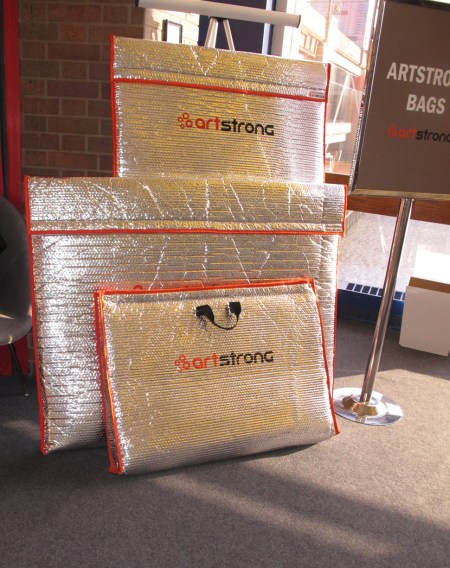
Art Strong Bags, a sponsor of the 2012 Armory show

March 10, 2012

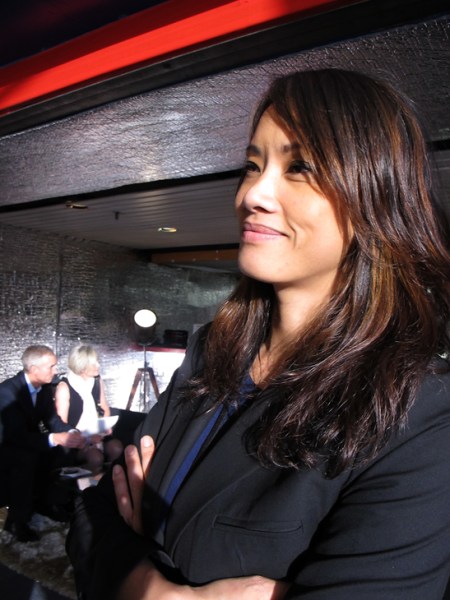
a friend of ours company ART STRONG BAGS is one of the sponsors of the Armory art show on pier 92 & 94 this weekend. Mary Nguyen pictured here

is the company’s president, founder and problem solver who came up with a solution of how to transport and protect art in a very convenient way. despite the aluminum  look it’s a very lightweight way to carry art and it’s green although it looks silver, green in that it’s very tough reusable and doesn’t fill trash heaps.

here is what Mary has to say about this product. artstrong bags are the most durable bags in the marketplace. Created with 5X the protection of normal bags, artstrong bags start with two layers of polyethylene bubbles sandwiched between one layer of fire retardant metallized polyester film and one layer of white polyethylene. Then we use shock-absorbing polyethylene foam that is filled with thousands of air cells that are resilient, anti-lint/dust/static free. The inside is lined with a superbly soft technologically innovative fabric that resists scratches and snags. Finally, our bags are sewn at the edges and reinforced with tough nylon to provide the most secure edges.

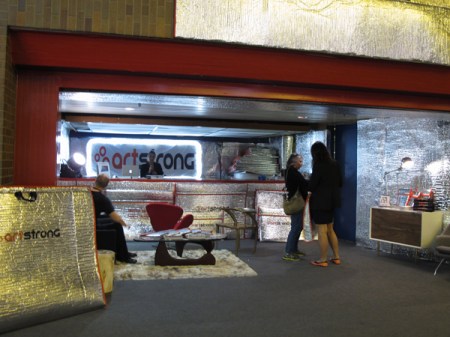
Art strong display is located just inside the entrance of pier 92, one doesn’t have to pay and enter the Armory show to see and feel them as they are before ticket entry, so if you want to play with them first hand you can do so

Art Strong display booth

right off the lounge area, heck you can even lounge around looking cool without spending money while people might think you’re an artist if you don’t wear a suit.

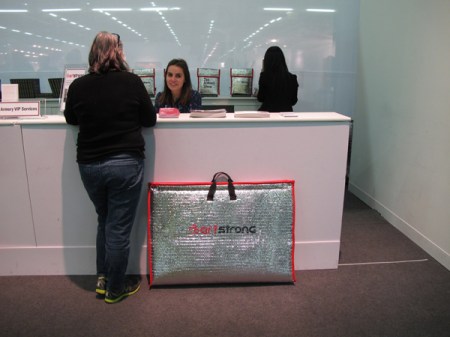
or you may find people wandering around the show as we did here at the contemporary ticket booth.

these bags are a great product filling a much needed demand in the art world. so if you’re considering purchasing a piece of art and want to carry it home safe and sound i would suggest you stop by and see what’s offered. after all we can’t be too careful of our loved ones can we?

i wonder who picked out the Art Strong model on their web site, must have been an interesting casting call at least.

oh well it’s nice to have fun and no animals were harmed writing this blog

jene youtt

Emmanuel Fremin Gallery at Scope 2012

March 10, 2012

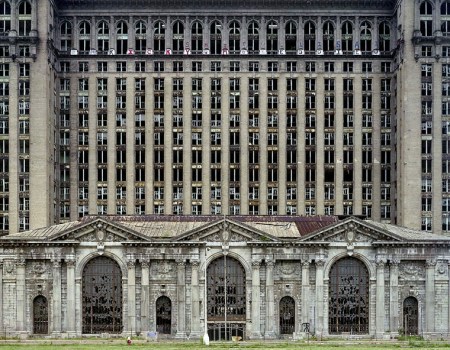
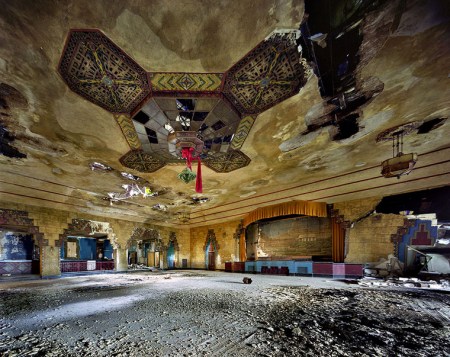
last night we visited Scope as part of Armory week and visited with Emmanuel Fremin who has a wonderful exhibit in his space. what attracted me the most, well i think of myself as a photographer, was his new association with Yves Marchand and Romain Meffre ” The Ruins of Detroit ” book and C prints. a gotta see, the prints are beautiful.

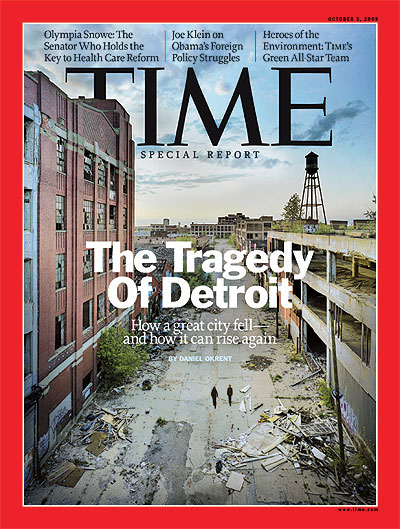
not to take anything away from the lovely oversized book which i’d love to have on my coffee table or bookshelves. this photographic essay of Detroit and it’s architectural fall from grace due to economic shenanigans is a serious comment on our lives and time. i remember the tragic  loss of New York’s  Pennsylvania Station to developers but this study of an American city Detroit which i first became aware of  in Time magazines coverage.

Time Cover

but the real tragedy is conveyed by the pictures which begin with the Michigan Central train Station.

and you could say ends in a ballroom full with ghost of many memories

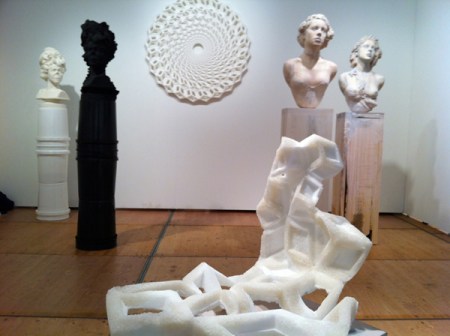
do stop by and see the prints and book, but wait there’s more also sculptures by Ted Lawson who works in salt, hard marble and other mediums

Entropy

That’s right there is still more from another artist working in unique and different mediums Fernando Mastrangelo

This too shall pass ( virgin mary )

made from Gunpowder, 13 rosaries, MDF, hemp, and automotive paint. while another piece in the show is made from

La Salva Mara ( santa muete )

Cremated human ash

the artist creates his work through a variety of materials, including sugar, coffee, corn, gunpowder, human cremated ash, and other controversial materials, Mastrangelo’s large scale sculptures often address social, cultural, and political issues relevant to the contemporary experience.most of the projects function as sculptural tableaus, and combine content, form and materials as a conceptual strategy.

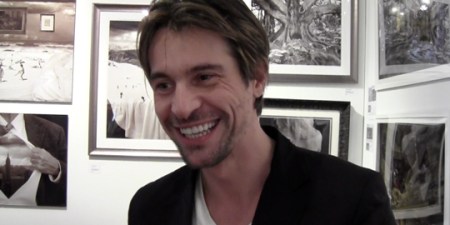
this show along with his chelsea gallery and the selection of artist is one of the reasons i find emmanuel’s choices so interesting. i never know who or what i’ll find at his openings. so stop by Scope this weekend and say hello to this charming fellow.

Emmanuel Fremin

say Fuzzy sent you.

jene youtt

Western Digital closes Hitachi GST acquisition

March 9, 2012

Western Digital on Thursday completed the acquisition of the hard drive business of Hitachi, and set up two subsidiaries with separate brands and products, to meet the conditions of antitrust regulators.

The company said in a statement late Thursday that it completed the acquisition of Viviti Technologies, formerly Hitachi Global Storage Technologies, effective March 8 for $3.9 billion in cash and 25 million shares of its common stock valued at about $0.9 billion.

Hitachi now owns 10 percent of Western Digital’s shares outstanding. Western Digital has paid about $392 million more in cash as part of an amendment to the purchase agreement. Western Digital will operate with WD Technologies and HGST as wholly-owned subsidiaries, with total revenue in 2011 of $15 billion.

“Similar to successful multi-brand models in other industries, the two subsidiaries will compete in the marketplace with separate brands and product lines while sharing common values of customer delight, value creation, consistent profitability and growth,” Western Digital said.

Western Digital announced the proposed acquisition in March last year. But its completion was delayed largely because of the need for regulatory clearances, amid concerns that the acquisition could reduce competition in the hard drive market in the wake of plans by Seagate Technology to acquire the hard disk drive (HDD) business of Samsung Electronics.

China’s Ministry of Commerce approved recently the Western Digital acquisition, but put the condition that the Hitachi unit operate independently for at least two years after the acquisition, citing concerns that the deal would weaken competition in the market.

Western Digital did not immediately respond to a request for comment.

“We are pleased with the operating model for WD—a model that has proven successful in other industries, where companies with scale and multiple competing brands deliver strong financial performance by creating customer and shareholder value,” it said in a statement with supplemental information for investors.

( i hope they make better enclosures of the drives than they do now, as i love Hitachi drives but not Western Digital )

see the rest of the story here

related story on Seagate purchasing Samsung HDD business here

originally posted in Macworld news.

it’s a changing world here

Hugo dances with Pina and comes out a wallflower

March 3, 2012

i hope my war correspondence phase is over but it just seemed to boil up on top of my mind these days. i am not able to shoot any images  due to having rotator cuff surgery, hey it’s spring. so i am out of it for a few months. we are putting together an exhibit for may, june, july out in lancaster, pa but more on that later.

i am not the best patient as i get feeling a bit better and want to get back in action, luckily i have mary watching over me so i don’t lift my arm, ouch it hurts to do that, but she’s there to help me, mostly from myself. but the other day i was feeling good enough to venture out and we decided to catch up on movie watching. seeing movies in suburbia is best done weekdays afternoons. we had the theater mostly to ourselves – just six other people there.

we have been going to movies, having seen the Artist, thinking it was a wonderful movie hoping it would win and we weren’t disappointed as i had been so many other years by the academy voters. having lived in LA years ago and worked in movies i often wondered if they, the academy members and i were seeing the same movies. this time we were happily rewarded.

the descendents didn’t move me at all, nor did the dull photography, set in hawaii. yes i’ve seen the vog there but lets have some lushness and color, this is a movie.

so we tuned into last sunday  for the academy awards broadcast hoping we would be delighted. the first award for cinematography went to robert richardson, won as director of photography on Hugo i had work for him and martin scorsese on Bringing out the Dead and seeing him create magic. he’s considered by some a bit of a odd ball but marty must love him as they’ve done three movies together these days. robert’s credits are amazing –  a who’s who’s of films.

this is one of the first years we had seen most of the academy award nominees except for Hugo which we thought would be full of kids, yes we do make up stories. so afternoon going was preferred as absent of children. we were a bit taken back by an admission price of $14.00 each, but hey you can’t put a price on a good time. after all it was in 3D and we loved wim wenders’  Pina in 3D. i even wrote about that here.

we thought the 3D added intimacy to the dance experience so we were up for Hugo. during the coming attractions previews  they showed the titanic as a 3D movie, interesting CGI has come a long way. i remember when it started down in culver city and the IATSE didn’t want anything to do with it until the members pushed the union into action to organize it. now it’s a multi million dollar budget item on most movies.

but here we are at Hugo. a lovely picture, robert did a wonderful job and deserved the award, one of three he’s earned but we were disappointed with the movie a as whole. there were times when my mind wandered, more than once, and i thought we were watching a pixar picture or shrek type of cartoon character, the story just wasn’t there. we think a good half hour could have been chopped on the cutting room floor.

this is marty’s love letter and a lovely tribute to the beginning of films and Georges Méliès’ work it did seem a bit out of place in this story. movies are dreams isn’t a new story but even dreams can go in some strange places, like saturday morning cartoons. oh did i mention such details as CGI dust as i explained to mary this very expensive production value. i wonder if the admission price could have been lowered by a buck had they deleted the dust.

Hugo, a boy living in the paris train station walls who’s trying to unravel a mystery left to him by his father, the automatron isn’t interesting enough we have to add a villian – the train inspector. main adversary to hugo was snatched from scooby doo cartoon character, who even has a dog that chases hugo. hmmmm

then the screen writer seemed to want the station inspector to be part love story/villain. if the story of Hugo  isn’t interesting enough who’s trying to unravel his personal mystery there comes along another grown up toy seller and his daughter, there always has to be a girl, friend to hugo who helps hugo solve the mystery. the father turns out to be none other than marty’s love: the Georges Méliès, the father of film character. happy ending

hey so what we get a short film history along with some dust. none of the nitrate film exploded burning down half of paris along with a happy ending. all that for $14.00 not bad although i remember going to saturdays matinees for $.25 oh well times change.

this is a movie that is hindered by it’s medium, 3 D. while Pina is enhanced by 3D. i am not a big fan of things whizzing before me. i remember Phantom of the Rue Morgue in 3D whoa that was a scary movie with bodies fall in your lap but clocks, dogs and stairways zipping past and through one please.

so if you’ve gotten this far you may have guessed i didn’t care much for the movie, had they saved me a buck of two by cutting out the CGI dust particles i might have enjoyed it much better but i notice details. 3D has come a long way and i am sure we’ll be seeing much more of it in the future.

i think Hugo would have been a wonderful movie story without all the special effects but we all have to learn to edit ourselves. as it is hugo is a lovely love letter to the craft of film making. it just doesn’t dance well, but we all need love.

i’ve gone on much too long with my prattle, oh well.

jene youtt
In praise of war correspondents, via LA Times

March 2, 2012

Op-Ed, LA Times

February 24, 2012|By Timothy M. Phelps

The deaths of Marie Colvin, Anthony Shadid and other journalists is tragic. But to pull back from war zones would leave untold the stories that must be chronicled.

  • The New York Times foreign correspondent was a two-time Pulitzer Prize winner known for telling the stories of people whose lives were disrupted by war in the Middle East. He was 43.
The New York Times foreign correspondent was a two-time Pulitzer Prize… (Julia Ewan / Washington Post)

Marie Colvin and I covered our first combat together in 1986, after the U.S. bombed Libya. She was 30, pretty, ambitious and talented. She soon had Col. Moammar Kadafi and his aides in her thrall and parlayed her many scoops for United Press International into a job as a foreign correspondent for the Sunday Times of London.

I last saw her a year ago, in Cairo during the revolution. Three decades of bearing witness to war showed in her face: I recognized her only from her black eye patch, which she had worn since a hand grenade destroyed her left eye in Sri Lanka in 2001. She seemed sadder and lonelier, and it was no wonder, given what she had been doing all those years.

Other correspondents cover conflicts for a few years and move on. Marie made war a steady diet. She was at the front lines in Iraq (during three different wars), Chechnya, Gaza, Lebanon, Afghanistan, Sri Lanka, Libya and many other places. She had defied death so many times, she seemed immortal. But then, on Wednesday, she was killed by a rocket while covering the conflict in Syria.

Her death came less than a week after that of Anthony Shadid, also in Syria. The New York Times correspondent — a friend from the old days and a former colleague — had sneaked into Syria to report on the violence there and apparently succumbed to an asthma attack triggered by the horses of the guides leading him back to Turkey.

Marie would not have been in the rocket’s path, and Anthony would not have been near those horses, if they had not considered it their duty to tell the world what was happening to the civilians of Syria.

Anthony’s calling card was his fluency in Arabic and the elegance of his writing. People in the Arab world are often portrayed one-dimensionally in the Western press, partly because correspondents are able to talk to them only through an interpreter. Born in Oklahoma City and educated at the University of Wisconsin in Madison, Anthony went to Cairo as a reporter for the Associated Press, determined to master the language of his grandparents and to use his skills to convey the complexity of life in the Middle East. In his quest to do so, he was shot in the shoulder while covering the West Bank in 2002 and captured by the Libyan army and held for a week last year.

I am often asked why journalists willingly put themselves in harm’s way. Anthony was a star, with two Pulitzer Prizes, who had nothing left to prove. Marie, who had been married but was childless, had more combat experience than any general but had no desire to stop.

Part of the reason war correspondents keep going is that there is thrill in danger, a thrill exacerbated by the closeness of death. But the larger, much more important answer is that they feel an overwhelming sense of duty to those whose lives have been torn apart by conflict. Would President Obama have intervened in Libya last year if U.S. journalists had not been covering the plight of the people of Benghazi? Could more coverage from the Western press have whipped up sentiment to stop a genocide in which 800,000 people died in Rwanda in 1994? What will stop the Syrian army from continuing to shell and shoot its own people if the stories of people like the 2-year-old baby whose death Marie chronicled in the days before her own death aren’t being told?

Shadid told NPR’s Terry Gross recently about an earlier illegal foray he made into Syria, saying he felt he had to go because “that story wouldn’t be told otherwise.” That story was so important, he said, “that it was worth taking risks for.”

But not, as war correspondents often say to one another, worth getting killed for. As if we could prevent death by making that distinction.

A number of journalists lost their lives covering the war in Iraq. But not a single U.S. staff correspondent was killed by hostile fire during eight years of war. Now, in less than a year we have lost, among others, photojournalists Tim Hetherington and Chris Hondros in Libya, and Anthony and Marie, along with French photographer Remi Ochlik, in Syria.

Losing these courageous journalists is tragic. But there is also reason to worry about another tragedy in the offing: the pulling back of media outlets from covering wars.

Part of the reason is cost. Covering wars can be expensive, as we discovered in Iraq. There, Western news agencies took serious security precautions, buying expensive armored cars, hiring armed guards and carefully calibrating their reporters’ movements with the help of security consultants. That wasn’t feasible in fast-moving Libya, and it is impossible in Syria, where reporters have to operate mostly undercover because of restrictions on their movements.

Still, some editors, concerned about safety and facing shrinking budgets, have begun to pull back. Indeed, Marie’s editor told her mother he had told her to leave Homs, that it was too dangerous. Marie had promised to leave after one more day. Now, with Homs surrounded and without a functioning morgue, it is unlikely she’ll return home even in death.

No editor wants to place a correspondent in jeopardy. But I know that Marie and Anthony would not want their deaths to be used to justify retreating from dangerous but important journalism.

Timothy M. Phelps, an editor in The Times’ Washington bureau, covered the Middle East for Newsday from 1986 to 1991.

hopefully this is going to be the last in this tragic series. this news is being fed to me and i’ve no idea why. because of my temporary health problem i am not shooting anything myself so i must feel that loss and it’s connecting with these human losses. that’s the only thing i can figure out but hey i never said i was the brightest bulb around.

but i’ll move on as does life.

jene youtt

Edith Bouvier, French reporter wounded in Syria, has been evacuated:

March 2, 2012
By Dylan Stableford | The Cutline – 5 hrs ago

Bouvier (AP)

Edith Bouvier, a French reporter wounded in the attack that killed American reporter Marie Colvin and French photographer Rémi Ochlik and injured several others in Homs, Syria, has been successfully evacuated to Lebanon, according to France 24.

One of Bouvier’s family members told the channel that she is “fine.” Bouvier, who suffered a broken leg in the attack, had been trapped in the besieged city for eight days. French photographer William Daniels, who was with Bouvier, also arrived safely in Lebanon, the station said.

French president Nicolas Sarkozy–who earlier this week erroneously announced that Bouvier had been evacuated with Paul Conroy, another photographer injured in the attack–told reporters in Brussels on Thursday that he had spoken to Bouvier via phone, and that the French government was coordinating her return home.

Following the Feb. 22 attack, Bouvier and Conroy posted a pair of YouTube videos, pleading for help from their government. Conroy said they had been injured in a “rocket attack,” and were being treated by a local medical team. He added that they were not being held captive, but that Bouvier, in particular, was in need of extensive medical attention.

The bodies of Colvin and Ochlik remain unaccounted for.

“We are relieved that Edith Bouvier and William Daniels are now safe but are concerned that the Syrian government’s assault on Homs has made it impossible to retrieve the bodies of our colleagues Marie Colvin and Rémi Ochlik,” said Mohamed Abdel Dayem, the Committee to Protect Journalists’ Middle East and North Africa program coordinator. “We remain deeply concerned for the safety of all Syrian journalists who are risking their lives to report on the unrest across the country.”

this according to yahoo news. see

Other popular Yahoo! News stories:

Why Syria is so dangerous for journalists
Marie Colvin, war reporter killed in Syria, was a guest on Anderson Cooper’s show hours before death
Journalists mourn NYT foreign correspondent Anthony Shadid, who died in Syria

more on the deaths and lives of photojournalist

March 1, 2012

Remembering 13 Unsung Heroes of Photojournalism

News stories of the deaths in Syria of American reporter Marie Colvin and French photographer Remi Ochlik totaled in the thousands last week. That was followed by hundreds of stories yesterday about the rescue of British photographer Paul Conroy, who was injured in the same attack in Homs, Syria that killed Ochlik and Colvin.

Lost in much of the coverage about Conroy’s rescue was the fact that 35 activists helped Conroy reach safety in Lebanon, and 13 of them died during the rescue mission. AP reported those deaths, which occurred when government troops attacked the activists.

Meanwhile, the death last Friday of Anas al-Tarsha, a young Syrian videographer and the fourth journalist to die in Homs within a week, was virtually unreported by the news media, except in Spain. The Committee to Protect Journalists, NPPA, Lightstalkers, and a few others also mentioned his death. The death of the fourth journalist, Syrian video blogger Rami al-Sayed, also received much less coverage last week than the deaths of Ochlik and Colvin.

In other words, Western journalists get into trouble, and it’s big news. Local journalists and fixers and others who get injured or killed along side them are too often relegated to the footnotes.

Of course, hundreds of Syrians have died and thousands more have been injured in Homs, where government troops have been shelling rebels and unarmed civilians alike for three weeks in order to keep the unpopular Syrian leader Bashar al-Assad in power.

But a disproportionate amount of Western media attention and outrage seems reserved for its own journalists, and it raises (again) the uncomfortable questions about the risks that Western journalists impose not only on themselves, but the locals who aid them. (The issue arose last spring, when a driver for four New York Times journalists went missing after they were detained at a checkpoint in Libya. It wasn’t until November that The New York Times quietly acknowledged the driver’s death.)

This isn’t to say that the deaths of Colvin, Ochlik or any other journalists are anything but a tragedy, regardless of their nationality. Nor is it to suggest selfishness or callousness on the part of individual journalists for whom drivers, fixers, or anyone else risks life and limb. (Conroy’s wife has told The Western Morning News that the photographer “is obviously very concerned for all the people who lost their lives in helping them out. It’s a real burden on him to know that so many people died.”)

What makes the issue so complicated is that journalists endanger themselves and others for good, defensible reasons. By bearing witness to the savagery committed by al-Assad, journalists are trying to help the Syrian people. And they are making a difference. The images and reports have turned the international community (with the glaring exceptions of China and Russia) against al-Assad, and put pressure on him to allow the Red Cross and Red Crescent in to help evacuate the dead and wounded.

That’s why al-Assad is targeting journalists with intent to kill them, while Syrian citizens are risking their lives to help those same journalists. The Syrians who died in the rescue of Paul Conroy undertook the mission voluntarily. But their deaths shouldn’t be his burden to bear alone, because they might have died for any journalist in Conroy’s predicament. To recognize and honor them for their sacrifice is to elevate and honor not only them, but all who put themselves at risk anywhere in the world to make the work of journalists possible.

story from PDN blog. see related stories.