Richard Avedon’s Lively Fashion Images at the Museum of Fine Arts, Boston
Written by Vincent Baldino
Wednesday, 11 August 2010 01:53
BOSTON, MA.- Richard Avedon (1923–2004) was the man who brought fashion photography to life. Instead of perpetuating static images of human mannequins posing stiffly in magazines, Avedon depicted his models as real women whose energy and exuberance complemented their modern lifestyles. Considered one of the great image-makers of the 20th century, he redefined fashion photography and his lasting contributions are explored in the traveling exhibition Avedon Fashion 1944–2000, a major retrospective devoted exclusively to his work in this medium. On view in the Foster Gallery at the Museum of Fine Arts, Boston (MFA), from August 10, 2010, through January 17, 2011, the exhibition highlights approximately 140 objects, including photographs, magazines, engravers’ prints, and contact sheets that span almost six decades of his successful career.
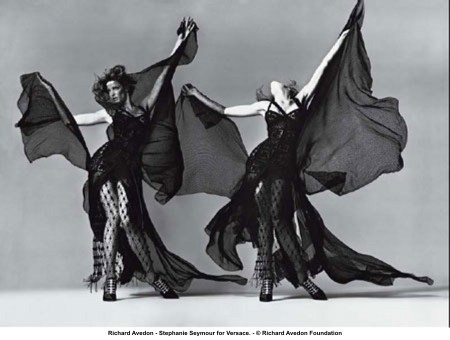
Richard-Avedon-Seymour-Versace
Avedon Fashion 1944–2000 examines Avedon’s years as a photographer who helped shape the image of the fashionable woman, drawing from thousands of pictures he took as staff photographer for Harper’s Bazaar and Vogue. It unfolds by decade, with the greatest emphasis on the classic work from the 1950s and 1960s, when Avedon’s distinct vision of the ideal American woman revolutionized magazine photography.
“Richard Avedon was one of the greatest photographers of all time, who forever transformed the way we look at fashion. The MFA is delighted to be able to showcase his supremely stylish and important work,” said Malcolm Rogers, Ann and Graham Gund Director of the Museum of Fine Arts, Boston.
Richard Avedon – Veruschka, dress by Kimberly, New York, January 1967. – © Richard Avedon FoundationThe exhibition begins with elegant, romantic, and lively images taken in Paris, where he visited extensively from 1947 to 1965 on assignment for Harper’s Bazaar.
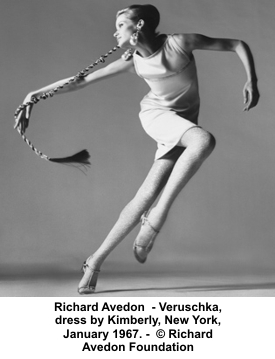
Richard-Avedon-Veruschka
Despite the bleakness of the post-war years, Paris still represented the height of sophistication, and Avedon infused his photographs with a sense of optimism, helping the City of Light reclaim its position as the capital of the fashion world. The photographer created imaginative narratives—sometimes continued through several issues of the magazine—highlighting couture collections and featuring his favorite models: Dorian Leigh, her sister Suzy Parker, Sunny Harnett, Dovima, Carmen, Elise Daniels, and even his wife, Doe Avedon. He took these smartly outfitted women out of the studio and photographed them in French locales: Daniels, dressed in a Balenciaga suit, watching street performers in the Marais district in 1948; Harnett, in an evening dress by Grès, playing roulette at the Casino in Le Touquet, France, in 1954; and Parker, draped in a Grès gown, sitting near cancan dancers at the Moulin Rouge in 1957. Avedon’s famous night scenes in Paris, which began in 1954, broadened his creative range. Like movie sets, the complex fashion shoots he directed used generators to light up entire city blocks, allowing him to capture stylish bon vivants enjoying Parisian nightlife.
During his early years at Harper’s Bazaar, fashion photographs by Avedon were more than just a vehicle to market luxurious clothing to post-World War II American women—they were the embodiment of a dynamic lifestyle. His expressive images celebrated spirited women laughing, jumping, and dancing—even roller skating in Paris—all while wearing the most beautiful clothes.
“Those candid snapshots were in direct contrast to what was being done. I came in at a time when there weren’t any young photographers working in a free way. Everyone was tired, the war was over, Dior let the skirts down, and suddenly everything was fun. It was historically a marvelous moment for a fashion photographer to begin. I think if I were starting today, it would be much harder,” said Avedon in 1965.
The son of a women’s clothing store owner (Avedon’s Fifth Avenue), Avedon became fascinated with fashion photography as a boy. As a young man, he joined the Merchant Marine (1942–44), where he was assigned to the photography division. After leaving the service, Avedon enrolled in design classes at the New School for Social Research taught by Alexey Brodovitch, the art director of Harper’s Bazaar. In 1944, at age 21, Avedon joined the magazine, primarily as a photographer for Junior Bazaar. Shortly thereafter, he became an official staff photographer, working with the now legendary figures Carmel Snow, Brodovitch, and Diana Vreeland.
During the height of his career, Avedon became fashion photography’s most influential and prolific practitioner. His style was energetic and playful, with a flair for the dramatic, and while Avedon’s location shoots were groundbreaking, his major studio shots were also ingeniously inventive. The photographer illustrated the excitement of the “new look” of Dior—featuring cinched waists and voluminous circle skirts—by showing his model twirling on a Parisian street (Renée, “The New Look of Dior,” Place de la Concorde, Paris, August 1947). He developed the “Avedon blur” using variable focus, a technique creating a subtle background scene while highlighting the model in the foreground, as seen in an image of a well-turned ankle showing off a fur-trimmed bootie in front of the softly visible Eiffel Tower (Shoe by Perugia, Place du Trocadero, Paris, August 1948). Avedon also liked to show models “behind-the-scenes”—sitting at a café, seemingly in tears (Elise Daniels, turban by Paulette, Rue François-Premier, Paris, August 1948); assessing an outfit in the mirror (Dorian Leigh, evening dress by Piguet, Helena Rubenstein’s apartment, Île Saint-Louis, Paris, August 1949); or shown within the backdrop of a studio set (Suzy Parker, evening dress by Dior, Paris, August 1956). In many of his photographs, dogs and other animals share center stage with the models—Dovima in a Balenciaga suit and Sacha, an afghan, sitting next to one another outdoors at the Café des Deux Magots, Paris (1955), or Dovima in a Dior evening dress, shown alongside elephants at the Cirque d’Hiver (1955)—one of the photographer’s many iconic images.
Avedon was one of the most engaging image-makers of the 20th century. He revolutionized fashion photography with his dynamic images that set an ideal of the modern American woman. His enormous success led to great fame, and the status he attracted helped define the role of the high-profile fashion photographer that we are familiar with today,” said Anne Havinga, the MFA’s Estrellita and Yousuf Karsh Senior Curator of Photographs, who is responsible for the show in Boston with Emily Voelker, the MFA’s Estrellita and Yousuf Karsh Assistant Curator of Photographs. The exhibition was curated by Carol Squiers, curator, and Vince Aletti, guest curator, for the International Center of Photography (ICP), in conjunction with The Richard Avedon Foundation, New York.
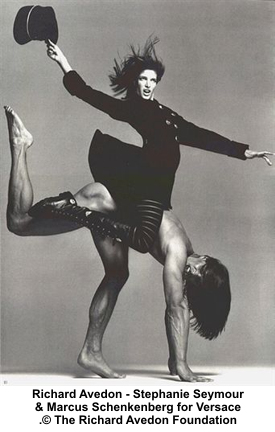
Richard-Avedon-Stephanie-Seymour
Avedon’s innovative approach enlivened the vocabulary of fashion photography, and even made him famous. The 1957 movie musical Funny Face is loosely based on Avedon, who served as the visual consultant for the production. Starring Fred Astaire as “Dick Avery,” a photographer working in New York and Paris, it co-starred Audrey Hepburn as his muse, a model chosen for her spirit and intelligence. Avedon’s own models were not only beautiful, but also embodied the idealized American woman, who had wit, personality, confidence, and a sense of adventure. They also reflected Avedon’s awareness of social and cultural changes. He was the first major photographer to use models of color, such as China Machado, a Portuguese-Chinese beauty he featured in the 1950s, or Donyale Luna, a sinewy model of African, Mexican, Egyptian, and Irish descent he worked with in the 1960s. His images elevated many of his models to celebrity status, especially in the 1960s and ’70s, when he worked with Jean Shrimpton, Lauren Hutton, Anjelica Huston, Twiggy, Penelope Tree, and Veruschka. In the 1980s and ’90s, his photographs helped bring supermodel fame to Kate Moss, Naomi Campbell, and Stephanie Seymour.
Avedon Fashion 1944–2000 includes a wide range of photographs that document the 1960s era, when advances in technology and demands for social reform became part of the evolving modern American experience. Among them are Avedon’s pictures of models wearing the “mod” fashions of the period at Cape Canaveral near an Atlas missile, or in the spacesuit-inspired fashions of André Courrèges, as seen in the famous April 1965 Harper’s Bazaar, the magazine’s 20th anniversary edition, which Avedon guest edited. The cover featured a Pop Art-inspired photograph by Avedon of Shrimpton in a day-glo pink helmet—the same photograph that appears on the cover of the exhibition’s catalogue, Avedon Fashion 1944–2000 (Abrams, New York, 2009). The photographer also embraced changing social mores with his forays into imagery that included nudity, or were discreetly erotic, as seen in his depiction of a suggested “ménage a trois” (Natty Abascal and Ana-Maria Abascal with model Helio Guerreiro, bathing suit by Brigance, Ibiza, Spain, September 1964).
In 1966, Avedon joined Vogue, where Vreelend had become its editor-in-chief. He captured the youthful brashness of the 1960s and turned Brooke Shields, Isabella Rossellini, and Barbra Streisand into fashion icons. With Vreeland’s approval, he also sought out quirky, unconventionally beautiful models, such as the wide-eyed waifs Penelope Tree and Twiggy, for his compelling photographs featuring Pop Art and “mod”-inspired fashions. Avedon’s work was included in most issues of Vogue until the mid 1970s. Vreeland was dismissed from the magazine in 1971, but Avedon stayed on, taking every cover photograph after 1980 until he quit in 1988. Avedon also photographed many imaginative advertising campaigns during his long career for clients including Versace, Calvin Klein, and Dior. In 1992, he was named the first staff photographer for The New Yorker, where his post-apocalyptic, wild fashion fable “In Memory of the Late Mr. and Mrs. Comfort,” featuring model Nadja Auermann and a skeleton, was published in 1995. In these later years, Avedon continued to contribute to Egoïste, a journal of fashion and the arts, where his photographs appeared from 1984 through 2000. He also pursued his own work as a portraitist, photojournalist, and the author of photography books until his death in 2004. His innovations are still evident in portraiture and fashion photography today.
Visit the Museum of Fine Arts, Boston at : http://www.mfa.org/
posted from Art KnowledgeNews
jene

 that’s why i love her


 Fuzzypictures's Weblog